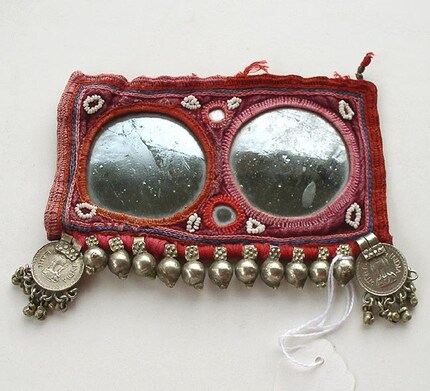
Banjara needlework captured a place in my list of favorites many years ago. Often gaudy, the spontaneous flavor of color, shisha mirror work, and ornaments always speaks to me of joy and happiness. The Banjara are often referred to as the "gypsies" of India and some draw a historical connection with them to the Roma.
Red is often the color of choice for the Banjara.
Wikipedia did not have much info on the Banjara, but here is a bit on their origin:
"Banjaras originally belong to Rajasthan and they were Rajputs who migrated to southern parts of India for trade and agriculture. They settled down in the southern or central areal of the country and slowly loosened contacts with Rajasthan, and their original community.
Over a period of time both the communities separated and they adopted the local culture. The language spoken by Banjaras settled in Yavatmal district of Vidarbha, Maharashtra is an admixture of Hindi,Rajasthani and Marathi. The word "Banjara" itself means " the one who travels and dosent have their own Home" The Banjara are (together with the Domba) sometimes called the "Gypsies of India".[2]"
I just got a batch of Banjara patches in and finished photographing them. I buy them directly from India from a woman who focuses on Banjara textiles. I thought I would offer them to all of you at 10% off before I start listing them on Etsy and eBay. I bought 40 of them and most are between 3-5" square. You will find them on my website with instructions on how to purchase. Prices range between $7.50 and $17.50, depending on size and workmanship. You won't get the dimensions with this offer as the discount is offered in exchange for my listing time.
Surya's Garden is working with Banjara women on an embroidery project. Visit their site for a description of their goals and for more information on the Banjara culture. Here is a snippet from their site which talks about Banjara embroidery:
"Signaling their ethnic membership, all Banjaras embroideries are designed for a nomadic life style and, while featuring geometric, floral and animal motifs used by a majority of India’s village peoples, Banjara embroidery design is strikingly different.
For dancing and ordinary ceremonial wear, women use traditional skirts, shawls and backless blouses generally made of commercial textiles, synthetic yarns and locally available mirrors and metal ornaments. The blouses usually are ornamented on the sleeves and fully embroidered with mirrors across the front. Embroidered flaps with metal ornaments are added to the blouses of married women. The shawls have embroidered borders along the top and bottom edges with a wider more elaborate strip of mirror embroidery at the center top that frames the face. The skirts, hanging low on the hips, are worn with the kodi sadak, a long rope of cowries; the waist bands are generally reinforced with sturdy embroidery, worked on a red quilted or twined ground.
Particularly fine pieces are made for prospective brides. Banjara women throughout India wear elaborate twisted and braided hairdos that support and display jewelry and textiles; those styles are typical of Rajasthan. The traditional dress is completed with rows of ivory or bone bracelets, nowadays made of white plastic, worn on the arms, with silver bangles, nose gold ring (bhuria), beads or silver coins necklaces."
An older Banjara patch with shisha mirrors and cowrie shells.
I'm also gathering information on the Banjara on my other website, Artezano Links. I have a few videos posted and will add books and other resources over the next week.
Banjara embroidery incorporates dimensional objects like mirrors, coins, shells, beads, ric rac and anything else they can find. Some of the results can be on the gaudy side, but they can never be described as boring! Belly dancers covet these patches to decorate their outfits, but why should they have all the fun? These are great accents on jean jackets, bags, pillows, and incorporated into larger fiber art pieces.
Are you in love yet? Go take a look while they are still available! Again, here is the link. Once I start listing them, they will go quickly. But, I would much rather sell them directly to you, then to go through the hassle of listing each one! So, the 10% off is also a thank you! Enjoy!
From time to time, I buy a bunch of Banjara patches from a woman in India. Wild, gaudy, and bright, they are among my favorite indigenous textiles. I love the shisha mirrors, coins, and use of color. Coveted by belly dancers as costume decorations, the patches are also great to use as accents on other accessories like pillows, bags, hats and larger textiles. My interest in an object, style or technique often leads me to dig deeper into the origin. Who made this? What is the cultural context? How is it used? What materials enrich this piece? With indigenous textiles, the story often has a dark side, one of abuse that can point to cultural annihilation. Such is the case with the extended family of the Banjara: the Roma (commonly known as gypsies throughout the world although they find that name pejorative).
The Romani people have long been associated with the Banjara as their languages and customs have similar roots. Yet, only since DNA analysis has become available has their connection been accepted as fact within the academic community. The Banjara have in their oral tradition stories of how part of their people left over one thousand years ago, never to come back. Most historians believe that the diaspora was spread initially through military contracts and then later continued as their descendants continued to move east, on into Europe and then to the New World.
Both the Banjara and the Roma have resisted assimilation into their dominant host societies. Marriage outside of the clan is discouraged and both retain similar dress codes and mores. Although the Roma have largely converted to Christianity, especially Roman Catholicism, in Europe, they have sincretized old beliefs into new ones.
I had read about the connection between the Banjara and the Roma in the past and knew I wanted to write a post about it for this blog. As always, the information is larger and more disturbing than I expected at the outset. The Roma have been persecuted wherever they have been for centuries. Most people know that they were also exterminated during the holocaust, but I was shocked at the numbers. The accepted guess is between 220,000-500,000 although some believe that the number was in the millions. Orders by the Nazis were to shoot them on sight, so who knows how many actually perished... (Roma People) More shocking to me was reading about forced sterilization of women without their consent in Europe as recent as 2005. The United Nations reported in 2000:
"It is a well-known fact that whenever the human rights of a group are trampled upon, the children and women bear the brunt of such abuse. They become, in fact, the victims of double discrimination. There have unfortunately been reports from Roma NGOs of sexual violence and also of forced sterilization suffered by Roma women. Moreover, there is information that young Roma women are lured or forced into prostitution, ending up as subjects of international trafficking. Particular attention should therefore be paid to their situation and national strategies in favour of the Roma should include a specific action plan for women." Roma People states that much of this is done through State policies: "In Communist Eastern Europe, Roma experienced assimilation schemes and restrictions of cultural freedom. The Romany language and Romani music were banned from public performance in Bulgaria. In Czechoslovakia, they were labeled a "socially degraded stratum," and Roma women were sterilized as part of a state policy to reduce their population. This policy was implemented with large financial incentives, threats of denying future welfare payments, with misinformation, or after administering drugs (Silverman 1995; Helsinki Watch 1991). An official inquiry from the Czech Republic, resulting in a report (December 2005), concluded that the Communist authorities had practiced an assimilation policy towards Roma, which "included efforts by social services to control the birth rate in the Romani community" and that "the problem of sexual sterilization carried out in the Czech Republic, either with improper motivation or illegally, exists."
The following video is a news report about some of the conditions Roma face in Europe today:
This is all so depressing! When I read and see things like this, I just cannot stomach the kind of world we live in! Yet, part of the reason the Roma are so persecuted is that they also play into the stereotypes that surround them: being filthy, procreating like rabbits, stealing, lying, using the system to have an easier life, etc. I worked in social service in a very poor area in Chicago and have always lived in urban neighborhoods where there are obvious extremes of poverty and wealth. The question always comes down to the chicken and the egg, which came first? Do the Roma exhibit "in-your-face" behavior because of how they are treated or are they treated the way they are because of their "in-your-face" behavior?
I believe that there are people who cannot and refuse to live in the systems which we have created and labeled as "civil". AND, these people include many artists I know! Somehow they survive, but they are always on the fringes, living a bare existence, drinking and smoking too much, mooching off of others when they can, unable to cope with responsibility, but also adding an interesting twist to what we perceive as reality. I'm somewhere between the tamed and the dregs. But, most of us have choices that the Roma, Banjara and others of nomadic traditions do not. In order to fit in, they have to deny the very core of their identity.
If I may speak for the American subconscious of the Roma stereotype, we are not as aggressive as the Europeans. Probably because we have more land, more diversity, and a bad record for how we have treated other minorities such as the Native Americans, Blacks and Chinese who were either here first or helped build this country. Oh, let's not forget the Mexicans!
We see the Roma, still referred to by the media as gypsies here, as romantic but dangerous, mysterious but unreliable, sexy but scary.... we love the music, the dance, the freedom, but only if it is at arm's length. Johnny Depp in "The Man Who Cried" embodies this perfectly. He oozes sex, is close to his horse, watches everything from a distance, signs his name with an X, and has absolutely no power. We want him, we envy him, but we don't want to be him.
Johnny Depp in "The Man Who Cried"
One of the most interesting Roma personalities for me is that of Sir Richard Burton, not the actor, but the British spy from the late 1800's. I read one of his biographies several years ago and was transfixed! Supposedly, he had Gypsy blood and was thus dark in features. Because of that, he easily assimilated into many different ethnic groups and was sent as a spy by the East India Company, then went on assignment for the Royal Geographical Society (one goal was to find the source of the Nile River), and has such credited translations to his name as the The Book of One Thousand Nights and A Night and the Kama Sutra! Burton was gifted with the ability to learn languages easily, slept with local women wherever he went, was one of the first Westerners to document the woman's perspective on many issues in Central and South Asia (this all while he was married to a controlling English woman!), and felt so strongly about the remedial properties of good sex that he translated and printed the Kama Sutra in his own basement, subversively, of course, in Victorian England. He later became a devout Muslim and was the first Westerner to enter Mecca (in disguise, but unnoticed).
And, the female gypsy is even more alluring and scary. She is controlling, powerful and has control of magical powers. Don't get her mad at you! Our portrayal of the gypsy woman has always been one of romanticism. She knows all and has no heart.
I didn't find any such dark references to the Banjara. Instead, they are recognized mostly for their music, dance and needlework. Interestingly enough, the Banjara and Roma have recognized each other as "family" and speak out together on issues concerning both of them. They have had several joint festivals and their leadership meets regularly. (See Banjara Times)
What to do with an untamed people? The latest strategy proposed for saving endangered large mammals around the globe, oh, this does include insects and birds, involves setting up safe corridors where they are likely to migrate. Would this be the solution for nomadic humans, too? Perhaps corridors between state and national parks where the untamed can roam free? This is a big issue for those of us who love tribal and indigenous textiles, where wool is the material and sheep are its provider. If nomads with their sheep cannot roam, they can no longer produce the material or the lifestyle which grants us such beautiful gifts.
Whatever the solution, my focus is in the arts and it is my hope that both the Banjara and the Romani will find at least part of their voice expressed through their artistic talent. In 2008 theNew York Timesreported a dismal show given in Bucharest where the Romani were given space in a show at the National Gallery. The report stated that the Romani make up 10% of Hungary's population but suffer 80% unemployment. They described the show more as a flea market than as an up-scale art exhibit. Yet, one important fact was noted in that the Hungarian Guard, a Hungarian right-wing extremist group known for its attacks on the Romani, left the exhibit alone. A small victory?
I often wonder what I would do, how I would be, if I were one of the persecuted. I know that I am a coward at heart, so I could never be one of those French resistance women who biked along with a loaf of bread in their basket, secrets hid in their bras... But, I can see myself as angry and bitter, ready to lash out at those who have mistreated me for so long. I have dogs. I love them and they respond. I see other dogs in the neighborhood who are tied, day in and day out, and they still seem so willing to please, so hopeful for love. Would I be like that? I think not. I think I would be foaming at the mouth, ready to bite, even as I, the coward, peed in my pants.
In the end, we need to find a balance where both the wild and the tame are protected. There has to be room for all of us and it must be in the context of nonviolence and human rights. Maybe some of us have a problem with the "wild", the uneducated, with those who lack an understanding of boundaries and private property. Then, I believe, it begins with us treating them how we would like to be treated. You know.... the Golden Rule.
New Banjara patches are in! Get a 10% discount on my website!
These patches are wonderful as you can incorporate them into larger textiles, attach them to bags, jean jackets, hats, and other accessories, or frame them as a small textile sample. The smaller ones are about 3x4 inches while larger ones can get up to 5x5 inches. All are hand embroidered by women who were traditionally nomadic in India. I get them from a supplier there, sight unseen, and she usually includes some newer ones and some older ones. You can tell by the embroidery thread that was used and by the wear on the back of the patches.
Shishas are low quality glass mirrors that are used in Indian embroidery. The story goes that they became popular after the Taj Mahal was built. The Banjara also believe that they have protective powers and protect the wearer against the evil eye. I have written a couple of articles about the Banjara here before. They are genetically proven to be the ancestors of the Roma (also known as gypsies). Click here to see those articles.
Instructions for purchasing the patches are on my website. Basically, you email me with the ones you want, I check for availability and send you a total and you pay via Pay Pal. I will start listing them on Etsy next week and once they are in the shop, you will have to go through their shopping cart to purchase them.
I apologize for the images. I have a new camera and am still learning how to use it. This batch of photos came out a bit muddy and fuzzy, but the colors are very close to the actual piece. Well, if you like these patches and want some, you better go take a look quickly! I usually sell about half of them with the first three days of posting them on my site. Otherwise, you will find what is left in my Etsy store.
Often lumped together in the same group with the Banjara and other nomads, the Kuchi of Afghanistan are mostly Pashtun, linked together through culture and tradition, more than by ethnic roots. I recently purchased a bunch of Kuchi beaded patches and have them listed in my Etsy store.
My business, Rayela Art, focuses on ethnic textiles and remnants and I am always interested in the cultures these pieces represent. And, as usual, a depressingly familia drama unfolds of poverty, injustice, lack of access to basic resources, and violations of both cultural life and the land. Although I have had quite a bit of exposure to what goes on in Afghanistan through friends and the media, I will not claim any expertise on the plight of the Kuchi. Instead, I found an article written by the Afghan Embassy in Japan that provides an excellent picture:
"The nomadic Kuchis are potentially the largest vulnerable population in Afghanistan. For centuries their semi-annual migrations with their herds of sheep, goats, donkeys, and camels led to important contributions in terms of skins, meat, and wool to local communities. More than 80% of Afghanistan's land is suitable only for sparse grazing making this sort of seasonal migration ideal. After the war against the Soviet Union, the subsequent years of foreign-imposed war, drought, and ethnic tensions, however, the number of Kuchis, as well as the size of their herds, has dropped dramatically.
The Kuchis were once celebrated in the west as handsome, romantic nomads adorned with silver and lapis jewelry. Traditionally, they have lived by selling or bartering animals, wool, meat, and dairy products for foodstuffs and other items with villagers. As they move from pasture to pasture, the Kuchis are able to escape the limits on the size of local herds, a restriction villagers are subjected to.
Since the fall of the Taliban, life for most Afghans has improved. However, this has not proved true for the Kuchis. Since the 1960's, 70's, and early 80's, the Kuchi population has shrunk by 40% and many of them reside in refugee or displacement camps. The reasons are numerous. The demise of the Kuchi tradition is the result of continued war, destruction of roads, drought, air raids, Soviet bombing and other war-related causes. These problems were further compounded by the fact that the drought from 1998 to 2002 caused the loss off 75% of the Kuchi herds. Pastures have still not recovered sufficiently. In addition, landmines and other unexploded ordinances have restricted the areas available for grazing. War also forced many Kuchis to flee their summer grazing lands in parts of central Afghanistan. When they returned, they found that locals in the areas had converted much of their pastures to farming lands.
Consequently, some Kuchis have given up their nomadic lifestyle and have taken up residence on the outskirts of cities, working as laborers. Many express a desire to return to their traditional role, but many aid agencies, however, concentrate on short-term economic and humanitarian aid, rather than the sort of long-term aid the Kuchis would need to rebuild their herds."
The situation is so bad that many Kuchi have ended up in refugee camps where life continues to offer misery and hunger:
The UN Refugee Agency (UNHCR) also has an excellent report detailing both a Kuchi profile and the issues they face. Here are some of the highlights:
Typically, there are three types of Kuchi: pure nomads, semi-sedentary and nomadic traders. The majority are semi-sedentary, living in the same winter area year after year. The purely nomadic Kuchi have no fixed abode, and are dependent on animals for their livelihood; their movements are determined by the weather and the availability of good pasturage. Traders constitute the smallest percentage of Kuchis; their main activity being the transport of goods. The semi-pastoral Kuchis are gradually tending towards a more sedentary way of life. The majority do so because they can no longer support themselves from their livestock.
The Kuchis constitute a great part of Afghanistan's cultural tradition. For centuries, they have migrated across the country in a search of seasonable pastures and milder weather. They were the main traders in Afghanistan, connecting South Asia with the Middle East. The livestock owned by the Kuchis made an important contribution in the national economy. They owned about 30 per cent of all the sheep and goats and most of the camels. Traditionally they exchanged tea, sugar matches etc. for wheat and vegetables with the settled people. They also acted as moneylenders and offered services in transportation along with additional labour at harvest time. Kuchi have been greatly affected by conflict, drought and demographic shifts. Therefore, it is only a small number of Kuchis who still follow their traditional livelihood of nomadic herding. Despite their history and their previous endowments the chronic state of instability in Afghanistan has left them among the poorest groups in the country.
With the development of the road system in Afghanistan in the 1950s and 1960s and the formation of road transportation companies with fleets of trucks, the traditional Kuchi camel caravan gradually became obsolete, greatly impacting the income and lifestyle of the community. The situation for the Kuchi became even more tenuous after the war and during the droughts of 1971-1972 and 1998-2002. These droughts are attributed with being responsible for the death of 75 per cent of the Kuchi animals.
During the Taliban regime, Kuchi nomads (being of Pashtun origin) were encouraged to settle on land that was already occupied by other ethnic groups. The lack of overall policy regarding land tenure and pasture rights by the authorities created prolonged disputes over the land and resources between the settled Afghans and the Kuchi. The traditional system of pasture rights seems to have been eroded and replaced by the power of the gun.
Kuchis who have livestock are often unable to drive their flocks to their traditional summer grazing pastures in the central highlands. Very little of the foreign assistance extended to Afghanistan by the international community has arrived to aid the Kuchis. Few assistance agencies work in the insecure areas in which they are located, and most donors emphasize short-term economic and humanitarian aid rather than the longer-term assistance the Kuchis need to rebuild their herds. As a result, most of the Kuchi today remain jobless and illiterate.
There are some efforts in progress trying to address these problems. For example, the Afghanistan PEACE Project, a collaboration of USAID and other NGOs, have put together an assessment of pastoral needs for different areas in Afghanistan. The major barriers they see for the Kuchi are access to water for themselves and their herds, access to veterinary services, and conflict with villages, warlords and among themselves as they compete for pasture and these resources. None of these problems have a quick fix and most likely, the end of a proud heritage of living on the land will soon come to an end.
I feel a link to these people and to the other groups I represent when I handle their textiles and crafts. Ironically, the Kuchi pieces I bought came from an American who is based over their with the US army. There are many groups who would like to do much more in Afghanistan through handicraft production, but the country is still so dangerous, that most of the fair trade products are centralized in Kabul. My hope is that someday, the Kuchi also will be able to access some of these services and make a living through the wonderful textile and beading skills they already possess. I would like to wipe these tears away and when I look at the beaded patches, instead of a tear, each bead represents a bit of hope.
A friend posted on Facebook that the lines had been forming in front of Best Buy early yesterday and that there were even many tents... It always strikes me as such a testament to our screwed up values when people will suffer the weather or discomfort for the cause of discounts or sports, but we can't get people out for causes like human rights, the environment, or peace.
Big heavy sigh....
On that note, here I am facing the big buying season of the year, hoping that I, too, will have some brisk business in my shops. It's the big contradiction of my life: I want to live simply so that others may simply live, and yet I love stuff, buy it and sell it. Stuff that nobody really needs. My comfort lies in that I truly believe that helping keep handcrafts alive is part of the fundamental picture of supporting self-sufficiency and encourages the arts to flourish on all levels. Understanding the source of raw materials, how they can be used and allowing self and cultural expression to make a mark is the spiritual side of stuff. Or, so I believe.
Kuchi Beaded Patch, Afghanistan
Most of "stuff" I carry are traditional textiles and remnants from ethnic groups around the world: Kuchi, Banjara, Kuna, Miao, and other minority groups. Many of them face terrible odds against surviving as a people as we force industrialization, relocation, and war upon them. These pieces of fabric represent long histories that may not be around for much longer.
Molas look fantastic when they are framed!
My target audience in buying is geared towards other fiber artists and sewers who can incorporate these bits and pieces of living history into their own work. But, they also make wonderful gifts. What can you do with a beaded patch like the one above? The easiest thing to make it into a finished gift is to frame it. If you sew, you can add it on to a bag, hat, book cover, or any fabric background, thus personalizing a simple commercial object.
Ralli Quilt from Pakistan
I also carry larger finished pieces like ralli quilts and suzani textiles. These are perfect gifts for college kids who like tribal art or for anyone who enjoys these textiles. Do you have a world traveler on your list? Then you surely will find something in my store for that hard-to-buy-for person!
Rayela Art can also be found on 1000 Markets. There you will find the things that I have made: Hats, bags, pillow covers.
After the Holiday season, I will focus on more of my own work, but first I have to finish listing all of the bins of "stuff" that are still going to go on Etsy and eBay. (I am in the process of re-organizing my eBay store and as of today, it is empty, but will soon be back on track...)
Now, for my shameless self-promotion: Mention this blog post and get free shipping in the US on any purchases through December 5th. Overseas customers, I'll refund $5 off your shipping cost, but don't forget to mention this post!
And, to all of us, I offer up my sincere hope that we may all experience great joy and bountiful love in this season! This can be a time for great stress and depression for many, but my hope is that we may all have peace and love in our hearts, today and every day.
Shameless Self-Promotion for Rayela Art: Free Shipping!



 Older Banjara patch
 Red is often the color of choice for the Banjara.
 Red is often the color of choice for the Banjara.
 Wikipedia did not have much info on the Banjara, but here is a bit on their origin:

 An older Banjara patch with shisha mirrors and cowrie shells.
 Banjara embroidery incorporates dimensional objects like mirrors, coins, shells, beads, ric rac and anything else they can find. Some of the results can be on the gaudy side, but they can never be described as boring! Belly dancers covet these patches to decorate their outfits, but why should they have all the fun? These are great accents on jean jackets, bags, pillows, and incorporated into larger fiber art pieces.
 Are you in love yet? Go take a look while they are still available! Again, here is the link. Once I start listing them, they will go quickly. But, I would much rather sell them directly to you, then to go through the hassle of listing each one! So, the 10% off is also a thank you! Enjoy!