TAFA: The Textile and Fiber Art List

Showing posts with label Native American. Show all posts

Thursday, November 24, 2011

Black Elk's Prayer: Meditation for Thanksgiving


Today is Thanksgiving 
here in the United States.


Top stories on BBC
News on this day of thanks:
Unrest, violence, and anger all over the world... 


Occupy Wall Street has spread to major cities around the United States.  As we hail on the Arab Spring, our leadership here cringes at our homegrown dissent of the status quo.  Arrests, pepper spray, beatings, evacuations... 


How do we make sense of it all?  
How do we give thanks?


Well, I know that the only way I can keep a smile on my face is to think small, to zoom into my own back yard and try to make my little world have a positive impact on what's around me.  The supposed domino effect... Everything we do has an impact on the world in some way:


Thanksgiving has become an annual tribute, for me, to the Native Americans who inhabited this land before we white people arrived.  Those first whites would have died if it had not been for the natives who showed them how to plant corn and survive the winter.


I planted a Native American variety of corn this year in my garden.  The stalks grew really, really tall and spindly.  Then, we had a big storm and they all fell over.  I read online that when there is too much clay in the soil, the roots can't take hold and it's a problem...  My uncle-the-farmer poo-poohed the idea of even trying a Native American variety of corn.  "Stay away from that and go with the hybrids that are tested and true."

 Hmmm.....  Maybe I want the challenge...  For sure, I would have been one of the white girls who would not have survived Thanksgiving in those early days...

I don't have Indians on a pedestal, glamorizing the past or seeing them as good while the whites were/are evil.  History happened as it did.  It is up to us to shape the future.  But, I do like the relationship that Natives had/have with the land and how God speaks to us through it.  So, on Thanksgiving, I find one story and think about that for the day.  


On this day, I will be thinking about Black Elk and John Neihardt.  Here is a little ditty about this video:

John Neihardt reciting Black Elk's Prayer. Neihardt wrote the prayer shortly after the 1931 historic talks he had with Black Elk at Pine Ridge Reservation. He was able to capture in poetic form what the great Sioux holy man was relating to
him in Lakota conversation. In 1971 Neihardt recorded his recitation of the prayer. Thirty five years later, grandson Robin composed the music and combined it digitally with John Neihardt's recording. The old photos in the video clip were taken by John Neihardt and his daughter Hilda during the 1931 meetings.


Black Elk's words resonate through time.  But, even more beautiful to me is the legacy that both he and Neihardt left for the future, collaborating together to create peace and understanding, a bridge between cultures.


May we all build our own bridges as we move ahead in history, knocking down one domino at a time.


Happy Thanksgiving!

Black Elk and Neihardt at the Sioux 
Victory celebration at Pine Ridge in September 1945.

Share/Bookmark

Sunday, November 30, 2008

Thanksgiving's Day of Mourning: Plymouth Pilgrims Slaughter their Native Hosts

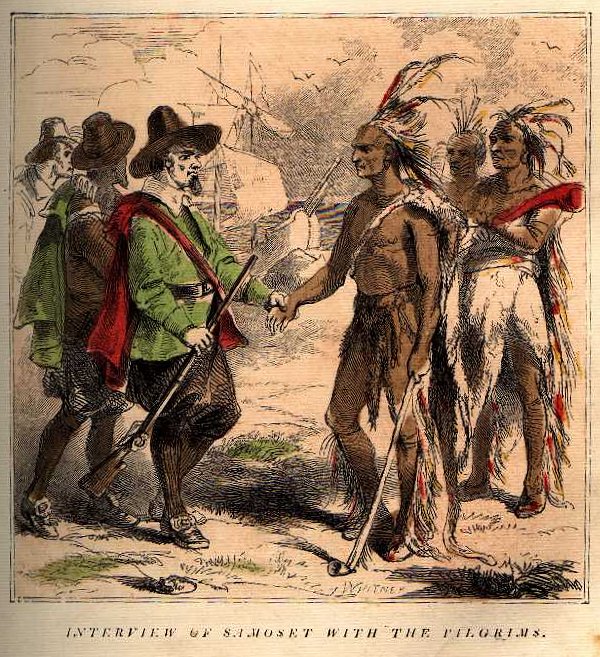
Samoset speaks English to the British colonists

Today is the last day of a long Thanksgiving weekend here in the United States. As a Sunday, many of us are recovering from too much food and from the beginning of the Holiday shopping season. Friday is called Black Friday here, where for decades now, mobs swamp department stores in search of good deals and discounts. In response to the post I did, Lincoln's Thanksgiving: What They Wore, a friend sent me an e-mail with the following article. It's depressing, a downer, but I feel compelled to post it.

Let me couch it with a couple of things. History is subjective. Period. Anyone recording what they see and experience do so from their perspective and that is always limited. However, in order to aspire to a "bird's eye view", stories should be told from a variety of perspectives. The story of Thanksgiving as an inter-racial bounty between whites and natives is so deeply ingrained in our American psyche that most of us will pass that on down to our kids.

I don't know what children are learning in school these days, but growing up overseas, we were fed beautiful stories about how this country developed. There were about 15 other American families in our city and the adults all made every effort to instill in us a sense of identity as an American, so we celebrated all the holidays.

I remember one Thanksgiving play we did in our church, all of us kids dressed up as pilgrims or Indians. I have a vague memory of making a silver buckle out of foil, so I think I was a pilgrim. The most vivid part of this faded memory is that there was a popcorn popper that failed to work when it was supposed to, but came to life in the wrong scene, making us all fall down with laughter. So, maybe we didn't get the historical facts down right. Do we just toss it out? I know that Thanksgiving has been a time in my life where giving thanks and honoring friends and family has been important.

I guess we could just dump the historical side and make it a simple day of thanks. Or, maybe we can acknowledge history for all the good, the bad and the ugly it represents, and aspire towards those values we wished the Pilgrims and Native Americans shared: cultural respect, sharing of resources, and the building of community.

I've found some images that relate to the article. Click on them to visit their source.

The Real Thanksgiving

Quoted from: The Hidden History of Massachusetts

Much of America's understanding of the early relationship between the Indian and the European is conveyed through the story of Thanksgiving. Proclaimed a holiday in 1863 by Abraham Lincoln, this fairy tale of a feast was allowed to exist in the American imagination pretty much untouched until 1970, the 350th anniversary of the landing of the Pilgrims. That is when Frank B. James, president of the Federated Eastern Indian League, prepared a speech for a Plymouth banquet that exposed the Pilgrims for having committed, among other crimes, the robbery of the graves of the Wampanoags. He wrote:

"We welcomed you, the white man, with open arms, little knowing that it was the beginning of the end; that before 50 years were to pass, the Wampanoag would no longer be a free people."

But white Massachusetts officials told him he could not deliver such a speech and offered to write him another. Instead, James declined to speak, and on Thanksgiving Day hundreds of Indians from around the country came to protest. It was the first National Day of Mourning, a day to mark the losses Native Americans suffered as the early settlers prospered. This true story of "Thanksgiving" is what whites did not want Mr. James to tell.

What Really Happened in Plymouth in 1621?
According to a single-paragraph account in the writings of one Pilgrim, a harvest feast did take place in Plymouth in 1621, probably in mid-October, but the Indians who attended were not even invited. Though it later became known as "Thanksgiving, " the Pilgrims never called it that. And amidst the imagery of a picnic of interracial harmony is some of the most terrifying bloodshed in New World history.

The Pilgrim crop had failed miserably that year, but the agricultural expertise of the Indians had produced twenty acres of corn, without which the Pilgrims would have surely perished. The Indians often brought food to the Pilgrims, who came from England ridiculously unprepared to survive and hence relied almost exclusively on handouts from the overly generous Indians-thus making the Pilgrims the western hemisphere's first class of welfare recipients. The Pilgrims invited the Indian sachem Massasoit to their feast, and it was Massasoit, engaging in the tribal tradition of equal sharing, who then invited ninety or more of his Indian brothers and sisters-to the annoyance of the 50 or so ungrateful Europeans. No turkey, cranberry sauce or pumpkin pie was served; they likely ate duck or geese and the venison from the 5 deer brought by Massasoit. In fact, most, if not all, of the food was most likely brought and prepared by the Indians, whose 10,000-year familiarity with the cuisine of the region had kept the whites alive up to that point.

Massasoit and Governor Carver

The Pilgrims wore no black hats or buckled shoes-these were the silly inventions of artists hundreds of years since that time. These lower-class Englishmen wore brightly colored clothing, with one of their church leaders recording among his possessions "1 paire of greene drawers." Contrary to the fabricated lore of storytellers generations since, no Pilgrims prayed at the meal, and the supposed good cheer and fellowship must have dissipated quickly once the Pilgrims brandished their weaponry in a primitive display of intimidation. What's more, the Pilgrims consumed a good deal of home brew. In fact, each Pilgrim drank at least a half gallon of beer a day, which they preferred even to water. This daily inebriation led their governor, William Bradford, to comment on his people's "notorious sin," which included their "drunkenness and uncleanliness" and rampant "sodomy"...

The Pilgrims of Plymouth, The Original Scalpers
Contrary to popular mythology the Pilgrims were no friends to the local Indians. They were engaged in a ruthless war of extermination against their hosts, even as they falsely posed as friends. Just days before the alleged Thanksgiving love-fest, a company of Pilgrims led by Myles Standish actively sought to chop off the head of a local chief. They deliberately caused a rivalry between two friendly Indians, pitting one against the other in an attempt to obtain "better intelligence and make them both more diligent." An 11-foot-high wall was erected around the entire settlement for the purpose of keeping the Indians out.

Any Indian who came within the vicinity of the Pilgrim settlement was subject to robbery, enslavement, or even murder. The Pilgrims further advertised their evil intentions and white racial hostility, when they mounted five cannons on a hill around their settlement, constructed a platform for artillery, and then organized their soldiers into four companies-all in preparation for the military destruction of their friends, the Indians.

Pilgrim Myles Standish eventually got his bloody prize. He went to the Indians, pretended to be a trader, then beheaded an Indian man named Wituwamat. He brought the head to Plymouth, where it was displayed on a wooden spike for many years, according to Gary B. Nash, "as a symbol of white power." Standish had the Indian man's young brother hanged from the rafters for good measure. From that time on, the whites were known to the Indians of Massachusetts by the name "Wotowquenange, " which in their tongue meant cutthroats and stabbers.

Who Were the "Savages"?
The myth of the fierce, ruthless Indian savage lusting after the blood of innocent Europeans must be vigorously dispelled at this point. In actuality, the historical record shows that the very opposite was true.

Once the European settlements stabilized, the whites turned on their hosts in a brutal way. The once amicable relationship was breeched again and again by the whites, who lusted over the riches of Indian land. A combination of the Pilgrims' demonization of the Indians, the concocted mythology of Eurocentric historians, and standard Hollywood propaganda has served to paint the gentle Indian as a tomahawk-swinging savage endlessly on the warpath, lusting for the blood of the God-fearing whites.

But the Pilgrims' own testimony obliterates that fallacy. The Indians engaged each other in military contests from time to time, but the causes of "war," the methods, and the resulting damage differed profoundly from the European variety:
  • Indian "wars" were largely symbolic and were about honor, not about territory or extermination.
  • "Wars" were fought as domestic correction for a specific act and were ended when correction was achieved. Such action might better be described as internal policing. The conquest or destruction of whole territories was a European concept.
  • Indian "wars" were often engaged in by family groups, not by whole tribal groups, and would involve only the family members.
  • A lengthy negotiation was engaged in between the aggrieved parties before escalation to physical confrontation would be sanctioned. Surprise attacks were unknown to the Indians.
  • It was regarded as evidence of bravery for a man to go into "battle" carrying no weapon that would do any harm at a distance-not even bows and arrows. The bravest act in war in some Indian cultures was to touch their adversary and escape before he could do physical harm.
  • The targeting of non-combatants like women, children, and the elderly was never contemplated. Indians expressed shock and repugnance when the Europeans told, and then showed, them that they considered women and children fair game in their style of warfare.
  • A major Indian "war" might end with less than a dozen casualties on both sides. Often, when the arrows had been expended the "war" would be halted. The European practice of wiping out whole nations in bloody massacres was incomprehensible to the Indian.
According to one scholar, "The most notable feature of Indian warfare was its relative innocuity." European observers of Indian wars often expressed surprise at how little harm they actually inflicted. "Their wars are far less bloody and devouring than the cruel wars of Europe", commented settler Roger Williams in 1643. Even Puritan warmonger and professional soldier Capt. John Mason scoffed at Indian warfare: "[Their] feeble manner...did hardly deserve the name of fighting." Fellow warmonger John Underhill spoke of the Narragansetts, after having spent a day "burning and spoiling" their country: "no Indians would come near us, but run from us, as the deer from the dogs." He concluded that the Indians might fight seven years and not kill seven men. Their fighting style, he wrote, "is more for pastime, than to conquer and subdue enemies." (photo: Narragans & Roger Williams)

All this describes a people for whom war is a deeply regrettable last resort. An agrarian people, the American Indians had devised a civilization that provided dozens of options all designed to avoid conflict--the very opposite of Europeans, for whom all-out war, a ferocious bloodlust, and systematic genocide are their apparent life force. Thomas Jefferson--who himself advocated the physical extermination of the American Indian--said of Europe, "They [Europeans] are nations of eternal war. All their energies are expended in the destruction of labor, property and lives of their people."

Puritan Holocaust
By the mid 1630s, a new group of 700 even holier Europeans calling themselves Puritans had arrived on 11 ships and settled in Boston-which only served to accelerate the brutality against the Indians.
Pequot

In one incident around 1637, a force of whites trapped some seven hundred Pequot Indians, mostly women, children, and the elderly, near the mouth of the Mystic River. Englishman John Mason attacked the Indian camp with "fire, sword, blunderbuss, and tomahawk." Only a handful escaped and few prisoners were taken-to the apparent delight of the Europeans:

To see them frying in the fire, and the streams of their blood quenching the same, and the stench was horrible; but the victory seemed a sweet sacrifice, and they gave praise thereof to God.

This event marked the first actual Thanksgiving. In just 10 years 12,000 whites had invaded New England, and as their numbers grew they pressed for all-out extermination of the Indian. Euro-diseases had reduced the population of the Massachusett nation from over 24,000 to less than 750; meanwhile, the number of European settlers in Massachusetts rose to more than 20,000 by 1646.

By 1675, the Massachusetts Englishmen were in a full-scale war with the great Indian chief of the Wampanoags, Metacomet. Renamed "King Philip" by the white man, Metacomet watched the steady erosion of the lifestyle and culture of his people as European-imposed laws and values engulfed them.

In 1671, the white man had ordered Metacomet to come to Plymouth to enforce upon him a new treaty, which included the humiliating rule that he could no longer sell his own land without prior approval from whites. They also demanded that he turn in his community's firearms. Marked for extermination by the merciless power of a distant king and his ruthless subjects, Metacomet retaliated in 1675 with raids on several isolated frontier towns. Eventually, the Indians attacked 52 of the 90 New England towns, destroying 13 of them. The Englishmen ultimately regrouped, and after much bloodletting defeated the great Indian nation, just half a century after their arrival on Massachusetts soil. Historian Douglas Edward Leach describes the bitter end:

"The ruthless executions, the cruel sentences... were all aimed at the same goal-unchallengeable white supremacy in southern New England. That the program succeeded is convincingly demonstrated by the almost complete docility of the local native ever since."

When Captain Benjamin Church tracked down and murdered Metacomet in 1676, his body was quartered and parts were "left for the wolves." The great Indian chief's hands were cut off and sent to Boston and his head went to Plymouth, where it was set upon a pole on the real first "day of public Thanksgiving for the beginning of revenge upon the enemy." Metacomet's nine-year-old son was destined for execution because, the whites reasoned, the offspring of the devil must pay for the sins of their father. The child was instead shipped to the Caribbean to spend his life in slavery.

As the Holocaust continued, several official Thanksgiving Days were proclaimed. Governor Joseph Dudley declared in 1704 a "General Thanksgiving" -not in celebration of the brotherhood of man-but for [God's] infinite Goodness to extend His Favors...In defeating and disappointing. .. the Expeditions of the Enemy [Indians] against us, And the good Success given us against them, by delivering so many of them into our hands...

(Governor Joseph Dudley pictured in photo at left. He was also somewhat involved in the Salem Witch Trials and was later accused by Boston merchants of being in league with smugglers and illicit traders. Wiki)

Just two years later one could reap a ££50 reward in Massachusetts for the scalp of an Indian-demonstratin g that the practice of scalping was a European tradition. According to one scholar, "Hunting redskins became...a popular sport in New England, especially since prisoners were worth good money..."

References in The Hidden History of Massachusetts: A Guide for Black Folks (C)(C) DR. TINGBA APIDTA, ; ISBN 0-9714462-0- 2

Interview of Samoset with the Pilgrims

Share/Bookmark

Sunday, June 22, 2008

Our Feathered Friends: Wear Them or Free Them?

It all started with Charlie (named after my brother who is a pilot), my little one-legged, parakeet. I had no control over the heat in my apartment in Chicago, so even on the coldest days, I had a couple of windows cracked open a bit. Charlie flew in through the kitchen window on a frigid winter day. Mitchie, my dog, cornered him. I knew nothing about caring for birds, so I got Charlie a cage, bought him some food, went online and read about parakeets. I took him to the gallery. Soon, one of our customers who knew a lot about birds, brought Charlie a companion. Then she brought two more. I got a bigger cage. She brought a box and told me to put it in the cage. Babies came. Another customer was moving and had a cockatiel with a broken wing, Pecky. She couldn't take him. Did I want him? Pecky was 14 years old at the time. Sure, why not? So, Pecky came. The bird lady felt sorry for him and brought a young female. The female turned out to be a male, Sebastian. Without ever intending to, I now have 9 parakeets (I took the box out. Enough is enough!) and two cockatiels. Although I feel a bit weird about having birds in captivity, none of these would survive in the wild. And, it seems like we will have to put most Nature behind bars to keep it alive.

The birds molt and drop feathers, which got me to thinking about how feathers have been used throughout history in adornments, clothing, and art. Feathers have had a central place in native ceremonial costumes and ornaments for centuries. Theresa Mitopoulou has a good article on The Decoration of the Head with Feathers that illustrates how feathers have been used throughout history and in different cultures. The photo at the left, for example, is from the Mexico City Museum of Anthropology of an Aztec head gear for emperors and priests. It was made with tail feathers of one hundred male quetzal birds, the national bird of Guatemala. She states, "The arrangement of the colored feathers had astronomic and calendar meaning." I found a traveler who photographed a Hawaiian cape he saw at a museum:


He said that it took five years to gather the feathers and another seven to sew them into the cape. He didn't state where he took this photo, but Sothebys has a similar one from the collection of the Niagara Falls Museum, estimated in worth at over $250,000.

The British Museum states that capes were made for Hawaiian and Polynesian nobility. They were used in ceremonies and in battle and many were gifted in the early 1800's to sea captains and their crews, the earliest outside explorers to the region.

James W. Reid wrote a book, Magic Feathers, Textile Art from Ancient Peru, which is illustrated with beautiful Nazca capes and details on the feathers and techniques used in the region.

Pathways to the Sun
Nazca culture, south coast of Peru, c. 400-800 AD
97 x 76 cm, cotton with applied feathers

The famous photographer, Edward Curtis, was the first to comprehensively document the life of Native Americans in the late 1800's. This photo of a Nez Pierce man with his head dress was exhibited at the Hall of American Indian Collection in the Hotel Astor.
Curtis and other photographers captured the public's imagination. The Bald Eagle had been chosen as the symbol of freedom and became the national bird in 1782. To Native Americans, the eagle is a messenger to the creator and represents endurance. In all of the United States, the eagle and its feathers were treasured. As the media developed, it made its way into books, magazines, then later in movies.

Bird Lady by Cristina Mittermeir
Highlands performer wearing a headdress made with the feathers of the superb bird of paradise. Highlands sing-sing, Papua New Guinea.

To this day, native people around the world continue to use feathers in ceremonies and dress. The Huli warriors of Papua New Guinea are often photographed for their bright face paint and costumes, feathers topping off their beautiful ensemble. Struggling to maintain identity in the face of a globalized world, these groups often are reduced to objects of tourism, but other efforts also seek to both honor and protect them. The above photo, for example, is available for purchase through Art for Conservation, an organization promoting grassroots conservation initiatives.

The fashion industry, of course, also has had a long history with feathers.

Marlene Dietrich wearing a feathered hat.

Victorian hats sported huge ostrich feathers and other exotic feathers continued to adorn hats and clothing through the 1950's. The following catalog is from a 1901 New York Millinery supply company, Fancy Feathers.

Smithsonian Institution Libraries

At some point, demand for all these feathers started creating shortages. Think of the demise of the passenger pigeon. Once the most populous bird in North America, five BILLION birds were killed off between 1870 and 1890. (Wikipedia) They had a high fat content that was used for cooking oil and to light Eastern street lamps. The last passenger pigeon died in Cincinnati, Ohio in 1914. Demand for bird feathers is not only ornamental, but also functional. Down feathers were and are still used for pillows and bedding. People started to worry and speaking up. Societies and organizations were formed. The National Audubon Society started publishing their Audubon Magazine in the 1880's, about the same time the passenger pigeon was getting killed off.

But, the attraction for feathers is powerful and we still continue to use them in our art and in our fashion. Handbags by Daphne offers this peacock feather bag for $85:

Jean Paul Gautier's wild feather dress was dubbed "Miss Turkey" by fellow blogger, Chanteuse. It's something else, isn't it?


So, there is that famous saying that "birds of a feather flock together"... Actually, we are destroying these feathered friends habitats all over the world. More and more, the chance for their survival will be as pets. Some African Grey parrots have become famous for how much they can learn, how cute they are and for their performance abilities. Here is Einstein performing on a TV show:


Menino, a Brazilian parrot, sings opera. My dogs came to watch him when I was playing his video:


And, Cody, a beautiful macaw, likes to be blow dried after his shower:


As with all of our natural resources, animal and plant life, care for these creatures and their feathers is in order. However, feathers are a renewable material. They do fall off naturally and birds do die. There is at least one organization that distributes molted feathers. Wingwise works specifically with Pueblo Indians and donates collected feathers for ceremonial purposes. Unfotunately, they have such a huge backlog of requests, that no new requests are taken at this time. The San Ildefonso girl at the left is wearing donated macaw feathers in her head dress.

It seems to me that this is really the solution for those of us who would like to continue to use feathers in art or garments. Bird sanctuaries, zoos, and pet owners should come together in some kind of a distribution system.

I also found some interesting trends in the green textile industry which is working on a fabric they are calling "chicken wool". The Independent reported that millions of tons of chicken feathers from chickens who are processed for the food market are disposed of yearly. They are working on a fabric which they consider will be superior to wool. Who knows what the next new trends will bring? We can only hope that they will address the needs of our fair feathered friends. Should we continue to wear them? Should they be freed from their cages and returned to the wild? Each of us has to answer these questions for ourselves. I know that my little companions wouldn't have a chance out there, so they are going to stay here. And, if any of you out there want some little parakeet feathers saved up for you, let me know and I'll start an envelope for you!


History repeats itself, but the special call of an art which has
passed away is never reproduced. It is as utterly gone out of the
world as the song of a destroyed wild bird.

-Joseph Conrad


Share/Bookmark

Tuesday, June 17, 2008

Huichol Yarn Paintings: Visions Destroyed by Poison


We normally think of using yarn to knit, crochet, or weave into garments, bags, rugs, hats, mittens, and other functional objects. The Huichol of Mexico, however, use it to "paint" sacred images that are connected with their Spiritual life. The yarn paintings evolved from making images from found objects (shells, nuts, twigs, etc.) and pressing them into a mixture of pine resin and beeswax. The first major exhibit of yarn paintings was held in 1962 in Guadalajara with simple images. (Wikipedia) Since then, especially Huichol who have migrated to the cities, the technique has been elevated to an elaborate art form with distinguished artists selling their work for several hundreds of dollars.

Wikipedia map of Huichol area

The Huichol refer to themselves as Wixáritari ("the people") in their native language. (Wikipedia) An estimated 7,000 remain in their native lands in the Sierra Madre, while another 13,000 have migrated to other parts of Mexico. The terrain in the mountains is rugged and difficult to traverse. This has meant a difficult life for the Huichol in eeking out a livelihood from poor soil, but it has also been the reason for them maintaining their culture and belief system intact for so many centuries.

Huichol homeland terrain, photo courtesy of the Huichol Center

The Huichol practice a peyote-based religion of ancestor worship that is centered on nature. Juan Negrin writes:

"The story of the Creation of the World chronicles the manner in which the ancestors emerged from an amorphous existence in darkness to find the way to light and harmonious life. Having accomplished their designs, the ancestors died physically. Following the ways of the ancestors involves the women preparing food, sweeping, weaving and caring for the young, while the men work in the fields, collect wood, build thatch roof silos and houses for the ancestors, and hunt the deer. It also involves invoking the god-Ancestors and reenacting their feats in drama-filled celebrations and pilgrimages to the five points of the earth: the center and the four corners. Through this ritualistic lifestyle, repeating timeless actions and actually impersonating the ancestors, the Huichol attempt to establish a direct relationship with the animistic spirits of nature which are none other than their Ancestors. This philosophy of life culminates eventually in death, when the wise join the pantheon of the Ancestors, becoming spirit allies and guides for their descendants.

The manifestations of the Ancestors are concrete and take such forms as earth, sun, fire, water, wind, corn, deer, rivers and rocks. The Ancestors give life and sustenance to the Huichol, while the Indian renews the powers of the Ancestors by his ritualistic conduct. The traditional way draws past and future together in an unbounded present that is a never-ending process of creation. What is here now existed before the world was created, only it now has a form and an identity supported by the activity of man in his symbiotic partnership with the ancestor spirits."

Indigo Arts Gallery: Peyote Mother (#JBS13)
Huichol yarn painting by Jose Benitez Sanchez, Nayarit, Mexico, c. 2005, $235


The Huichol are as colorful in their dress as reflected in their paintings. The following three photos are courtesy of The Huichol Center's archives, an organization dedicated to providing the Huichol with social services, health care, literacy and empowerment:

Huichol Shaman


Huichol Peyote Face Painting Ceremony


Huichol children

Wikipedia photo of woman and child


The Huichol are adept at many other forms of textile arts. They weave, sew, embroider, decorating their surroundings and clothing with bright, colorful motifs, much of which incorporates religious symbolism in the same way, although in a simplified version, as the yarn paintings. I have noticed that many cultures around the world who live in difficult, arid terrain work in these bright colors, while many forest peoples work with an earthier color palette. Perhaps this is one way to balance out the lack of or over abundance of color in Nature. Many of the Huichol crafts have found their way to the tourist market or to retail outlets who strive to help theml earn income in this way. Hands Around the World works closely with Huichol families and market dolls like the one in the photo, as well as beaded work (also embedded in bees wax and pine resin) and many other crafts. Indigo Arts Gallery is a gorgeous site with ethnic art from around the world. They sell top quality yarn paintings, portraying each Huichol artist with sensitivity and a good history on both the item and artist. The piece below and one earlier in the article are two examples of the beautiful work they have available.

Indigo Arts Gallery: Peyote Ceremony in the Sacred Land of Wirikuta (#MRC11)
Huichol yarn painting by Maximino Renteria de la Cruz,
Nayarit, Mexico, c. 2006 $4,200

Unfortunately, life for the Huichol, is not as bright and colorful as their paintings and art. All of these attempts at marketing their work has not brought in enough income to bring them out of poverty. So, many Huichol leave the Sierra Madre Occidental for periods where they will work as cheap labor in tobacco fields. The following video explains what happens:


These people are being poisoned, plain and simple. Pesticides that are illegal in the United States are used openly by companies in Mexico and other developing countries. The Huichol and other laborers are given no protection or guidance in how to use them. They are dropping dead. Like so many indigenous groups around the world, these people are considered expendable. The Huichol Center for Cultural Survival and Traditional Arts identifies the problems facing the Huichol in detail. They also have instituted viable options to combat these problems. The Center is requesting help from the International community to help them achieve the goals they have of literacy, increase job opportunities in the Huichol lands, promote sustainable agriculture, and, above all, that the Huichol achieve recognition as part of the "First People" movement, where indigenous groups receive government recognition as a people who need to be protected from the intrusions of modern development.

As Susana Valadez from the Huichol Center states, "It is sad to think that this viable living culture might soon be converted into remnants under glass at the local museum..."

More Huichol crafts available at the Singing Shaman Traders.

Share/Bookmark

LinkWithin

Related Posts with Thumbnails