
TAFA: The Textile and Fiber Art List

Showing posts with label Symbolism. Show all posts

Friday, August 20, 2010

TAFA Members Talk: Carol Larson

TAFA Member: Carol Larson


Last February I launched an organization called TAFA: The Textile and Fiber Art List.  We are now at over 150 members and each new member who joins brings an interesting story.  When Carol joined, her Tall Girl Series caught my eye, and as a tall person myself  (I'm 5'11"), I asked her about it.  I was horrified to hear that her parents had her surgically shortened when she was a teenager so that she would "fit in" better.  

Me and Adelia, 1975
I know very well what it feels like to stick out and tower over everyone else.  I grew up in Brazil as a missionary kid and although our city was incredibly diverse, I was still very tall compared to the locals, especially for a girl.  My best friend was Japanese.  We met when I was 6 and she was 9 years old.  We were the same height and weight.  She stopped growing and I kept going and going and going.  I grew quickly and was almost my full height at the age of 12.  I have always had joint problems and as I am aging, the problems have become worse.  

Carol's story is important to me in many ways.  Most significantly, it is a testimony to the healing power of art.  As I have expanded my creative community through the internet, I have found that many of us deal with all kinds of physical ailments and that having a creative outlet not only heals, but in many cases, also allows us to work at home and earn an income that might be difficult in a traditional work environment.  

Secondly, it is an example to me of how our society enables horrible mutilations in the name of "beauty".  We look down on "primitive" groups who practice tattooing, scarification, tooth chipping, and most abhorrent, female genital circumcision.  Yet, our "evolved" modern society endorses all kinds of mutilation in order to look younger, more sexy, and to fit in.  I heard once that Dolly Parton, Cher, and Elizabeth Taylor, all short women, had their bottom ribs removed in order to have a better hour glass figure.  I don't know if that is true, but do know that it is a practice in the movie industry.  The worst example of this is Sarah Burge who has had over 100 surgeries to look like Barbie, the doll.  On the other hand, I have several friends who have had breast cancer, had their breasts removed and are now going through breast reconstruction surgeries.  Each person needs to decide for themselves what they need in order to come to peace with their unique burdens.  Carol, however, wasn't allowed to make that choice.  Her parents did it for her and then forced her into silence.  She has now found her voice. 

***
Carol: A Tall Girl

Carol Larson
When I was 17 years old and 78” tall I was surgically shortened with the intention of giving me a normal life. I was also forbidden by my father from talking about it.  Fast forward four decades and I was living in daily pain in a broken body with anger and sorrow oozing from my pores. With my family maintaining the secret, I began to speak by writing.

From my stories I created thermofax screens and screen-printed the words to cloth. I felt compelled to do more so I began a four-year healing process which became the Tall Girl Series: A Body of Work: 23 narrative quilts, a self-published book, a PowerPoint lecture and a traveling exhibit. www.live2dye.com/tallgirl.html

The Tall Girl Series: A Body of Work made its debut February 2010 at Rogue Community College’s Wiseman Gallery in Grants Pass, Oregon with a future exhibit June 13-July 8, 2011 at the Park National Bank Gallery at University of Cincinnati Clermont College in Batavia, OH.  I spend a fair amount of my time marketing this exhibit as it carries a very powerful social message about self-esteem and body image, a subject still so relevant today.


"In My Wildest Dreams", Art Quilt by Carol Larson

Included in this series are: In My Wildest Dreams (53” x 31”) which illustrates my frustration with my loss of mobility; that I can no longer dance, run or ski.


"On a Scale of 1-10", Art Quilt by Carol Larson


On a Scale of 1-10 (43” x 61”) addresses how often the pain is off the medical industry’s scale of pain measurement.  In this detail shot from Medical Research (70” x 33”) the viewer sees the scrutiny & humiliation I endured as a ‘case study’ for aspiring medical students.


"Medical Research", Art Quilt by Carol Larson

Completing the Tall Girl Series: A Body of Work allowed me to heal these old wounds to my body and my heart, to take my story public and to receive acknowledgment that indeed this was a barbaric solution to what was really a parental obsession.  The series also allowed me acceptance of the long-term debilitation brought by these surgeries and living in daily pain. 

Being a great believer in holistic medicine I now rely primarily on acupuncture, acupressure and movement for pain management; although I am not ruling out medical marijuana brownies in my elder years!  Today my focus is on challenges and obstacles; as stamina, agility and comfort are my primary concerns in life. The more present I am in my body the less often I am injured.


Currents Series, Art Qults by Carol Larson
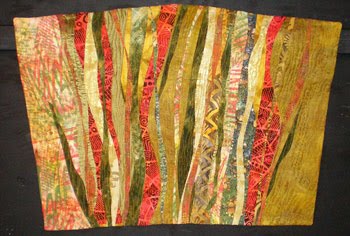


Completion of the series also freed up my creativity to design new and exciting work. In my everyday work I dye, paint and stitch art quilts with a variety of vintage textiles.   The Currents series deals with my obsession for the curvy line and new work, Upheaval, represents the chaos brought on by Alzheimer’s which now affects my father.

"Upheaval"  Art Quilt by Carol Larson


Visit Carol's Member Profile on TAFA for more information on her work and web links.
Click: Carol Larson 

 Do leave comments for Carol both here and on TAFA.  We welcome you!

Share/Bookmark

Wednesday, December 3, 2008

Prayer Rugs, Kilims & Suzanis, A Few of My Favorite Things by Catherine Salter Bayar

When I was a very young girl, my mom took my brother and me to the movie theater to see “The Sound of Music”. We loved it so much that we left the theater, drove over to pick my dad up from work, and went right back to see it a second time. The best part of the story was Julie Andrews cheering up unhappy children by singing, “Raindrops on roses and whiskers on kittens…” I learned then that remembering the little things I most loved was a great way to lift my spirits out of the doldrums. Perhaps that’s why I collect vintage textiles – they remind me of the best things in life.

Turkish Prayer Rug

Like this small prayer rug, probably woven by a girl not a lot older than I was when I saw that movie. Turkish village girls would start learning to weave practically as soon as they could walk and talk, so that by the time they were old enough to marry, their dowries would be complete.

Prayer Rug Tree of Life Medallion

Prayer rugs were not only good training for larger carpets; they were something every person in the home would need for their prayers five times a day. This central medallion is full of Tree of Life symbolism, to remind those who saw it to appreciate their connectedness to all those relatives in the village who nurtured their roots in life.


Hearts, floral vines and zigzags of fresh water were other reminders, along with the waxing and waning moons over the mountains as a sign of how fast time flies.

Long Kurdish Kilim Runner

Near Mount Ararat in Eastern Anatolia, Kurdish tribes would weave pairs of animals into their colorful wool kilims to recall the story of how Noah was commanded by God to collect two of every animal on the earth and take them along in the Ark.

Animals Depicted in the Kilim,
Important in the Weaver's Life


Chickens and ducks must have been an important part of this weaver’s daily life, though all sorts of farm animals are depicted here.

Woven Flowers, Representing Beauty and Abundance

And of course, flowers were almost always woven in, as a sign of appreciation for abundance and beauty. But my favorites are suzanis, especially this one:

40 Yr Old Suzani

Embroidered in Central Asia more than 40 years ago, it is a veritable Garden of Eden. Comprised entirely of flowers, leaves and tendrils in hot pinks, oranges and pungent greens, just looking at it makes me smile.


The embroiderer who drew the pattern was ambitious in the amount of detail she added. She and the friends who must have helped her did not complete stitching all the curling bits and pieces, so ink marks are still evident.

Ink marks still evident on this Suzani from the 1960's.

What fiber artist can’t relate to starting such a large project and never getting it all done?

I marvel that the backs of suzanis look nearly as good as the fronts:

The backs of Suzani embroideries are almost as solid as the fronts.

The edges are bound in a contrasting color cotton and machine stitched, but in controlled wavy patterns that would not be so easy to do.


The embroiderers did manage to stitch outlines around the border leaves. My favorite details are the chain stitched bands that enclose the border, so precisely executed they look knitted.

Scorch marks from an iron add history and character to this suzani.

Alas, someone once took a too-hot iron to the heavy sateen that I think is silk, though it may well be cotton…I’ve never snipped a piece to burn and find out. Much of the pale background is covered with scorch marks, and there are occasional stains that show that I’m not the first woman to love this suzani. Though disparaged in today’s world in which everything and everyone must be without flaw, to me, this suzani’s imperfections give it an extra layer of character on top of the beautiful embroidery. Like my favorite things in life, I’ll take the bitter with the sweet.

These three treasures can be found in my Etsy shop, along with lots of other vintage fiber art finds. Click on their names to visit the listing:


Catherine Salter Bayar lives with her husband Abit in Selcuk, near Ephesus, Turkey, where they own a vintage textile shop and a water pipe & wine bar. A regular contributor of this blog, Catherine is also a member of our Fiber Focus group. She is currently working on a book on Turkish textiles. Visit Catherine and Abit at www.bazaarbayar.com or www.bazaarbayar.etsy.com.


Visit us: Ataturk Mahallesi, Siegburg Caddesi, 3 Selcuk 35920 Izmir Turkey
Phone: 90.232.892.6508

Share/Bookmark

Thursday, August 28, 2008

Watatu: Kanga, Kitenge and Proverbs from Tanzania


Kanga and Kitenge
– a living part of the East African culture
The Kanga (also spelled khanga) is an about 1 meter wide and 1,5 meter long piece of textile, which is used mainly in Kenya and Tanzania as garment, for carrying babies etc. In Uganda it is called Leso. The Kanga is of cotton and is printed using the silkscreen technique with a frame (pindo in Swahili) and a theme (mji) inside it. There is also often a slogan or proverb (ujumbe or jina) printed on the textile. The Kanga is easy to fold, tie and wind. It is often bought in pairs, and then cut to two pieces – one to wrap around you as a skirt and the other piece around your shoulders.

Kanga


The ujumbe or jina here says “I wish you all the best”.

The Kitenge (vitenge in plural) is another kind of textile, but of a thicker quality, and it has usually an edging only a long side or not at all. It is printed using rotary spinning machines. Even kitenge is sold in lengths sufficient to cover ones body. Specific patterns are designed for national holidays, jubilees etc. While similar textiles as the kitenge can be found all around Africa, the kanga is specific for East Africa and it has a fascinating history.

Kitenge


Women of Zanzibar created the Kanga
In the middle of the 19th century there was an abundance of imported goods in the bazaars in Zanzibar. Textiles were imported from India, the Far East and Europe. The Portuguese contributed with printed textiles to be used as shawls. They came in 0.50 meters wide rolls with square patterns. Normally you would cut off one square and sell it, but some women bought six squares instead, cut it in two pieces and sew them together to get new patterns.

The story goes that the new patterns were called “Kanga” as they reminded of the plumage of the speckled guinea fowl. In Swahili, the word kanga means precisely that: guinea fowl. However, in the book “Kanga – the cloth that speaks” - available at Watatu - the writer Sharifa Zawawi, who is Professor Emeritus of Classical Languages, has a completely different theory on the origin of the word, which we will not reveal here.

”I am also a kanga”

”A wife is a fruit to take well care of”
In the beginning of the 20th century the trader Kaderdina Hajee Essak in Mombasa, often called Abdullah, got the idea of printing texts on the textiles, preferably proverbs from the rich Swahili cultural heritage. His textiles, which carried the trademark "K.H.E.-Mali ya Abdullah", quickly created a new fashion, which lasts up till today.

The texts are in Swahili, which is spoken in East Africa and Central Africa. It is the official language in Kenya and Tanzania (a union of Zanzibar and Tanganyika). The words on the kangas can often - if not just being printed for a jubilee or being political or religious slogans - have a double meaning. With a kanga you can indirectly say what you want to your neighbour, rival or others. The texts can be seen as document of historical and political events as well as prevailing values in the Swahili society and how they have changed during times.

The Mji and Jina (see above) are what characterizes the kanga and its popularity. The popularity of the Mji, that occupies the most important area of the kanga, save for its colours and the art, may be overshadowed by the context of the jina. The jina is usually printed in uppercase letters in colours that match the central motif and most likely on white background to improve its readability. Kangas without text are called kanga bubu – a dumb kanga.

The ujumbe or jina here says, “A wife is a fruit to take well care of”.

In the beginning the pattern at the kangas was printed by hand using wooden stamps. Nowadays it is an industrial item, where the textile industry in Tanzania has to compete with cheaper copies (but of less good quality) of kangas from India and China, where even the text in Swahili is copied.

In sorrow and happiness
In Tanzania the kanga is used for all events in life. When a girl is going to be married, she is covered with kangas. She is also given kangas as gifts. Also when people go to celebrate the birth of a child, the women put a kanga around the waist, and when someone has passed, and people go to pay their respects, the women put a kanga around the waist.

Also notice here the dress at the bottom is made of a kanga!

There is a special design of a kanga called kisutu. It has a beautiful pattern with a lot of details and you can get it in red and black or blue. The red and black one is called kisutu cha arusi and in Zanzibar the bride is wrapped in it at the wedding day. At the permanent kanga exhibition at the National Museum of Zanzibar, they tell you that this specific ”wedding kanga” has a bloody story linked to it. It is said that a woman killed her husband with a knife, because he didn’t give her this kanga.

Kisutu cha arusi


A kanga or kitenge for you
The kanga and the kitenge are wonderful products, you can really use them for everything. Our online shop has a wonderful selection of kanga and kitenge, other African textiles, baby carriers, African fashion, coffee, and much more! And, if you sew, kanga and kitenge work great in quilts or made into your own clothing, bags, curtains, or table cloths.


We are three old friends, Watatu (=three in Swahili), one from Sweden and two from Tanzania who are trying to promote the use of kanga and kitenge also outside East Africa. Do come visit our site!


Written by

Karin Zetterqvist
Watatu Textil
©Watatu

Sources:
”Textil i Afrika” by Erik Cardfelt, Karin Olsson
“Kanga – The Cloth That Speaks” by Sharifa Zawawi
Article “The Kanga” in Bang Magazine, July/August 2007


See Karin's article on Bark Cloth in Uganda.

Share/Bookmark

Wednesday, August 27, 2008

A Maze in the Amazon: The Shipibo-Conibo Path in Textiles


I first learned about the Shipibo through their beautiful ceramics. Fine black lines create mazes of pattern on white backgrounds, framed by the red tierra cotta clay. As I was exposed to more of their work, I saw that those designs were also abundant in their textiles, as facial tattoos and as wall art on the outside of their houses.

A Different Approach carries Shipibo pottery wholesale.
They are a fair trade organization that support many pottery
efforts in Central and South America.


Many authors refer to the Shipibo in conjunction with another indigenous group, the Conibo, as one people, the Shipibo-Conibo, as the two have merged through intermarriage. They live along the Amazon River and its tributaries in small villages, although many cities like Iquitos and Lima now have Shipibo communities as well. Estimates number the population at 35,000 people in 300 villages. As with most indigenous groups around the world, the Shipibo-Conibo face the old story of displacement due to logging (Cultural Survival has an article about mahogany culling in the region), climate change, and assimilation into the mainstream popular culture. Yet, they have been able to find a better balance than many other groups through their profound knowledge of medicinal herbs, shamanism, and production of handicrafts and textiles.

Several permaculture efforts have networked with them in an effort to help them produce better foods locally, decreasing their dependency on trade. Ecoversity describes some of the challenges they have experienced in reaching remote communities while other less isolated groups have enjoyed significant gains through participating in events such as the Santa Fe International Art Market.

Photo by Howard G. Charing
See his pdf article, Communion with the Infinite, for more information
on the textiles and their spiritual significance.

Shipibo-Conibo textiles are closely connected to their religious context. The World Culture Encyclopedia has a page description of Shipibo belief. Boiled down to one paragraph, they believe that spirits or gods live up in the sky which can be accessed by the "vegetalista" or herbalist (shaman). Western medicine is fine for treating diseases of the flesh, but the vegetalista will know how to cure the spiritual maladies. Shipibo cosmology translates itself into art through the vision of being part of a larger whole. Dan James Pantone, Ph.D., has an excellent article which explains some of this dynamic. I thought this insight was especially interesting:

"The art form of the Shipibos is little understood by the outside world. To the artists, is not something that they are taught, rather they are inspired to create their distinctive patterns. The women, rather than the men in the village, are the artists. Commonly the women will work together to produce a single piece. Each of the women seems to be moved by the same artistic spirit and one woman can interrupt her work and then assign another woman in the village to complete a particular piece. When the artwork is finished, the resulting piece will look like it was made by a single artist. This really is communal art at its finest."

Photo by Lorna Li

It reminds me a bit of quilting bees, yet if you watch how these textiles are made, it's a little more abstract in design than most quilting patterns. The textiles also call up Aborigine work to me. Instead of dots marking a pathway, lines move you through the piece.

Vintage 1960's Shipibo Textile, by Patina Green

There are two main forms of the textiles, both very different in their final impact. The simple white and black textiles are painted with vegetable dyes, resulting in stark geometric contrasts. The second uses embroidery. Although the patterns are also geometric, the use of color introduces the potential for walking on the wild side of the maze. Designs may explode with clashing oranges and blues, while others may bring calm and a sense of peace with greens and purples.


"This is the "Wayvana" pattern:
the wavy lines mimicking each other are people eating together
underneath a tree (the little square in the middle)." Willem Malten


Sabine Rittner, of Heidelberg, Germany, spent several months with the Shipibo in 2005. Coming from a music therapy background, she researched how the vegetalista or shaman approached healing in their context. She quotes:

`Every human being possesses a body pattern that is formed by his energy flow and is not visible to the average villager but to the shaman. When the competent and experienced shaman uses the plant in question, then he gets insights into a patient's energy field and flow of life force, energetic disturbances and blockades. Shipibo shamans say that the ayahuasqua drink helps them to see through a patient's body, like x-rays. However, they see neither skeleton nor organs but rather the disturbances and blockades in energetic balance. The exact site of the illness may be located in this way. The ayahuasqua plant permits shamans also to contact the spirit world. Above all the so-called `masters of powerful trees' support a shaman in his therapeutic work. These patterns resemble the style of the patterns we admire on earthen vessels and textiles. But according to the shamans' descriptions they are much finer and more complex. If a person falls ill in the course of his life this becomes visible in an imbalance, a distortion, an unclearness or agitation of his body pattern. Ayahuasca helps a shaman to see the pattern and evaluate it. He tries to reconstruct the pattern through songs transmitted to him in his ayahuasca induced state by the masters of the trees. For the Shipibo these songs are sacred and healing, they are also called `pattern medicine'. When a shaman sings his therapeutic song, then rhythm and intensity of the song show their effects in a patient's body pattern. While the shaman's healing song leaves the breath of his mouth in a linear and rhythmic flow, it forms a fine pattern that becomes embedded in the patient's body and causes harmony in the energy balance and the mind.' (From: Gebhard-Sayer/Illius, 1991).


She concludes her fascinating article with a note on what she learned:

"Everything I tried to present in this paper is the result of momentary impressions. Despite written versions of the Shipibo language, theirs is an oral culture living in the flow of `improvisation', that is, being recreated all the time. There is the continuity of a common history, a tradition passed on in tales, myths, shapes, colours and music. But this is the art of creation that lives anew every day, every moment, with each listener. The stories told in ethnological books are, strictly speaking, only true in the moment of telling, not for the next day, not for the next ayahuasquero, not for the next village. It was a lesson and a challenge for me to discuss with the Shipibo this kind of `permanent impermanence' that has more contradictions than consistencies.

My intention was not to idealize the Shipibo culture. Notwithstanding our postmodern longing for the `original' and `authentic', the life of the Shipibo is full of existential problems, with unbelievable material poverty and tremendous social wealth. I am deeply grateful to them for accepting me as a guest and permitting me insights into their everyday lives and spiritual healing traditions."

On that note, perhaps we should all give up some thanks for our own roles as guests on this earth and for our impermanent contributions to the maze we each walk in.


Here are some Shipibo products available on Amazon and Novica:


Share/Bookmark

Friday, July 4, 2008

I Pledge Allegiance to the Flag...

According to legend, Betsy Ross made the first American flag.
Here, she shows it to George Washington and others.


I pledge allegiance to the flag of the United States of America,
and to the republic for which it stands, one nation under God, indivisible, with liberty and justice for all.


Today is Independence Day here in the United States. That means flags waving, picnics, firecrackers and a day off for most of us. For my dogs, it means several days of fear and trembling as each firecracker makes them jump through the roof.

Flag of 1818. Felted wool made from recycled sweaters; antique buttons. 1996.
by Morna Crites-Moore

The pledge of allegiance to the flag are words that all Americans have drilled into them as children or which must be stated on becoming a citizen. I learned them as a child growing up in Brazil, along with the American, Canadian and Brazilian national anthems. The flag, pledge and anthem are all historical symbols of this country, reminding us of a cultural identity, heritage and instilling a sense of nation on a multi-cultural and diverse population. This identity comes as a double-edged sword for many of us, especially when the flag waves over political decisions we may not agree with. The pledge itself has often been dissected, word for word and questioned in what exactly it means to have allegiance, to what the republic stands for, if God actually exists and whether liberty and justice do truly exist for all.

Dream-folk Art Flag by Pegskitchenstudio

As I grew older, I found myself distrusting both the flag and the pledge. I didn't want to be "American", I wanted to be a world citizen. I learned about covert CIA operations in Latin America, about multinational interests in the third world, and on and on. But, I could feel pride in all the NGO's and assistance the United States has also given to third world countries, for all the Nobel prizes won, for artists who have continually led the world in expanding ideas of free speech and cultural analysis, and for all the other good things that have been born on this soil.

Crime Scene by Pam Glew

I cannot disassociate myself from my heritage- I am American. But, I don't own an American flag. I own three Brazilian ones. Hmmm.... Is Brazil that much better than the US that I can wave its flag and not the American one? No, I think it is because I am not Brazilian that I can long for it. As an American, I am burdened with the responsibility of citizenry. I see all that we are lacking, all our potential, how far we have to go to truly have liberty and justice for all and the vision is overwhelming.

in memory of the fallen by eddyizm

I have several friends who have been so disenchanted by the Bush years that they are either moving to Canada or another country or they ardently wish they could. I don't feel that way. I am glad to be here in this time and in this place. Not only am I staying, but I moved from North to South, which was a big shocker to many of my Northern friends. "The South is so racist! They're all Republicans down there!" And, on and on. Well, I am pleased to report that I love the South. I have been welcomed and feel quite at home here. Sure, maybe I'm a little bit "different" (I've learned that down here this means "weird"), but I think that if we truly believe in world citizenry, this begins in our own back yards.

Military Blog by Rich Kelly

The American flag has a become a symbol of power, and to many people of other countries, a symbol of oppression and domination. We have made political decisions that have cost a terrible price in terms of loss of life and livelihoods to millions of people. They are angry and I believe, justly so. But, the American flag is also a symbol of freedom, democracy, and opportunity. I have been in a couple of situations overseas when the sight of the American flag flying at an embassy's entrance was a sight for sore eyes. There is such a huge sense of relief, of home, when you see that flag and you are an American citizen in distress on foreign soil. An American life might not be worth much here on its own soil, but outside of the borders, a citizen knows his or her own value.

United America by Jessica Tennill

So, I have come to accept my identity and responsibility as an American. I do my best to be a good citizen. But, I still distrust the notion of patriotism. I have several friends from Germany. They definitely share a common German cultural identity, but none of them know their national anthem or pledge of allegiance. World War II made Germans very wary of any national emotions that would lead to blind patriotism. I prefer this approach as well. Statements like "Love it or Leave it!" do nothing to build solid ground, to rationally look at our social problems and see how we can fix them, to recognize that we are now a diverse nation with a complex agenda. Barack Obama gave a speech about "One Nation under God" that sought to address some of these complexities. It is printed in full on Sojourners website. It gives me hope to know that there are leaders, like him, who honor the flag and the pledge and who might help soothe the wounds we have inflicted in other countries.

This giant American Flag is made of ironed-together plastic grocery bags.
It was made by LeBrie Rich and Bill Will for an installation called "New Economy" in 2007.
In the installation the flag was inflatable controlled by a coin-op mechanism connected to a squirrel cage fan hidden in a pedestal.
Viewers put in a quarter and the flag inflated and lifted off the wall for about 20 seconds.


I thought it would be interesting to take a look at flag art on Etsy to illustrate this post. There were tons of kitschy little things, but also some interesting pieces. All of the artists portrayed here have stores on Etsy and I encourage you to check them out. Click on the photos and it will take you to their listings. I, of course, am drawn more to political art, but there are also pillows, hats, comforters, goose clothing, earrings, pendants, bags and who knows what else on Etsy that you can search for using the key words, "American Flag". Enjoy your celebration!
Share/Bookmark

LinkWithin

Related Posts with Thumbnails