I just listed several vintage sari borders on Etsy. Hmmmmm.... Do I really, really want to sell them? No, no, no!!!! I want them! Oh, the difficulty of parting with such gorgeousness! But, I have my own stash, so I just have to do the right thing and pass them on to others who will also know how to use these wonderful remnants.
These sari borders are all from India, rayon, and commercially manufactured. At least, I assume that none of them have been hand woven. They are probably around 20 years old, salvaged from saris that became worn, torn, or stained. Handwoven saris from the good old days actually included real metal threads in the brocade (silver, copper, brass, and even gold). Until around the 1970's, those old saris that were damaged were burnt to recover the metal content. Then, the fiber lovers from the West started buying up vintage textiles in Asia and a new market opened up for salvaged textiles. Now, there are many cottage industries in India and Pakistan that work solely with these salvaged textiles, making quilts, pillows, bags and other things out of the handmade embroideries and weavings so abundant in their ancestral traditions.
The great thing about these sari borders is the length. Most of the rolls I listed have around 7 yards of length to them, plenty to work with in any project! Because of their age, they do have weak spots and small tears. I usually use a light fusible backing to support those areas.
The rich colors and metallic threads transform plain fabrics and projects into royal beauty! Those of you who enjoy a Victorian look will especially love what the borders can do for your projects. Imagine them accenting curtain bottoms in a room that blends old and new.... Ah, yes!
Rayela Art hats, using ultrasuede and vintage sari borders.
I've used the sari borders in hats, bags, pillows and in one quilt. Projects need to take into consideration the fragile nature of the borders. So, using them on a jean jacket or a purse that will take a beating might not be the best use of the trim.
Rayela Art evening bag: ultrasuede, sari border, beads and trim.
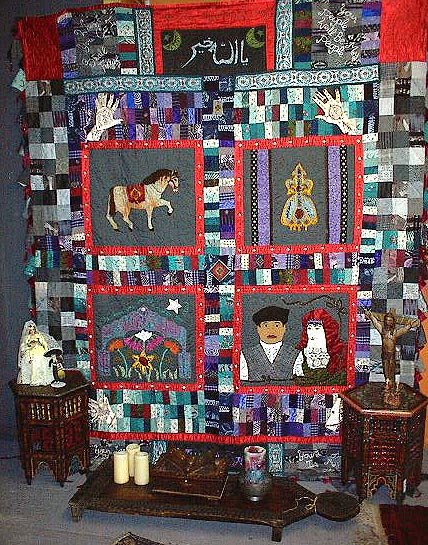
I had great fun using the borders in a quilt that I made for a friend. I really need to get a better photo of the quilt, but here is one that will at least give you an idea of how the border was used:
The border frames the top and bottom of the quilt. You can see the top here. This is a huge quilt, part of the reason why I haven't gotten a good photo of it yet. Terribly difficult to display with proper lighting. It took me nine months and over 1,000 hours to make.
There. Now you have an idea of what you can do with these vintage sari rolls. Click here to see what is available on my Etsy shop. If I am out of stock, know that I will get more in soon. Have you used these in your work? I would love to hear about your ideas on how to use them, too!
Sari borders! A great way to make your sewing projects look rich and royal!
Yesterday I wrote a post about winter wear on Etsy. We've had a terrible cold spell here in Kentucky, so I picked woolen goodies that I could lust after. There is nothing like wool to keep you warm when those temps hit rock bottom! I have a store on Etsy and like to support the sellers there whenever possible. I also have one on 1000 Markets and it didn't seem fair to do a post on Etsy without also doing on on 1000 Markets. Actually, many of us sell in both places and several of the sellers shown have joined the fiber art/textiles network I started on Ning, The Fiber Focus Group. Over time, those who are more active online and in social networks start bumping into each other, forming cyber friendships.
Now, to shop on 1000 Markets! I am looking for an outfit that will keep me warm from head to toe. Maybe it's a bit too fancy to sit at the computer as I am now, but this is the destination I have in mind. A cold house with freezing floors. The water pipes have burst and six inches of water have flooded the whole ground under the house. Head to toe, I need warmth.
The place to start is the head. Cover your head when you are cold! And, why not do it with art for your head? DreamWoven's hats have been a long time favorite of mine. Someday I will own one. "Simone", the hat above is the bestest hat in the whole wide world! I love it, love it, love it!!!!! All of the images are hyperlinked to the product in this post and you must click on DreamWoven's hat so that you can see it from all angles. DreamWoven and I have been cyberfriends for quite awhile now. We're both Rachels and we both enjoy the role of helping others find larger markets for their work. She is on staff at 1000 Markets and has always been a great support, encouraging us all to move forward with our work.
DreamWoven's hat is open at the back, so I will need to keep my neck warm with this beautiful scarflette by Tickled Pink Knits. The fibers are various soft wools, including alpaca, so it is sure to be luxurious! I like the frilliness, harking back to Victorian wear mixed with enough ruggedness and texture to fit a Viking like me.
Coco and Juan specialize in Plus Size wear which is perfect for me. I like the lines in this top and think it will work just fine with what I've got so far. Notice how the side panels of the blouse curve in, helping provide at least an illusion of a slender figure. I know I need all the help I can get! I would prefer a solid knit and it looks to me like Coco and Juan would probably work with you on your choice of fabric and color.
Modern Era Design makes these custom choices clear upfront. The brown in these pants isn't going to really work well with what I have picked, but they have color swatches to pick from and there are several other choices that I could go with. In fact, they will make it to your size, too.
Comfort was what I was looking for, which I found, with the added benefit that the cotton jersey is organic. Gotta support those green industries!
I'm thinking that those comfy pants might just not be warm enough, so I'm going to add these custom dyed leggings from Dye Diana Dye. When I first saw her name, a long time ago now, I just thought it was the most clever play on words! Her work is impeccable and she has many other dyed garments that are stunningly beautiful. Keep dyeing, Diana, but live a long, long life!
This photo is a little dark, but I loved these tabi socks by Twiddle Toes. (Another great name!) Tabi socks were originally used by the Japanese with their wooden kimono flip flops. Now, we can also wear them and Twiddle Toes has them in a bunch of different colors!
The tabi socks will need some booties, so I picked a pair made by my friend Catherine at Bazaar Bayar, another of my cyber friends. She has been knitting up a storm lately and you will have to go look at her other lacey slippers. I thought these slippers were very reasonably priced!
Many of Catherine's knitting designs use complex color and texture patterns and some hearken to her second home, Turkey. I decided that I really, really wanted one of her hand warmers, too.
Those rusty colors are perfect for me. I would like the thumb and finger area to be a little longer, down to the first knuckle. Can you do that, Catherine? My friend Diane made the one I have on now and the thumb area goes almost all the way to the thumbnail. I really like that. Catherine has several other pairs in her store. Type away and keep your fingers warm!
I'm feeling like my top is not enough. I shopped around and couldn't find a sweater or vest that I liked on 1,000 Markets. I wanted something long and roomy. If you are a knitter, know that there is very little competition with those products right now. Might be a good niche for you! But, I did find something else that I really liked:
Isn't this a stunning piece? Marge calls it a "fling" because you can fling one end over a shoulder. She was inspired by the Middle Eastern marketplace and used a variety of threads, including bamboo (!!!!), to weave this piece. Will it match my hat? I've got a lot of different reds going on here, but I think it will all work. I am warm and I am beautiful! All because I shopped on 1000 Markets! My total bill? Only $923.... Interesting. About the same I "spent" on Etsy. (In my dreams!!!)
How does shopping here compare to Etsy? Well, one thing is for sure, the search here works. It is so easier to find things here because they are in defined categories. The drop down menu is available on every page and is as smooth as butter.
How about the product selection? I was disappointed to see that some categories were pretty sparse. 1000 Markets is a juried venue so each store has to be approved before it hits the marketplace. That means that the approval process is much more laborious, but it eliminates all the junky stuff you might see elsewhere. There is a lot of talent on 1000 Markets and I am sure that if the exact item cannot be found, someone would be willing to make it for you.
Have you visited 1000 Markets? Shopped there? I would love to hear of your experience, as a buyer, seller or voyeur.... Stay warm and dress well!
A friend posted on Facebook that the lines had been forming in front of Best Buy early yesterday and that there were even many tents... It always strikes me as such a testament to our screwed up values when people will suffer the weather or discomfort for the cause of discounts or sports, but we can't get people out for causes like human rights, the environment, or peace.
Big heavy sigh....
On that note, here I am facing the big buying season of the year, hoping that I, too, will have some brisk business in my shops. It's the big contradiction of my life: I want to live simply so that others may simply live, and yet I love stuff, buy it and sell it. Stuff that nobody really needs. My comfort lies in that I truly believe that helping keep handcrafts alive is part of the fundamental picture of supporting self-sufficiency and encourages the arts to flourish on all levels. Understanding the source of raw materials, how they can be used and allowing self and cultural expression to make a mark is the spiritual side of stuff. Or, so I believe.
Kuchi Beaded Patch, Afghanistan
Most of "stuff" I carry are traditional textiles and remnants from ethnic groups around the world: Kuchi, Banjara, Kuna, Miao, and other minority groups. Many of them face terrible odds against surviving as a people as we force industrialization, relocation, and war upon them. These pieces of fabric represent long histories that may not be around for much longer.
Molas look fantastic when they are framed!
My target audience in buying is geared towards other fiber artists and sewers who can incorporate these bits and pieces of living history into their own work. But, they also make wonderful gifts. What can you do with a beaded patch like the one above? The easiest thing to make it into a finished gift is to frame it. If you sew, you can add it on to a bag, hat, book cover, or any fabric background, thus personalizing a simple commercial object.
Ralli Quilt from Pakistan
I also carry larger finished pieces like ralli quilts and suzani textiles. These are perfect gifts for college kids who like tribal art or for anyone who enjoys these textiles. Do you have a world traveler on your list? Then you surely will find something in my store for that hard-to-buy-for person!
Rayela Art can also be found on 1000 Markets. There you will find the things that I have made: Hats, bags, pillow covers.
After the Holiday season, I will focus on more of my own work, but first I have to finish listing all of the bins of "stuff" that are still going to go on Etsy and eBay. (I am in the process of re-organizing my eBay store and as of today, it is empty, but will soon be back on track...)
Now, for my shameless self-promotion: Mention this blog post and get free shipping in the US on any purchases through December 5th. Overseas customers, I'll refund $5 off your shipping cost, but don't forget to mention this post!
And, to all of us, I offer up my sincere hope that we may all experience great joy and bountiful love in this season! This can be a time for great stress and depression for many, but my hope is that we may all have peace and love in our hearts, today and every day.
Shameless Self-Promotion for Rayela Art: Free Shipping!
Research continues on discoloring and degradation of fusible sprays, webs and batting.
by Gina DeLorenzi
To help artists in make informed choices when they buy fusible products, Janet Evenson and Patricia Cox-Crews, U Nebraska - Lincoln, published recent research on fusible sprays, webs and battings. They wanted to know how these products discolor and degrade over time since they could find no published results concerning the long-term performance of adhesive-containing products available to quilt makers and home sewers..
Scientists at the university used infrared spectroscopy to determine the chemical classification of the adhesive sprays. Fusible batting adhesives were identified by proton nuclear magnetic resonance.
The goal was to identify discoloration, yellowing, strength loss, bleed through, stiffening and color changes other than yellow. Various methods to accelerate aging were used.
Major brands of fusible products were studied. Control samples were prepared for comparison. Since different products have different chemical properties, and product formulas change over time, comparing different brands of fusible sprays for example, can only be stated as “this product developed more stiffening than that”. In other words, there can be no exact comparisons between 2 brands performing the same function, merely in relation to each other. One brand may become stiffer, or cause more yellowing, or lose strength sooner. In several cases, percentages of degradation are given for these comparisons, making the information more relevant.
It is reassuring to read in the report that fusible batting products do not appear to deteriorate or cause deterioration in quilts. “The fusible batting adhesive formulations may contain cellulose ethers. Cellulose ether-based adhesives are quite stable to light and have been used for long-term conservation treatments.”
The results for fusible sprays and webs are more disturbing. Read the complete article, its methodology, findings and conclusions.
Evanson and Cox-Crews conclude:
“The fusible webs evaluated, while acceptable for quilts intended to last for 10 to 20 years, could not be recommended for quilts intended to be handed down from generation to generation or for studio art quilts intended for sale to serious collectors or museums. A museum curator or knowledgeable collector will not want to pay thousands of dollars for a quilt that only has a lifespan of 20 years."
Quiltmakers should carefully consider their long term expectations for each quilt they make andselect adhesive-containing products accordingly.
We gratefully acknowledge the financial support provided for this research by the International Quilt Association and Quilter’s Newsletter Magazine.” (quoted excerpts from the referenced article)
Do you have a disappointing "fusing story" to share? Please leave a comment with your experience.
Gina is a self taught quilt artist. She creates visual and emotional impressions in her fiber art by allowing a relationship between various fabrics to emerge. The stunning results of her dyeing and sewing techniques energize the direction each art work takes.
Gina is a regular contributor here on Fiber Focus. Click here to see her past posts. She is also the quilt moderator for our Fiber Focus Group.
Considering the cost of artistic materials, angst over making a mistake purchasing fabric or paints or other art expenses can lead to procrastination, loss of a great idea or ineffective artwork.
Sure, looking at magazines for appealing color combinations is one solution. But those glossy pictures are not my own creation and I have had no success translating magazine adverts to real art. I like Color Harmony by Hideaki Chijiiwa for musing over color choices.
Colorjack is a website that has 3 tools to get instant color palettes. These tools are called Color Theory Visualizers. To use Color Galaxy, just let your cursor hover over any of the array of colored boxes and a palette appears. To use Color Sphere move your cursor around on a ball. Color Studio has you moving your cursor along bars. The colors chosen indicate their RGB (red,green,blue) values. Hue, saturation and value (HSV) codes are automatically generated.
For Photoshop enthusiasts, Colorjack has a link to a list of links for Photoshop tutorials plus several other color related websites.
For quilters who don’t want to be constrained by the fabric industry’s annual colorways in printed quilt fabric, Colorjack could help you delve into your stash and try some different color combinations using what you already have.
Artists working in oil or other media, dig out your half used paint tubes and enter what you have on hand into the software.
An unexpected color combination just might inspire that vague idea wandering in your dreams or sketchbook. Plus using up, recycling and rethinking our product stashes are always smart ideas.
Circus Quilt by Gina DeLorenzi, quilt artist
View featured Quilter of the Month, Suzan Engler Sign up to receive future featured Artists of the Month
Gina is a self taught quilt artist. She creates visual and emotional impressions in her fiber art by allowing a relationship between various fabrics to emerge. The stunning results of her dyeing and sewing techniques energize the direction each art work takes.
Gina is a regular contributor here on Fiber Focus. Click here to see her past posts.
"Gina's kaleidoscopic quilt collages are a focal point on walls in any setting."Ellen Ray PaneroNew York artist represented in the Guggeheim
“The colors are so vibrant, one’s eye is mesmerized.”Eva Birkner
Top seller for Rayela Art: Textile Stamps from Afghanistan
A couple of weeks ago, I reached a goal many of us strive to achieve: 1,000 Sales on Etsy! That is an accomplishment, both on my part for persisting and actually coming up with 1,000 items to sell, and on Etsy's part, for its growth as vibrant marketplace for small time sellers like me. I started selling on Etsy on May 31, 2007, which makes it a little over two years, averaging 500 sales a year.
I thought I would use this landmark as a way to evaluate what this means in terms of making a living online. Those of you who are in the same boat will surely relate to some of what I've experienced and those of you who are newbies in this will hopefully come away with some good pointers.
Etsy is an online MarketPlace which allows sellers to open stores that sell things that they make, vintage items or anything that can be used as a supply in making crafts. The site is not juried, which means that among the bounty of treasures, one will also find garbage and items which stretch or even disobey the guidelines set by Etsy on what is allowed. As stated in their "About Us" page,
Who is Etsy?
Etsy was founded by Rob Kalin, Chris Maguire, Haim Schoppik and Jared Tarbell in June, 2005. We are a community and a company.
In the four years since its inception, Etsy has grown into a vibrant, international marketplace that has attracted high quality sellers offering an abundance of eye candy that is truly remarkable. Here is an interview with Etsy's founder and former CEO, Rob Kalin, talking about the financial side of Etsy as a concept:
As you can see by Rob's age, Etsy is a young company both in terms of how long its been around and in its leadership. Etsy, from its inception, committed itself to being both a marketplace and a community. They have succeeded in both and should have every reason to be proud of both their track record and the impact they have made on the handmade revolution. I do have some critiques about their methodology and priorities, but will address them late in this post.
1,000 sales! Does this mean that it is viable to make a living at online sales, even in this horrible economy? Well, let's take a look at what these sales mean.
As of today, there are 159,786 sellers registered on Etsy. A significant number of these, have only one item in their shop or have not had any new product listed in a couple of years. Yet, everyone who opens a shop on Etsy must have a hope that their product will sell, that they will generate some income from their time and energy invested in opening the shop. Then, there is a large percentage of sellers who use Etsy as a side gig for a hobby. Someone knits too many scarves, they are compulsive about it, everyone they know already got for Christmas and birthdays in the last five years, so they put them on Etsy in the hopes that they will at least get reimbursed for their yarn. Finally, there are those of us who sell on Etsy because it is part of our business. We need the sales because they are our income. The sales help pay our bills, materials, business expenses, feed our children and so on. If you look at the stores with the most inventory, you will see that they are selling supplies, mostly beads. Etsy Wiki lists the top sellers on Etsy. The top 14 have over 20,000 sales, and the number one seller, Lululaland, has over 52,000 sales! Lululaland has also been on Etsy for about two years, so even if each sale was a dollar, that business would be bringing in $26K just on Etsy. But, most of us are not selling in those quantities. Let's take a closer look at what 1,000 sales might mean.
Wikipedia states that Etsy makes money by charging a listing fee of 20 cents for each item and getting 3.5 percent of every sale,[28] with the average sale about $15 or $20 and mostly sold by women,[7] who tend to be college-educated and in their twenties and thirties.[21] Let's look at an average price point of $20 per item. 20 x 1,000 = $20,000. Sounds like good money, but when you think that 1,000 sales could take two years, that means $10K a year or $833 a month. Out of that, one has to take out expenses like the fees charged by Etsy and Pay Pal and cost of goods sold. Even if you make all of your product out of recycled items that have a very low purchase point, there will be costs involved in finishing a product, in computer maintenance, and all kinds of hidden fees or costs. If we doubled that pricepoint to $40 per item, we would have a more livable income of $1,666 a month. But, what if your rent is $1,500 a month? And, in this economy, selling higher ticket items has definitely become more difficult. Do you see the challenge here? OK, now I will share some of my experience and what I consider to be key to surviving through online sales.
My business, Rayela Art, focuses on textiles and supplies for the textile artist. If you look at my shop on Etsy, you will see that my largest categories are Fabric, Trim, Remnants(59) and Textiles, Quilts, Throws(54). You will find remnants from salvaged ethnic textiles and clothing as well as new, finished items like cotton spreads from India that make great quilt backs or that can be cut up as fabric. I have worked with handicrafts from around the world since 1988 and also have several skills including sewing, working with clay, and refinishing furniture. I started selling online about 10 years ago, mostly on eBay but I have also tried several other venues that have come and gone or that simply did not generate enough sales to make the effort worthwhile. Last year my income was around $32K, generated mostly by my online sales, but I also have a part time job, work on commissions, do henna tattoos in the summer and have provided some technical assistance for other businesses. I have cheap rent and a husband who helps subsidize what I fall short on. My income was not enough to pay for my expenses, but it was a great improvement over the previous year which was around $20K. My goal is to grow another 25% this year. I consider myself an expert in my field and have learned my business through the school of hard knocks. My hope is that you will find an easier route!
Diversify "Do not put all your eggs in one basket!" We've heard this over and over. And, it is true. My main outlet now is Etsy although I still keep my eBay store and have recently been accepted into 1,000 Markets where I have the things I make. I also have a booth in an antiques store in downtown Paducah which has started to generate significant sales. Online sales, like any retail sales, go through different, unpredictable cycles. Sometimes, a week can go by with no sales, and then all of a suddent there will be a spurt where there is activity here or there or on all three sites. As I stated above, I also have outside income and I find that I need that, both for the stability as well as for a foot in the "real world". Being tied to a computer all day, every day can become an unhealthy, isolating lifestyle.
Rayela Art: Vintage and Ethnic Textile Supplies on Etsy
Product Line Define your product. I love many different kinds of crafts and have had experience in selling wonderful crafts from all over the world. When first started selling online, I also had a brick and mortar shop in Chicago. I had three different shops over a 15 year period, always focused on ethnic crafts from around the world and when I began selling on eBay, I sold baskets, carvings, jewelry and even furniture. I decided to focus on textiles because of the ease in shipping and storage and because I decided to focus my own craft skills on sewing. Having an identity helps customers understand your business. If you sell vintage, zoom in on one period or collection instead of having a mish-mash of stuff that will make your store look like a junk shop.
Avoid jumping on the bandwagon and selling whatever is hot at the moment. For example, the most saturated category on Etsy is handmade jewelry. Everybody who gets hooked on beads starts stringing them, hoping that their special selection will stand out. Very few do. It's one of the toughest markets to break into. I know how to string beads, too, and have made some beautiful necklaces and bracelets, but so have thousands of others. If you want to work with beads, think of some products that are less competitive: wineglass markers, pull cords, beaded curtains, and so on.
Price Point Have a range of prices in your shop. My lowest priced items right now are at $7.50, mostly textile stamps like this one:
I have never sold an item that was over $200, although I have had customers spend more than that on several items purchased together. Give your customers and option and use your sections well. I don't sell anything under $5. I would rather group small ticket items together to make a $10 sale. I can't justify the environmental cost of selling really cheap items singly.
Product Quantity Again, give your customer options! I try to keep my store on Etsy stocked at over 200 items. Right now I am low in all three stores and am working on photos of new items. Those of you who have spent some time on the Etsy forum will have seen post after post of sellers crying out for help, asking "Why am I not selling?" and you go take a look at their shop and they have three items, or at best, 20. What store can operate on low inventory? What street vendor ever sat on a blanket with three items to sell? If you are making your own things, it is hard to grow your store with a healthy selection, but it can be done. Think about growing your inventory and then later, just maintaining it. I worked out the numbers of how many hats and purses I would have to make to have a decent inventory. I could do it, but instead, I have chosen to re-sell the types of things I have in my store so that my sewing could be my creative work. Etsy gives us 10 sections. Try to separate your product line into those sections. It can be by price, color, size, type of product, age, whatever. Then, try to have at least 10 items in each category. That means, a stock of at least 100 items.
Presentation Make your store beautiful! Take good photos, explain who you are, what your policies are, and make it professional. If you can't spell or write well in English, have someone help you. Do NOT use texting as a form of writing, do NOT write everything in caps, and do use capitals in the beginning of a sentence. Remember, although Etsy sellers and management might be young, most of the buyers with disposable income will be savvy, professional women who are over 40. Until this recession hit us, 30% of my buyers were Europeans and Australians. English is the language used on Etsy and if you want to sell and make your store believable, use language as well as images to sell your product. Make your message positive and welcoming. Cultivate your online image.
Even if your photos are not great, make sure they are clear.
Customer Service Those 1,000 sales I made only happened because people out there decided to put their trust and money in my hands. And, I delivered. I am grateful for every single one of them, no matter how small the sale. And, when they come back, I almost weep with joy! I have many repeat customers which shows me that I have come up with a product line that is well received and that my customers like how I do business. I do not spend a lot of time and money on cute packaging. I respond immediately to every sale, thanking the customer for their purchase and informing them when I will ship (usually the next business day) and I offer free shipping on purchases over $100. I use the United States Postal Service for almost all of my shipping, printing labels through Pay Pal, and mostly using flat rate envelopes which fit most of my items. Almost all of my sales include multiple purchases, so those 1,000 sales really reflect perhaps around 600 individual sales. My cost in offering free shipping last year was over $1,000, so it is a significant cost, averaging about 10% of the total sale.
I cannot stress how important it is to treat your customers well. They do not need cuteness. They appreciate efficiency, quality products, good packaging, and timely shipping.
Marketing Ah, marketing.... This has been the major burden for me in this business of selling online. There is no way around it. You have to get out there and form your online community. A lot of it can be quite fun and I now count quite a few people who I will probably never meet in real life as dear friends. But, it is time consuming and involves constant vigilance of the new venues that are out there. I'm on a whole bunch of groups and networks and even twitter occasionally (watch my eyes roll around in my head!), but I focus my time, energy and money on this here blog (bad grammar intended), Facebook (which I think is an excellent tool!), Project Wonderful, and the Ning group that I started, The Fiber Focus Group. Some of my peers are in all of them, while each also has unique relationships that do not overlap into each other.
When I first started selling on Etsy, I spent a lot of time on the Etsy Forum. I learned a great deal there and have huge respect for the sellers there who take time to guide newbies and confused sellers into making sense out of many difficult issues. But, as I became more savvy with how it worked, many topics began to get repetitive and I also found a strong bias against people like me who work with cultural crafts. There is a definite clique on Etsy in favor of the young indie movement that excludes many traditional crafters or those who work in other craft areas. Then, when I started this blog, I was focused on creating content and found that each post took several hours to produce. Now, I rarely visit the forum, although I continue to refer others there.
I have subscribed to Google Analytics which analyzes traffic to my Etsy store. Over time, this shows what marketing efforts succeed in drawing traffic to the store. In the last six months, 38% of my traffic has been generated through Etsy's internal traffic (including my repeat customers), 23% through Google Key Words, and 4% through this blog. The remaining 35% was broken down into very small percentages from many different sources. You absolutely cannot sit back and wait for business to come to you! How you choose to build your online community is your choice, but it is important especially if you have limited income and cannot spend big marketing bucks on getting visibility.
Etsy Critique
I like Etsy. I think it has done a wonderful job in providing a beautiful venue for those of us who sell online. It is a huge community and a significant force in providing small businesses with a platform for economic change. I would like to continue to have a presence there for a long time and I hope that as it matures as a site, so will its leadership. I have several complaints that I have whined about in other posts, mostly related to seller tools and its search system. I also find it inexcusable that they do not find a place for fair trade products. The bias against cultural crafts that I mentioned above is really disheartening as the handmade movement is global and should include those who are underserved, lack access to larger markets and who do not have computer skills. I would buy much more from fair trade suppliers if I had an outlet for their products on Etsy. But, I respect their guidelines and stick to those items which I can sell there.
My store on eBay is sorely depleted right now, basically because I have lost the joy of selling there even though I have always had wonderful customers there, too. But, I don't like eBay's management and they have become very expensive. Yet, they provide the best seller tools I have seen on any online market and their search system works. 1,000 Markets is a beautiful model which I believe will become serious competition for Etsy. Even though they are only a few months old, they arrived with a mature, sensitive and beautiful template. I know that they will only keep on getting better and their number one goal is to match buyers to sellers in a vibrant way. Etsy's number one goal seems to be creating community, which is fine, but would be even better if they did that within a business model that made life a little easier for the seller.
Oh, I could go on and on, but these are my basic insights I thought I would share with you today. Whatever my moans and groans, I am deeply thankful that I even have this lifestyle as a choice. It's hard work and it takes discipline to attend to all the many facets of running an online business. You are tied to a business and cannot take off on trips easily. But, there is also a great deal of freedom that comes with this lifestyle. I have my first vegetable garden this year. If the weather is nice, I can go outside and work on it. I can go to the public pool if I want to. I can clean the house, play with my dogs, sew, read or do whatever the muse of the moment mandates. I treasure this freedom and for that, I thank Etsy for all that it has provided me in the last two years and I especially thank all of the customers who have made this 1,000 sales goal possible!
You've seen some of the eye candy showing up in commercial advertising recently. Short, simple, effective, sometimes even profound.
The advertising world is moving to a new model for grabbing and keeping our attention. It is capitalizing on the concept of “social objects”. A social object is the centerpiece of any conversation. It doesn't matter what the object or idea is, simply that there's a connection going on between people centered on the object or idea.
The Mile Long Aids Memorial Quilt, A "Cube Grenade"
I don't think you can purposely manipulate social objects like the beer ads that try to make us buy their beer by associating good times with friends, BBQ's, tubs of beer and a lot of laughing. Social objects are spontaneous happenings. (It's the viral phenomenon of social networks.)
“Big social objects have more social gravity. They attract conversation like stars and big planets attract matter from space. Tiny social objects are more like a meteor shower; each one has very little gravitational pull as such, but when you add up all the tiny particles in space, they embody more total matter than the big constellations.” Juri Engelstrom, product manager at Google.
If the social object (idea) is a very good one, it could become a “cube grenade”. Cube grenade is the curiosity-arousing phrase created by cartoonist Hugh MacLeod. Cube grenades jump start conversations, they make us keep returning to an idea or object again and again, they motivate us to do something, go somewhere, they get us all excited about the new cool thing. McLeod says tube grenades stir up Trouble in the best sense of the word. A cube grenade can get left behind by a “conversation” that becomes so interesting that it eclipses the original social object. When such a transformation happens, people, ideas and actions can change the world, (for good or bad, sadly).
I made my one and only art cube grenade about 6 years ago and I've have been resting on it ever since. Allegria is the best art quilt I have made. Allegria engages. It causes people to come back to it over and over. I could have sold several Allegrias, I still get requests for it. I think it will hold its own for many years even while quilt art trends come and go.
It's time for me to make another cube grenade with my fabric art. More of my art should be cube grenades. I should try to make every art quilt a cube grenade.
Human cubicles improving the world.
Make Your Own Cube Grenade!
Every human is his or her our own cubicle. Each of us can create a cube grenade with our talent and resources. When we create a cube grenade with our art, we “blow away the competition”. So, getting back to the title of this article, let's make cube grenades in our art and with our daily lives. The world sure needs improvement in all the basics. Whether we think Play it Forward, Random Acts of Kindness, or Cube Grenades, we need to get to work, right now.
Gina is a self taught quilt artist. She creates visual and emotional impressions in her fiber art by allowing a relationship between various fabrics to emerge. The stunning results of her dyeing and sewing techniques energize the direction each art work takes.
Gina is a regular contributor here on Fiber Focus. Click here to see her past posts.
Those of us who sell online often have problems figuring out how much to charge for the things we make. If we look around at what others are charging, we might find a huge disparity in price for similar items. There are several factors that come into play in deciding price point:
Motivation. Is this just a hobby? Do you sit in front of the TV at night and knit like a maniac, decompressing from the day's acivities? Do you end up with too many scarves, mittens, hats and sweaters? Too many to give away at Christmas? Why not sell them and at least pay for the yarn? Or, is this a business? You are your own cottage industry and you want to make a living by working at home, keeping your own hours, owner of your time and your life.
Cost of Supplies. Fabric, for example, can come cheaply by repurposing, thrift stores or sales. Or, you might pay $10 a yard for designer fabric. Silk and other specialty fabrics can cost $60 a yard or more. If you are producing an item as a business, you include the cost in your price point so that you can buy more supplies.
Time. How long does it take you to make something? Has some arthiritis slowed you down? Are you learning as you go? Or, are you whipping out several pieces a day? Can you keep up with having new and fresh inventory in stock?
Uniqueness of Product. You love beads and are stringing them into nice necklaces. Have you taken a look lately at what the competition is for jewelry? Yes, these necklaces may be nice, but how many millions of other people are doing the same thing, buying from similar suppliers, and making your window of opportunity more competitive?
Branding. You've been around for awhile now. You've worked hard for many years and finally people are buying from you because they want a piece of YOU. Your name has worth and adds value because there is market demand for the reputation you have created.
I was recently accepted as a seller in 1,000 Markets, a new online juried marketplace for artists and crafters who sell quality products. I make hats and am a part of "just hats", a group of fellow vendors on 1,000 Markets who also make hats. The photos in this post are hats made by the members of this group. I thought it would help illustrate the discussion of price by showing different price points, materials and styles chosen by our members. All of these hats are available for sale at the writing of this post. You can visit the listing by clicking on the link in the photo description.
So, we all sell hats and we may have different reasons for why we price as we do. Some people try to figure out an hourly wage for themselves. I try to estimate time and hope to make around $15 an hour plus supplies. Can you knit or crochet a hat in under two hours? If so, maybe you can keep your prices at around $30 or $40 a hat. But, some people may not need the money and if they are just selling for fun, as a hobby, they might make something similar to your hat and charge only $15, creating a problem in the market, unintentionally, for those who really depend on their sales to pay their bills.
The sari hat below is one of my hats. This one was part of a production run where I made 10 similar hats in about three or four days. The materials were all free except for thread and the vintage sari borders. You can save time by sewing in a production mode where you do all the cutting at once, make stacks of the pieces and sew them in order, work on the finishing steps at the end. Almost everything I make, sells. Eventually. I made this hat two years ago. So, this is another thing to consider: Stock.
If you are selling the things you make as a business, you have to have enough stock in hand to give customers choices in what they may want to purchase. Hats also have seasonal looks. A faux-fur hat probably will not sell in the summer to an American audience. Well, someone taking a trip to the North Pole might want it, but a business savvy entrepreneur will want to market their wares to the largest available public within their niche.
So, we've determined that $15 an hour might be an OK wage for making cool hats. How many hats do you have to make a living? Figure out what income you need to make in a month. Budget it all out. Include your living expenses, food, gas, car repairs, health insurance payments, rent, mortgage, etc. How about your business expenses? Marketing, fees, shipping supplies, and so on. Let's say you do that and figure that you need about $3,000 a month to pay for everything and have a little left over for fun stuff. $3K a month is the goal that I have set for myself, but I have cheap rent, so this might be really low for someone living in a more expensive area. I also don't have kids to support. I need to double my sales to reach my goal, but it is achievable. Remember, this is the worst economy since the Great Depression, so we all have to hang in there and hope that things will get better in time.
If 3K is the goal, how many $30 hats do you have to sell in a month? Well, that would be about 100 hats, or 3 hats a day. This means you also have to make at least 21 hats a week to keep your stock up. And, if you want to give your customers a selection, you need to have that surplus stock, so maybe you should think about making 30 hats a week. Can you do that? Is this a realistic production goal for you?
Perhaps a better way to look at it is to think about that goal of 3K and work backwards. If you need to make $100 a day, what can you do to increase the value of your product? How can you tweak it so that it is coveted and can be sold for more. If you price your hats at around $50, you would only need to sell two a day. Or, if you are in the $100 range, you would only need to sell 1 a day.
I could make the 21 hats a week if I set my mind to it. I worked this out a couple of years ago for myself and looked at what kind of production I would need to commit to if I wanted my primary income to come from the things I made. My problem is that I get bored with production. I can make a run of ten similar things, but then I want to do something else. There are so many ideas in my head that I don't have time to explore. So, in my business, I have chosen to focus on building the stock for my imported textiles and supplies and have that be my main source of income. My goal is to reach the point where I am replenishing rather than building stock, which will hopefully leave me time to have fun with my sewing. I will still want to sell it, but if I am not under production pressure, I can keep my work fresh for both myself and the customer.
But, for those who are living solely off the the things they make, my suggestion, especially if new to the business, is to have several price points. If you can stomach being in production mode, have a large inventory of products under $50. These are easier to sell, especially to impulse buyers. Then, start building a collection of more interesting work. Explore how you can make a name for yourself, find a niche that feels comfortable for you. Perhaps those hats that are priced over $100 will take longer to sell, but when they do, they will make up for the days with no sales. In the end, you need to find the right balance of products that can bring in the $100 a day that you need to meet your monthly goal.
You know the saying, "Don't keep all of your eggs in one basket." If you trip, fall, the basket crashes and you end up with broken eggs. I sell on Etsy, eBay and 1,000 Markets. I have a booth at Just English's Antiques in downtown Paducah. I also have some things on consignment at HeART of Healing Gallery. I've tried many different online venues over the years and if I had more product, I would be in more places. But, each location also involves a time commitment and record keeping.
Figure out how much you can handle and try to find at least three different venues for your places. Markets cycle and when things are slow in one place, they might be better in another. You will also find that different venues support higher or lower price points. 1,000 Markets is still a new venue, but I have a feeling that it will be serious competition for Etsy down the road. Part of the reason is that they jury their stores and keep a high level of quality and originality in their mix. They are positioning themselves to interest people who are mature and have disposable incomes. Etsy has many wonderful qualities, but they have really targetted their audience to the younger indie crowd, creative people who are living on the edge and may not be able to spend as much. I believe that the $30 hats will end up on Etsy and the $100 ones will go over to 1,000 Markets. And, that is fine. If you can sell in both places and can make that $100 a day in combined sales, your goal has been reached!
Hidden Costs
That $15 an hour you are charging to make a product is also covering all the time it takes to photograph the finished product, list it, ship it, and keep track of records. Each venue you sell in most likely has a community that wants some of your time. Then you blog, twitter, network on facebook and so on. These are your hidden costs for marketing those hats you are making. Is $15 an hour really covering your materials, ideas, marketing and running the business? Think about it....
The reality for most of us is that we cannot reach those financial goals we set for ourselves. Most of us need to take on part-time jobs in the "real" world to subsidize our dreams of becoming self-employed. The lucky ones have spouses or other income that support their work so that they are not sales driven. But, whatever the scenario, take a look at what you are making and give yourself an evaluation. Are you charging enough for what you make? Those who underprice their products do a disservice to the rest of us in the art business community. Yes, we all want to sell, but not charging a fair price makes it harder for any of us to succeed. Why? Because those who underprice create the same market for cheap products, side-by-side with sweatshop factories and subsidized imports from China. How we each price our products makes a statement on who we are collectively, as a people. By respecting our own work and the materials that went into them, we extend that respect to the community at large.
I would love to hear some comments on this. Do you have a formula you use to price your products? As a consumer, how do you look at pricing when you buy something handmade? This is a tough issue on both sides, so I am sure that there are plenty of insights out there to help us all along.