TAFA: The Textile and Fiber Art List

Showing posts with label Weaving. Show all posts

Wednesday, October 12, 2011

Following the Bison Trail Part II by Doris Florig

"Gros Ventre", Bison Fiber Sculpture by Doris Florig


Part II.  Gros Ventre


Read Part I
It took all summer to complete but it was worth every minute. While working on him, he got moved around quite a bit from studio to studio. Everywhere he went he created quite a stir. Unlike other art work, there was never a hesitation in the response of the observer.   Some jumped because he seemed so real, others thought he was scary and others laughed showing great pleasure.  The reactions changed as he took shape, but there was always an uninhibited reaction. He has been fun from start to finish.
He was constructed from nothing but wire, a raw fleece, felted wool, yarn, real bison hair and real horns. Once completed, he sold immediately. I am happy to say that he went to a good home. He was purchased by Marie-Eve and Harvey Locke.  Harvey is the founder of the Yellowstone to Yukon Conservation Initiative, commonly known as Y2Y. One of their projects is to reintroduce the Bison to Banff National Park.
With my approval Harvey and Marie-Eve named their new sculpture after the location where he was conceived, “Gross Ventre”.  Headed for Canada, they left my studio grinning and smiling. ”Gros Ventre” become the first bison to migrate to Banff National Park as part of the BISON BELONG project.
Should I do a big horn sheep next?

______________


Doris Florig is currently teaching in the fiber department at Jackson Hole, WY at the Center for the Arts. To learn more about workshops and classes offered contact Doris: email.

Doris is a TAFA member although her member profile is still not posted. Visit her website.
 

Share/Bookmark

Thursday, September 8, 2011

The Rayela Review: HAND/EYE Magazine

HAND/EYE Magazine, World Textiles, Summer 2011

I was honored and super pleased to receive a copy of HAND/EYE's latest magazine, World Textiles, in exchange for a review here on Fiber Focus.  This is an easy task, theroretically, for the magazine is right up my alley, showcasing textile efforts happening all over the world.  But, of course, I also want to do something different with this review, so I hope that what I say will encourage you to jump up and immediately act on buying your own copy.

HAND/EYE's bi-line, right under the name, says: Connecting cultures and inspiring action.  That is exactly what it does.  The 68 pages tell story after story about how one person had a vision, pursued it and in doing so is transforming a community as well as impacting how that specific tradition or technique can thrive in a modern and industrial world.

Take a look at the table of contents:


  • From Australia, India Flint shares how her children have taken the skills handed down within the family to express their own interests in unique ways.  
  • Six stories follow from Asia, zooming in on Laos, Japan, India, and Cambodia.
  • In Africa, three stories look at silk, weaving and Berber rag rugs.
  • A quick stop in Europe takes us to a tiny Dutch area where women still embellish their clothing with a dot technique.
  • Latin America gets five stories: Mexican Maya, Colombia, Peru...
  • Then, another six stories in North America.
These stories are about empowering indigenous people, healing social wounds, exploring how one tradition can refresh another.  The engine behind the movement comes from the people.  The resulting products are eye-popping, gorgeous, and marketable to high-end markets (as well as affordable ones) which can sustain the communities that make them.

Anouphanethong Thammavong fled Thailand in 1975 and returned in 2001, finding his grandmother's legacy in woven silks.  From the ashes of history rose Soie de Lune.
The magazine, richly illustrated, does a wonderful job of showcasing both the people and the product.  Eyes and silk glow, hands and weave touch, bodies become color, washed in the folds of gorgeous fabrics, embroidery, and stitches.

This is a great time for me to do this review as it was almost exactly a year ago since I first heard about HAND/EYE.  I had launched TAFA earlier that year and one of the members sent me a link and said, "You will love this!"  I began getting the weekly e-mails.  (Subscribe to them, too!)  Eventually, I approached them and asked them if they would do a story on TAFA, which they did.  (Click to read it.)  One thing led to another and they also became a TAFA member:  HAND/EYE's TAFA Member Profile.

Our long term goals are very similar: we want the world to be place that understands and supports the power of craft, of creating something beautiful that is functional or that makes us think.  HAND/EYE has a broader focus, as they also write about clay, wood, glass, and other handmade traditions, which I think is just great!  And, from our communities on facebook and other online groups, we are not alone.  There is a thirst out there for the stories we are telling!


Rehwa Society trains and employs women with limited opportunities in India.

What is the place of a magazine in our techy world?

Even with all this enthusiasm, we are also coming out of whiplash from the demise of another favored magazine, FiberArts, which had published for over 30 years and was a mainstay for many of us.  The reality of today's world is that we are seeing magazines, newspapers and publishing companies closing down their paper products and moving them to cyber venues only.

Should we even be in the business of publishing anymore?  Why have a hard copy that you can hold in your hands and turn real pages?  If we are concerned about the environment, why should we encourage paper production?

Well,  I must say that I am happy to see many paper things disappear or decrease:  trashy novels, catalogs that were not requested, junk mail....  The cost has cleaned up a lot of the abuse.  But, at the same time, there is a place for documenting our stories through hard copies that are not electronic.  Information on the web can be so fleeting.  And, if there is a power shortage, there goes the access.  I have many books on textiles, cultural anthropology, theology, etc.  Those are references that I can check at will, that I can hold in my hand and feel connected to that paper.  Plus, there is a whole segment of our population, like my mother, who refuses to learn how to use the computer.  HAND/EYE Magazine is one of those publications that should continue to tell the story for many, many more years.


The highland communities in Chiapas, Mexico, continue to have dynamic indigenous traditions and dress.


What you should know:
HAND/EYE publishes these beautiful magazines a couple of times a year.  Back issues are still available for their issues on Central Asia and Haiti.  Each magazine is $15.  Think about all of the time and effort that goes into collecting these stories and then taking them to print.  In between, there is much, much more that you can access online.  There are three sites that you can visit:
  • HAND/EYE Magazine  (online) discusses the intersections of art, craft, design, effective philanthropy, and enlightented consumption.  Get it by email once a week with an average of three new stories. 
  • HAND/EYE Blog  invites makers, collectors and commentators alike to be part of the discussion by bringing what they make, what they collect, what they obsess about, onto the screens of our devoted handmade community.
  • 12 Small Things by HAND/EYE offers high quality, handmade, artisan goods from around the globe. Our collections support craftspeople working to improve the lives of their families and communities in some of the most challenging situations on the planet. Their stories are those of strength, hope, and beauty, and each of our products reflects these qualities in their design and craftsmanship. 12 Small Things by HAND/EYE strives to assist these communities and artisans through commerce. 

Native American artist Teri Greeves tell her story through hand-sewn beads on manufactured high tops.

The Key Words

Here is my exercise:  we are always reducing our curiosity or hunt on the web down to key words that capture what we want.  I will pick a word from each page of this World Textiles issue and see what we come up with.  Ready?  Here goes:

Hope + India Flint + child + Laos +Paris + baby + weaver + Japan + origami + nuno + handloom + heritage + Muslim + saris + India + UNESCO + eco-culturalist + silk + ancient + yam juice + Raw Mango + royalty + sustainable + road + Cambodia + Madagascar + feathers + South African + embroidery + rags + Morocco + Amazigh + Dutch + dots + Chiapas + Maya + backstrap + fashion + threads + globetrotter + sophisticated + indigenous + Peruvian + ancestral + nature's + organic + Rome + costume designer + hope + symbols + vision + empowerment + textures + conscious consumption + indigo + Korean + moccasins + beads + healing + machine embroidery + Rowland Ricketts + sukumo + opacity + vitality.

What do you think?  One page, one word.  Are we speaking the same language?  Is there enough there to spark your interest?  Order your copy of World Textiles and support HAND/EYE in the wonderful work that they do: connecting cultures and inspiring action.  It is not only fascinating to those of us who love these textiles and techniques, but also so important in making the world a safer and healthier place for all.  The more we can communicate, share, learn, and break down the barriers that divide us, the more we understand that even if names, places and techniques are different, we are really all on a common journey.

And, if that journey includes some raw silk, indigo and a good story along the way, I am a happy camper indeed!

Share/Bookmark

Thursday, June 23, 2011

Following the Bison Hair Trail by Doris Florig

Bison by Doris Florig
"This guy has a lot of shedding to do..."


I have been looking for weeks and couldn’t find any bison hair. Each time I would see the herd, the bison looked shaggier and shaggier. I watched to see where they were spending their time and then I would go back and search the area: mainly, following their paths through thick, scrubby areas down by the streams. I knew that I should find the small clumps of hairs on eye level branches.

No, fibers don't grow on trees.
The bison hair gets caught on the trees as the herds pass through thickly wooded areas.


I started early May. The weather was warm enough to be outside searching for the hair but it was not consistent: there were a lot of ups and downs, freezing at night and sometimes warm during the day or snowy. I thought that the winter was over but now I think that the Bison knew more about what to expect then I. But, at last on May 26, I spotted a clump of fibers dangling from a fallen tree trunk. After that first sighting it was easy. I found fibers dangling from the branches just about every 10 – 15 feet apart.

You have to look closely to find the fibers.


I gathered with enthusiasm until I heard strange sound. Once I realized I was hearing snorting sounds, I decided that I better move on and come back another day.

" I think I should come back later..."

I have never been afraid of wildlife, assuming they are more afraid of me then I am of them. But, in the case of the bison, every year in Yellowstone Park someone gets seriously, injured by a charging bison. One time from my car, I saw a bison leisurely walking down the yellow line of the road. As he passed the car approaching in the opposite lane, he calmly bent down, hooked his horn under the wheel well and ripped the fender away from the car. Keeping that in mind, I closed my zip lock collecting bag, walked back to the van and headed back to Jackson Hole.


I will be using the fiber to make a very large bison head felted sculpture so I will need a lot of fiber. Right now I am working on the foundation of the face. It will be made of wool. It will be several months before I get to the point of adding finishing touches with the real bison fibers. I will spend many hours returning to Gros Ventre National Forest gathering more bison fibers. It reminds me of collecting for natural dyes; the best part is being outdoors and learning about the environment. Spending time on the bison range is such an incredible experience.

The three dimensional portrait will be part of an exhibit known as the the Yellowstone to Yukon Tapestry Series by Doris Florig.


Doris Florig, weaver of the wild!

Doris Florig is currently teaching in the fiber department at Jackson Hole, WY at the Center for the Arts. To learn more about workshops and classes offered contact Doris: email.

Doris is a TAFA member although her member profile is still not posted. Visit her website.
Share/Bookmark

Tuesday, March 15, 2011

Doris Florig: Weaver on a Boat, Explorer of Traditions

"Grand Isle Corn" by Doris Florig
Searching for the Ruins of an Indigo Plantation

By Doris Florig

Six years ago, each time I told  friends that my husband, Dennis, and I had decided to spend our winters on our cruising sail boat, the first thing they all said was, “so I guess you will have to give up weaving”.  Well, I knew that was not a possibility. I knew I could adjust to nomadic style looms, but, I had no idea that my knowledge of weaving would grow with such diversity. Weaving has given me the key to open the doors to connect with new people, their culture and history.

Doris learning about mud dyeing from a Carib Amerindian in Dominica.


Dennis checking the sail trim.
Most recently, while sailing the Eastern Caribbean chain, we sailed to the island of Maria-Galante, Guadeloupe. Before arriving, I looked through a French publication by the Conseil General De La Guadeloupe. It showed a photo of ruins of 17th century indigo processing vats. My experience with natural dyeing is extensive but lacking in any exposure to Indigo. I knew that this was to be the beginning of what would develop into an intensive study of INDIGO. We rented a car and set out on a quest to broaden my knowledge of the history and the processing of Indigo. 

It wasn’t as easy as I thought. Somehow I guess I was thinking there would be something very oblivious like a sign saying “Historic Site”. We found the general area, but not the site.  I approached an elderly French women on the roadside. Knowing that neither of us spoke the same language, I approached her with the photo of the ruins and a map. Well, the map was of no help. I had forgotten that people, who don’t travel, can’t relate to maps. The photo was of some help, but we didn’t connect until I pointed to the blue on her dress and said INDIGO.  I detected a slight smile and twinkle in her eye that indicated she understood. She pointed towards the sea.  So, downhill I went and quickly discovered a field with a small low stone structure, possibly an old barn. Ignoring the oxen scattered about the field, I headed toward the structure not knowing what to expect.

The oxen didn't bother Dennis.


It took a while but eventually, I realized that it could be nothing other than the foundation for the production of Indigo.


Indigo vat ruins in Guadeloupe.


The stone ruins formed three very distinct shapes approximately 12 x 12 feet which indicated to me that these were the walls of the vats. The first vat was for fermenting the indigo for a period of 24 hours. The second vat would have been used for the churning process and the third vat used for draining the fluid from the sludge used to make the dye.  The whole thing was a mystery until I saw the openings for the draining process. That was a dead give-away, I had indeed discovered the ruins from a 17th century Indigo Plantation. I felt like an amateur archeologist. The discovery of this foundation is now the beginning of my quest to fully understand and experience the process of dyeing with indigo.

Dennis discovered the remains of an old cauldron. We think it was original equipment used in  the processing.


At the next island, Domonica, we visited a Carib Reservation. They knew no history of Indigo dyeing but Dennis and I were convinced that they were cooking their Cassava bread on a broken historic cauldron.


Doris Florig is a weaver/fiber artist. She will teach natural dye classes in Jackson Hole this summer. On Aug 6 and 7, 2011 she will present a natural dye lecture and a demonstration in Fargo, North Dakota.

Visit Doris Florig's website.


Doris, in the saloon,settled into weaving her winter tapestry project, THE GATES OF NAHANNI.  The original painting for this cartoon was done by Dwayne Harty supported by the Yellowstone Yukon Conservation Project directed by Harvey Locke.


Share/Bookmark

Thursday, February 17, 2011

A Weaver in New Harmony: Laura Foster Nicholson


A couple of years ago, Lou Hong, a Chicago friend, connected me to Laura Foster Nicholson on Facebook, "You just have to meet her!"   The quilt show was about to happen in Paducah and Laura was going to have a booth here.  We met, chatted, hit it off, and when I launched TAFA last year, she was one of the first people to sign on.  Laura lives in New, Harmony, Indiana- a two hour drive from Paducah.  Another friend, John Jeffery, also lives there.  (See my past post about his wife, Claudia)  Repeatedly, she has said, "You've got to come and see this place!"  Last week, I did.


Laura Foster Nicholson, Weaver and Designer

Life is full of serendipity and pleasant surprises.  Two new people in my life:  Brother Gregory Waldrop and weaver Ann Fraley.  Both are active at the Fountain Avenue United Methodist Church just a block from my house.  He preaches and she is one of the top lay leaders.  I've become a wayward Lutheran and started attending this church some time back.  Gregory grew up in this area and connects the dots:  art, economic development, spirituality, lay leadership, community involvement all mesh into what he sees as the core values behind his ministry.  He has welcomed artists into his church, along with other misfits.  Ann, a weaver, also completed seminary.  Although she did not choose ordination, she aptly calls herself "Woman of the Cloth".  Her weaving studio now sits in the church's annex.

Somehow, New Harmony comes up in one of our conversations and it turns out to be a favorite destination of Gregory's.  I tell them about Laura and John and we decide to all go.  Why does Gregory like this place so much?  Because New Harmony has a fascinating story.  This post going to be long enough without me going into the whole history, but basically it's a story about utopian dreams that failed yet kept coming back in various transformations.  It's a tiny little place, just a few blocks, really.  Residents can even legally run around the streets in golf carts!  But, there are a bunch of artists there, wonderful historic buildings, lots of sculptures, a couple of cool labyrinths, trees, trails, and awful bridge you have to cross right before entering the town.  This video is a bit dark, but it's a nice overview of what happened there.  (It also has a hysterical ending.)


Good old Wikipedia has more information on the Harmonists (kind of like Shakers) and others who settled and influenced the town.

So, off we went!  We had to cross four rivers to get there.  One was done by barge!  (When's the last time you were on one?)


Ann and Gregory in the car.


On the way to New Harmony, by barge...

We met Laura and John at The Red Geranium, a lovely restaurant.  (That link also has a bunch of info on the town).  Another couple, friends of Laura, also joined us, both artists.  Rita also sells vintage quilt tops and other cool stuff and will have a booth here in Paducah during the quilt show.  Unfortunately she does not have a website, but when the time gets close, we can leave the info of where she will be if you are interested in her wares.  (Leave a comment and sign up for email updates to get the info.)


Time to walk around!  Most of the buildings are old Shaker style houses which have been restored to their original specs.  A block away from the restaurant we got to see the "Roofless Church", a beautiful but strange structure, built by architect Philip Johnson.  Getting married?  This is a favorite place to tie that knot!


John Jeffery at the Roofless Church

Inside of the structure


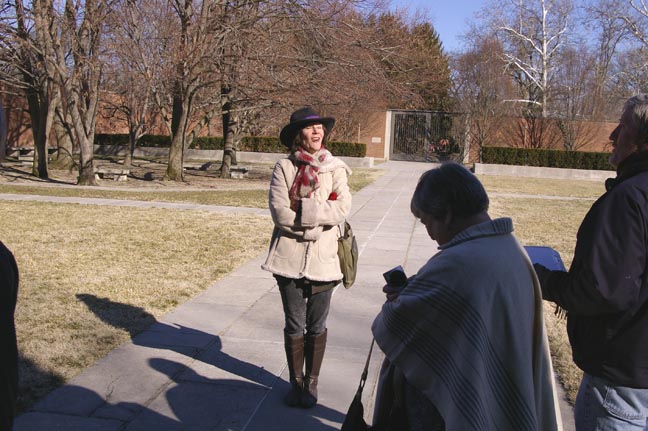
Laura Foster Nicholson talking about New Harmony

Laura of LFN Textiles

More walking, seeing a couple of Laura's friends who have shops in town, and then, of course, the highlight of seeing her studio.  Laura is an incredibly talented weaver.  Her work often refers to bees (which she has- I bought some of her delicious honey!), stones, barns, vegetable gardens and other images from nature.  I have been looking at images of her work for these two years and was shocked at how different they look in real life.  There is no sense of scale in the images and I imagined the weavings to be thick and weighty.  Instead, many of the ones I was familiar with were light and airy.  She also incorporates threads that cast a metallic sheen which I never noticed in the images.  For example, barn roofs are done in a silver thread, capturing the effect of sun hitting tin.  See Laura's member profile on TAFA to find her web links.


Laura Foster Nicholson in her weaving studio.

Brother Gregory Waldrop enjoying the insider's view of New Harmony.


Ann Fraley and John Jeffery.


Rachel Biel and Laura Foster Nicholson.

Just some cool weaving images:


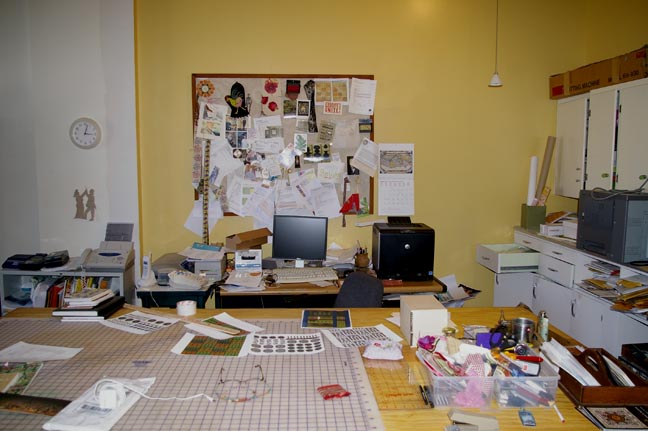
I have a lot of patience, but the idea of threading a loom is beyond the pale, in my book.  I know I would just make a huge mess of it all, like a kitten with a ball of yarn.  I was heartened, however, by Laura's design space, about as messy as my own!


I always feel kind of ashamed of all my "stuff".  Fabric, threads, beads...  drawers of them, bins stacked high, tin containers filled.  Then, when I go into another creative space like this, I see that I am all right.  It's OK.  Really.

Laura actually has two businesses: one as a working artist and another as a designer of ribbons and home accents.  Crate and Barrel has carried many of her products.  She gets to keep some of the samples, like this gorgeous curtain:


From there, we went on to her home, a traditional Harmonite structure that has been restored.  Wonderful wood everywhere, big windows, lots of natural light, a gorgeous back yard....  The only two things that I didn't like were the stairs going up to the second floor and the kitchen.  The stairs were those narrow wooden ones, which always make me feel like I am going to slip and fall (I had a bad fall on stairs when I was a teenager).  The kitchen is just tiny.  I like big ones where you can sit around and talk as the cooking happens.  But, the Harmonites were utilitarian and their buildings and furniture were made for function and longevity.  The house has a wonderful fireplace, thick insulated walls (with some horsehair and clay mixture) and will probably last another one hundred years.

I also wanted to see John's farm.  We jumped into the cars, drove the two blocks out of town, went a little bit further and there it was.  (If you read the post on Claudia, there is a video there that shows the inside of the house).  The thing I will remember about all of these places in New harmony are the windows and natural light pouring in, looking out on peaceful scenes that nourish the soul.  John's house was also like that, a place where the muse could just take over.


John Jeffery, Laura Foster Nicholson, Gregory Waldrop, Ann Fraley

Each of us had plenty of stories to share.  As I reflect back on what we saw and heard, I think that what will stick with me is this desire we have had over time to find our own utopias.  New Harmony had several visionary people who left their mark there.  Some failed, other succeeded.  But, there does not seem to be a true formula for harmonious co-existence.  We certainly have not evolved in that direction as a society!  The chaos and hatefulness we have today among both our leaders and in our citizenry just shows how impossible it seems to build a heaven on earth.  Yet, there are pockets of peace and those places are precious.  In the end, the harmony that is found within is the one that makes a safe haven.
 
I was told that there are cheap cabins there that can be rented (someday? ahhhh....).  If you need a place of retreat, I point you in that direction.  As for us, the day flew by quickly and we had to head on home.  The sky blessed us in all of its glory.  A day well spent.


Share/Bookmark

LinkWithin

Related Posts with Thumbnails