TAFA: The Textile and Fiber Art List

Showing posts with label La Chapina Huipil Crafts. Show all posts

Friday, October 24, 2008

Flying Messages to the Dead by Erin Stoy and John Barrie

Kite Flying in Guatemala Honors the Dead

Communication and contact with ancestors is an important part of life for people in communities throughout the world, who often put aside a time each year to commemorate and honor this connection. In Guatemala, as in much of Latin America, this commemoration takes place on the first and second days of November, with the first (El Día de Los Muertos or ‘Day of the Dead’) being the focal point. Among many activities that take place across the country, one of the most striking can be found in the town of Santiago Sacatepéquez, situated at a distance of 25km from Antigua.

A Gigantic Circular Kite with its Barrileteros

An amazing spectacle appears in the first days of November: Gigantic circular kites up to 15m (50 ft) in diameter, bearing designs of breathtaking intricacy and color, are exhibited by their proud creators. Other kites of up to 5m (16ft) in diameter fly high above the crowds. The giant kites are constructed over a period of three months by groups of barrileteros (kite makers), who compete on November 1st for prizes in different categories. The prizes received are modest, but the honor and respect gained by winning are great.

The practice of building giant kites in Santiago Sacatepéquez is now in its 109th year, and -- while its origins are somewhat hazy – many people there view the tradition as symbolizing the communication between this earthly realm and the elevated sphere of the dead. Another popular view is that the flapping of the kites’ tails in the air scares away evil spirits, giving good spirits the freedom to enjoy the day with their still-living relatives.

Guatemalan Kites Communicate with the Dead
and Scare Away Evil Spirits


The great majority of those involved with building and flying kites in Santiago are Kaqchiquel-speaking indigenas (indigenous people), and many traditional Mayan spiritual ceremonies take place around the creation of the kites each year. The process of creating, showing, and flying kites in Santiago has become an integral part of the identity of the indigenous people of the town, something that is rightly regarded with enormous pride. The residents of Santiago are happy to share this tradition with outsiders, both Guatemalan and from further afield, and every year on November 1st the town is filled with visitors eager to witness the spectacle for themselves. Visitors are also welcome to attend the wider range of events leading up to November 1st. The people of Santiago Sacatepéquez invite you to witness their colorful festivities first-hand!

Erin Stoy, John Barrie and Little Azucena in Guatemala

Erin Stoy, a regular contributor of Fiber Focus, owns La Chapina Huipil Crafts. She is an American whoʼs lived in Guatemala for over a year and a half, caring for the daughter she and her husband are in the process of adopting. During her time in Guatemala,she has developed a passion for Mayan textiles. She has been selling arts and crafts she makes from used huipiles (traditional, hand-woven Guatemalan blouses) since October 2007. Her blog is http://huipil-crafts.blogspot.com/ and her Etsy shop, which is stocked full of treasures, is http://www.etsy.com/shop.php?user_id=5857359. Visit her!
Share/Bookmark

Monday, September 15, 2008

La Chapina Huipil Crafts Expands Etsy Store: Guatemalan Supplies!


It's not easy to find your niche on Etsy- the competition is fierce! But, some sellers find their market and are able to grow their stores into healthy operations. I've had the pleasure of watching Erin Stoy of La Chapina Huipil Crafts do exactly that! I asked Erin to share her experience as I think she has hit on the key to making a living through online sales: balance your handmade creations with complementary supplies. Look around your environment and see what you can find that others might want!

Other key lessons to learn from Erin: clear photos, affordable prices, healthy selection (her store is stocked with over 200 items right now), and good descriptions.

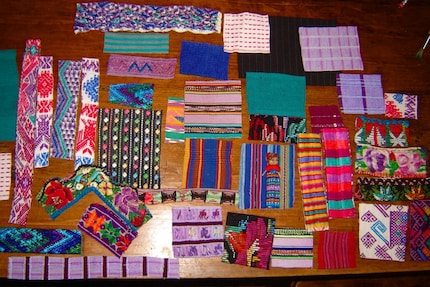
When I joined Etsy in May of this year, my plan was simply to continue selling my hand-sewn crafts made from recycled Guatemalan textiles. I'd had success doing that off-Etsy for the previous seven months, especially with my Christmas ornaments and personalized art for kids' rooms. However, with sales in my new shop starting off slowly, I began to brainstorm ways I could expand my product offerings. I noticed that the top sellers on Etsy were almost all suppliers, and that certainly made sense: Etsy is a market full of creative people wanting to buy interesting things with which they can make their own arts and crafts! So instead of trying to compete solely based on my handicrafts, I began my search in the local markets and shops here in Antigua, Guatemala, for textiles to sell as supplies. I'd already been selling bags full of my textile scraps, so this was the next logical step, and I began offering cintas (hand-woven hair ribbons) and squares of textile fabric, along with the occasional whole huipil (traditional hand-woven blouse worn by indigenous women and girls in Guatemala).


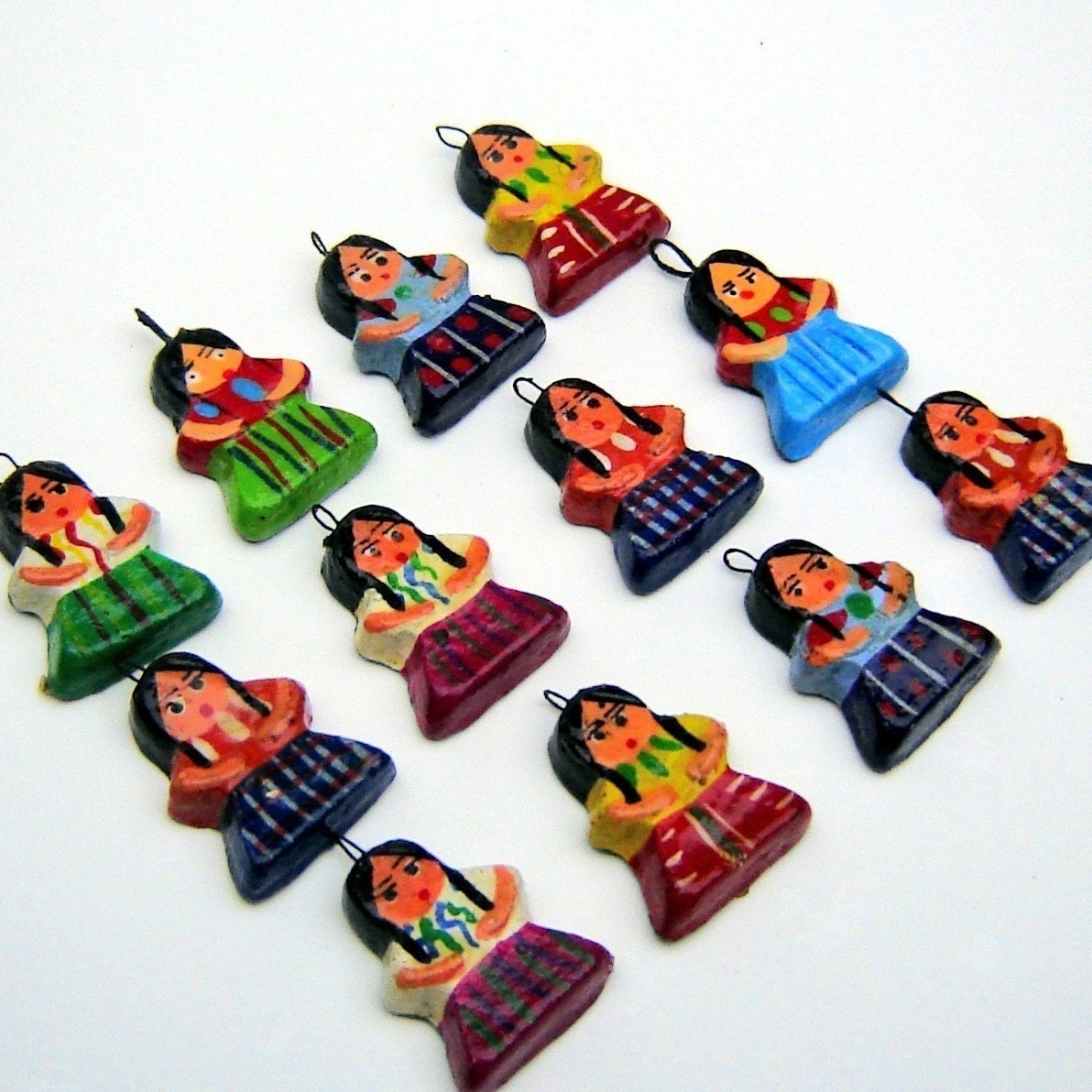
It took a change in mindset to make the move to sell something unrelated to textiles, as the name of my shop was and is "La Chapina Huipil Crafts". At first the idea of this change made me uncomfortable, as if I were abandoning my original vision, but then I came across a great little shop that sold ceramic beads made in Guatemala and Peru. I loved these little beads and charms, and I knew many of my customers would, too. Tiny Guatemalan people in traditional dress, little animals, fruits and veggies, and skulls (for Day of the Dead!) are just some of the styles of beads I now regularly stock in my shop.


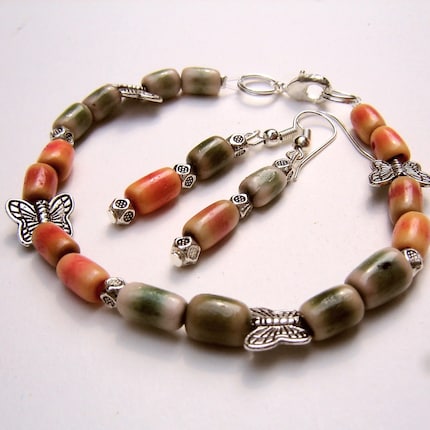
Once I started selling beads, I found myself really wanting to try my own hand at making jewelry for the shop. However, jewelry is one of the most saturated categories on Etsy, so I needed to make a niche for myself. I found a local source for beads made of tagua, which grows in the South American rainforest and is an excellent and eco-friendly alternative to ivory. Using dyed beads and slices made from tagua seeds and nuts, I've had a great time making some simple jewelry, and the fact that it is environmentally friendly fits with my previous emphasis on recycled materials.


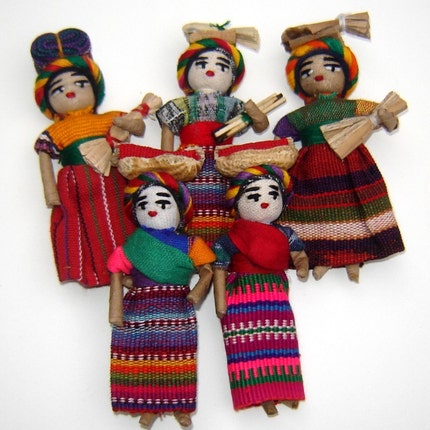
A few months into my expansion, three of my ten shop sections are dedicated to supplies. Some of my best sellers are different sizes and styles of Guatemalan worry dolls, ceramic beads, and lovely small prints -- great as scrapbooking embellishments -- by a local watercolor artist. I also carry some wood items like miniature handpainted masks and fruit.


Although huipiles are no longer the sole focus of my shop, they still have a special place among the other Latin American crafts and supplies. Offering supplies has greatly increased sales (though lowering the average selling price per item) and brought in many new customers who are not necessarily interested in the items I make myself. And perhaps most importantly, the search for new supplies is a lot of fun !


Erin Stoy of La Chapina Huipil Crafts is an American whoʼs lived in Guatemala for over a year, caring for the daughter she and her husband are in the process of adopting. During her time in Guatemala,she has developed a passion for Mayan textiles. She has been selling arts and crafts she makes from used huipiles (traditional, hand-woven Guatemalan blouses) since October 2007. Her blog is http://huipil-crafts.blogspot.com and her Etsy shop is http://lachapina.etsy.com.
Share/Bookmark

Saturday, July 12, 2008

Fiber Focus Goes Social on Ning!

I noticed that several of the bloggers and textile artists I admire were part of a social networking site called "Stitchin' Fingers".

Visit stitchin fingers


I took a look, was impressed by the work there, and thought it would be fun for my own work (which I haven't had time to do in months!). So, I joined, loaded my photos and people started commenting. It was nice to receive questions about technique and find that there was some serious interest in the things I've made.

Then, I thought about how much I love ethnic textiles and fiber work and all the social dimensions these pieces evoke for me. Morna from Bittersweet suggested another fiber art site on Ning which was also beautiful, but I decided I would like something that had more of a global focus. I searched around and didn't see anything that really grabbed me.

My muse bonked me on the head and I realized that I could start my own site on Ning that would complement the wonderful direction this blog has taken. The blog is getting good traffic and I am told that people love reading it, but few comments are left and I often feel like I am sending things out to outer space. I stayed up late and did it, finishing by sending off a bunch of invitations to fiber friends. I woke up this morning pleased to find that several had joined. And, so far, these are all wonderful artists with fire in their bellies. I'm ecstatic!

The concept, then, is that Fiber Focus, the blog features fiber-related articles. Fiber Focus on Ning personalizes this theme into a place where members can promote their work and businesses, discuss topics, share what's going on them, suggest books, films, music, and recipes that inspire them, and so on.

Several contributors are writing regularly for Fiber Focus. They come from varied backgrounds and share their insights with us in their own way. Click on their names to see each one's articles all on one page.

Catherine Salter Bayar lives with her husband Abit in Selcuk, near Ephesus, Turkey, where they own a vintage textile shop and a water pipe & wine bar. Catherine is working on a book about Turkish textiles. Her articles for Fiber Focus look at symbolism in design and at the textile trade in Turkey.

Visit them at www.bazaarbayar.com or www.bazaarbayar.etsy.com
.


Diane Gerlach, AKA the Yin-Yang Knitter, is a long-time friend of mine. She is an avid charity knitter for two organizations that support orphans in Afghanistan and soldiers in that same region. I have also benefited from her knitting and own hats, neck-warmers and fingerless gloves made by her expert hands.


Erin Stoy of La Chapina Huipil Crafts is an American whoʼs lived in Guatemala for over a year, caring for the daughter she and her husband are in the process of adopting. During her time in Guatemala,she has developed a passion for Mayan textiles. She has been selling arts and crafts she makes from used huipiles (traditional, hand-woven Guatemalan blouses) since October 2007. Her blog is http://huipil-crafts.blogspot.com and her Etsy shop is http://lachapina.etsy.com.


California quilter, Donna Hussain, has exhibited in major quilt shows around the country and authored books. Her articles on Fiber Focus explore techniques she has developed that have often been inspired by Islamic designs.


Each of these brings a fresh perspective and unique voice to Fiber Focus. Many others have also contributed articles on their work, on fair trade, on green trends, and on other topics. The common denominators are fiber and an interest in our place in the world. Fiber art and traditions are the spring board that connect us to one another. I would love to grow this platform with more regular contributors and have a dynamic platform where we can really learn from each other.

Explore the blog and the new site on Ning. Like what you see? Come on in! Add your voice and expertise. We would love to meet you!
Share/Bookmark

Monday, June 9, 2008

Yolanda: A Lifetime of Embroidery in Patzun, Guatemala

by Erin Stoy


Huipiles are the traditional, hand-woven blouses worn by women in Guatemala, and the designs vary by village. Those made in Patzun feature red or burgundy fabric with thin stripes. They are different from many other Guatemalan huipiles because the adornments are embroidered onto the fabric instead of being woven into it. Yolanda Rodriguez Yos, a 22-year-old woman from Patzun, estimates that 90% of women in her hometown wear traje (traditional Mayan dress). The remaining women work in the capital and wear ropa americana (American clothing) much of the time.

Yolanda's mother taught her second eldest daughter to embroider when she was 12 years old. This is a common age for girls to learn, although daughters of wealthier families may not learn until they are 15 or 20 years old. These wealthier girls do not need to embroider to help the family earn money.

The women of Yolanda's family, however, embroidered huipiles to sell at the Sunday market in Patzun. Yolanda believes that about 85% of women in Patzun know how to embroider. For families like hers, it is too expensive to purchase completed huipiles, so they purchase fabric from local weavers and create and embroider the huipiles themselves. The Rodriguez Yos family purchases its fabric from an aunt, who weaves but does not embroider.

As a young teenager, Yolanda would go to school until noon, come home and eat lunch, then work on embroidery from 1:00-6:00pm. After a break for dinner, she would embroider again from 7:00pm-midnight. Her mother would have one huipil made by Yolanda; one by her older sister, Erika; and one by herself to take to the market each Sunday. The exchange rate is currently 7.38 quetzales per dollar. Each huipil would sell for about 175Q, 110Q of which was materials (70Q for woven fabric and 45 for thread). That left a whopping 65Q (less than US$9) for 70 hours of work! And most of that money had to be re-invested in fabric and thread for the next huipil.


Yolanda's sister, Erica, began embroidering at age eight and never liked it. Yolanda laughs that Erica's huipiles would feature about four flowers, whereas the average one has about 20. Yolanda and her mother frequently had to finish Erika's huipiles to get them ready to sell. Yolanda enjoyed using her imagination to design flowers and choose colors, which remain her favorite aspects of embroidery. (Sewing the randa, or piece that joins the two pieces of woven fabric, is the part she likes the least.)

"Randa", embroidery covering the seam between two pieces of fabric.

For Christmas, each girl would receive fabric and thread in order to make a huipil for herself.

Yolanda is particularly efficient in her embroidery, in that it takes her one week to do what it takes many women two to four weeks to do. Instead of layering two colors on top of each other, making the embroidery very thick, she interconnects the different colors, making only one layer of thread. This saves not only time, but also money spent on thread. And she prefers the finished look to that of the thicker embroidery.

The basic steps for creating a huipil from Patzun, if one is starting with cloth already made:

1. Sew two panels of fabric together. This embroidery can be done in patterns of triangles, jugs, straight lines, or knots in the form of flowers.

2. Choose the shape of the collar opening shape: round, square, diamond, or star.

3. Divide the fabric into visual quadrants. With pen,draw flowers, leaves, and buds. (Some women, like Yolanda, prefer to draw and then embroider one quadrant at a time.) Be very careful when drawing the circle around the collar to make sure you're not going lopsided. The design should be the same in all four quadrants, but the colors can be different on the front and back. This is the step in which the embroiderer can use the most creativity and imagination, selecting a combinations of colors and designing the flowers. Keep in mind the question of purpose: Is the huipil for a wedding or fiesta or for everyday use? This will help determine the formality of the design.

4. Design sleeve adornments, if they will be used. Some people prefer large flowers here, some small, some none at all. Yolanda's mother is of the belief that there should be very little adornment on the sleeves, if any. Large flowers are too extravagant, the equivalent of wearing too much jewelry or makeup.

5. Complete embroidery.

6. Sew sides of huipil.

Yolanda has made about 200 huipiles in her life (10 are ones she wears even today) but hasn't done much embroidery in the last three years. Between her social work studies at a local university, her English classes, and her job as a housekeeper, she hasn't had any extra time for sewing. However, she would like to do more in the future, and plans to teach her future daughters because it's a valuable skill for Guatemalan women to have.


Erin Stoy of La Chapina Huipil Crafts is an American whoʼs lived in Guatemala for over a year, caring for the daughter she and her husband are in the process of adopting. During her time in Guatemala,she has developed a passion for Mayan textiles; she has been selling arts and crafts she makes from used huipiles (traditional, hand-woven Guatemalan blouses) since October 2007. Her blog is http://huipil-crafts.blogspot.com and her Etsy shop is http://lachapina.etsy.com.

This photo of Erin with her daughter, Azucena, was taken in November, 2007.

Share/Bookmark

Wednesday, May 28, 2008

Guest Artist: Erin Stoy of La Chapina Huipil Crafts

Used huipil Erin purchased in Santiago Atitlan's market.

Erin Stoy
is an American who’s lived in Guatemala for over a year, caring for the daughter she and her husband are in the process of adopting. The case has been frought with difficulties, making their stay an unusually long one. Despite the financial and emotional stress of the situation, Erin is grateful that – as Azucena’s legal foster mother in Guatemala – she and her husband have had the opportunity to have their little girl with them since the age of eight months. Another positive thing to come from the experience has been Erin’s new passion for Guatemalan textiles; she has been selling arts and crafts she makes from used huipiles (traditional, hand-woven Guatemalan blouses) since October 2007.

Erin with Azucena in Nov '07.

In August of 2007, a local orphanage was raided here in Guatemala, and political tensions surrounding international adoption were running very high. Agencies began suggesting that fostering parents, like us, stay inside with our kids until things calmed down. Rumors abounded that the police were going to question any gringos they saw with Guatemalan children. So for close to two months, I only left the apartment with our daughter, Azucena, a handful of times.

Market in Santiago Atitlan

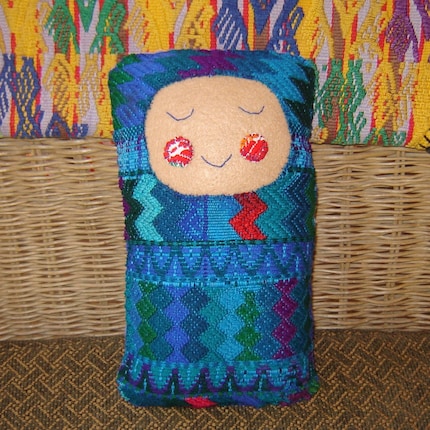
As one would imagine, being confined to apartment grounds with a toddler for that long was challenging. Eager for something to do while Azucena napped or played on her own, I started looking at craft blogs for inspiration. I hand-sewed about 20 stuffed animals and little dolls out of Azucena’s outgrown baby clothes and, later, felt. It was a fun diversion from the stressful reality of our situation.

Baby Doll

I had long thought something really pretty could be made from the embroidered collars of huipiles. Once I got the sewing bug, I started visiting a shop here in Antigua that frequently had used collars and other huipil scraps for sale. The first things I made were some pillows that featured collars from Chichicastenango; I embroidered Spanish words like “esperanza” (hope) and “amistad” (friendship) within the circle formed by the collar.

One of the pillows Erin made from a huipil collar from Chichi.

For my next project, I purchased several small of bags of huipil scraps in order to make Christmas ornaments for some family members back home. Afterwards, I posted photos of the ornaments on my personal blog, and the next thing I knew, I had people leaving comments saying they wanted to buy sets for their own families. An online friend who was coming to Guatemala kindly offered to transport any items I sold back to the US for shipping through the USPS. I accepted and was thrilled to have the opportunity to earn some money to help with the many expenses we were incurring by having to maintain households in both the US and Guatemala. Largely through word of mouth throughout the online adoption world, I ended up selling about $2500 worth of Christmas ornaments over the next couple months.

Christmas ornaments.

After Christmas, I began making new items from the huipil fabric, including animals, simple baby dolls, fabric magnets inspired by Semana Santa street carpets, and personalized art for children’s rooms. Lately I’ve been doing more collages. This spring, I moved the craft items from my personal blog to a separate crafts blog and opened a shop on Etsy. I hope to continue making and selling arts and crafts from these beautiful used Guatemalan textiles; they are too lovely not to be re-purposed and enjoyed. Maybe I’ll even get a sewing machine when I get back to the States!

Christmas ornaments.

Erin’s work as can be seen on huipil-crafts.blogspot.com and lachapina.etsy.com.
Share/Bookmark

LinkWithin

Related Posts with Thumbnails