TAFA: The Textile and Fiber Art List

Showing posts with label Bamboo. Show all posts

Tuesday, August 12, 2008

"Baa, baa, Etsy... Have you any wool?"

Sheep with Backup Singers, 10x10 matted fine art print
"Yes, Sir! Yes, Sir! Three bags full!" Actually, Etsy wool suppliers have bags and bags of wonderful eye-candy, wool spun in all color palettes, textures, and blends catering to the knitter, felter, weaver, and wild fiber artist. For those of us living in the Northern Hemisphere, August reminds us that the warmth of Summer is coming to an end. We had sweltering summer days last week here in Kentucky with temperatures over 100 degrees. Today has been on the chilly side, reminding me of my stash of wool accessories made by my friend, Diane the Yin Yang Knitter. Soon it will be time to get out her fingerless gloves, hats, and neck warmers.

I am not a knitter, weaver, or spinner. But, I do come from farm stock and long for connections that bring me close to the earth. Last year at around Christmas time, I read a post on Etsy's forum that moved me almost to tears. I don't remember the member's name, but there was a wool supplier thanking everyone for their support. Etsy purchases of their wool had helped them save their farm. How often do we really think about the impact our purchases really have on the lives of the suppliers? Yes, the wool on Etsy is going to be more expensive than the finds you can get on eBay, but if objects did have spirits, you can bet that Etsy wool is happy wool.

There are scores of suppliers on Etsy, but I just picked a few examples to wet your whistle. I happen to migrate towards texture and color. You cannot ask for more texture than Yarnzombie's, also known as Gaslight Dyeworks, offerings:

ABALONE Handspun Supercoiled Yarn - 7.15 ounces
'Abalone' was spun from hand dyed combed roving
that includes wool, mohair, soy silk, and nylon sparkle.


Yarn Zombie's blog will dazzle you with more textured visuals, excellent narratives and stories told by this Ohio artist.

I found that many of these yarn people have a great sense of humor. Muriel of Willow Acre Fibers warns you not to eat her chocolate-covered cherry roving, unless you are a sheep!

CHOCOLATE-COVERED CHERRIES Handpainted Fine Merino Roving, 4.125 This roving, or combed top, will felt nicely and it's excellent for spinning. It's very fine 21 micron merino and spins like a dream.

She states in her profile: "I usually set up shop out under my huge willow tree, with some music, tables, roving, dyes, and my 1950's retro Nesco! Spinning under the willow is a little piece of surreal heaven as well. I hope all those lovely days somehow infuse into the fiber that wings its way to you!" Talk about happy yarn! Sounds like a dream to me...

Lisa Weisman of Sexy Sheep moved to North Carolina from New York. She's another one who chuckles as she names her wool. She likes to shred ugly sweaters and make gorgeous, chunky wool like this steel grey wad of glory:

Eno River: recycled sweater, marino, yak down, wensleydale sheep locks 104 yards/4.6 ounces, worsted to bulky weight

Lisa writes about her shredding compulsions, of life in North Carolina and shows some of her knitting in her Re-yarn blog. She has a wonderful writing style. Of a hat and booties she made for a friend's baby, she stated, "Knitting this made my ovaries hurt."

A couple of youngsters from Heidelberg, Germany call themselves Weird and Twisted. They spin, knit and crochet because they can't keep their hands still. Has any research ever been done on how crafting keeps people out of jail? Or, maybe from doing hard drugs? They share a blog in which they seem to be perfectly normal. And, look a sample of their weird and twisted beauty!

This lustrous Art Yarn has been hand spun from hand-dyed, poisonous green and yellow merino/silk blend and then plied with a metallic thread. There are lots of tiny green glass beads and many, many coils.

We are so fortunate to live in time when fiber materials have become so innovative and interesting. The above spinners have used alpaca, sheep's wool, silk and other materials to create their gorgeous textures. Now, bamboo has become a resource increasingly available in many forms to fiber artists. As a quilter, I am excited about the bamboo batting that is hitting the market. Traditions Fiber Arts of Linden, Texas has a nice selection of bamboo yarn and roving. They also carry spinning wheels and other accessories. Judy left her newspaper editor job to pursue a passion for all things fiber.

Y0139 hand dyed Hand spun Bamboo Yarn Silver Fern and Lemon Drops

Farmhouse Weavers has a set up similar to the post I mentioned where Etsy sales saved the farm. They have their own sheep and sell raw fleece, spun yarns and finished woven products.

Working the land and animal husbandry are labor intensive occupations with little social recognition. We've lost many of the mentors that would have been around a hundred years ago who knew the tricks of the trade. I think it is interesting how many of these sellers started out with a hobby like knitting or crocheting, got interested in the source, and worked backwards until they finally landed on a plot of land with feet firmly planted where many had walked so long ago. It takes guts and it also takes a supportive community of buyers to keep them in business.

We started with a sheep and ended with another, but I must say a bit more about the opening photo. Nature Mandela's photos caught my eye when I first started selling on Etsy. I have coveted those singing sheep for a long time now and someday hope to own a copy for myself. Allison Trentelman also makes stunning mandalas out of photoshopped nature images. All of these artists contribute towards careful preservation of our land, our heritage, our creativity and our relationship towards the animals and people around us. Visit their shops, support them with your purchases, and spread the word. (While you're at it, come visit my shop, too... heh, heh)


"Mandalas are a beautiful way to bring harmony to a room and the beauty of nature indoors. All of my mandala prints are created from digital photographs of the Maine natural landscape, and manipulated in Photoshop into the mandala shape. I have created over one thousand mandalas over the last several years. Each mandala is constructed with perfect geometry and presented with high quality archival materials." -Allison Trentelman

Share/Bookmark

Monday, June 2, 2008

Eco Housing: Baskets So Big You Can Live In Them!

Have you ever seen a basket so beautiful that you wish you could blow it up to a much bigger size, magnify it, step into it and live in it? Well, there are traditional dwellings around the world that have lived out this concept, using the natural fiber materials found in their environment to build simple to elaborate living structures. Bamboo, wood, straw, banana leaf, grasses and many other renewable materials take the basic concept in assembling a basket to that larger dimension.

In 1973, a book called Shelter was one of the first to document dwellings from around the world in one place. It is still available through Shelter Publications, which has since published a couple of other publications on the same theme. The book has over 1,000 images of yurts, huts, tents, domes, tree houses and other dwellings in their traditional environment or inspired by native cultures. The book inspired me to get others like it and to think of living spaces in a new way.

Urban and suburban sprawl in the United States have been swirling out of control for the last fifteen years. McMansions behind bars in gated communities promise isolation from crime, other undesirable outside influences, manicured lawns, uniformity, and above all, distance from nature.

Where would you rather live? Here?

A gated community in Ontario, Canada.

Or, here?

A Toraja House in Indonesia

Now there is a huge housing crisis with millions facing foreclosure, displacement, and financial ruin. The increasing cost of oil has also put a stopper into the car culture, the desire for the biggest monster on wheels possible. How many of us really need a hummer? Without downplaying the real pain many families are facing in the loss of their homes, jobs, and access to transportation, this crisis is helping give green construction and transportation businesses the boost they needed to enter mainstream markets.

Several years ago I knew I was fed up with life in Chicago. I longed to be closer to nature, my business was not doing well (retail store selling handicrafts), the cost of living was enormous, and I just wanted out. I started thinking about maybe having a bed and breakfast somewhere with a cultural theme. I knew I wanted to be somewhere in the SouthEast and started researching bed and breakfasts in that area. Everything was Victorian or cute country. Then I found some green businesses, mostly in Florida. New Mexico, California and other Western states had a ton of wonderful spas and green hospitality places with interesting architecture and commitments towards sustainability and low impact living. Sigh... All these wonderful experiments going on all over the country... but, they all need capital and acceptability from the public.

One day, I sat back and had this wonderful vision of a place I would love to be a part of. I saw this villa unfold in front of me, full of the craftsmanship I so love, people from all over the world, a place of teaching and of recovery from the city. I wrote it down, researched it, and called it the Peace Villa. I didn't pursue it, but kept it up on my website, just in case someday it would come off the shelf.

Since that time, similar ideas have been pursued by others, both in terms of personal housing and for recreational purposes. Simon Dale built a house in Wales for his family, what I consider the ultimate dream of living in a big basket.

Simon gave me permission to use his photos and text from his website, so I have a bit below.

"It was built by myself and my father in law with help from passers by and visiting friends. 4 months after starting we were moved in and cosy. I estimate 1000-1500 man hours and £3000 put in to this point. Not really so much in house buying terms (roughly £60/sq m excluding labour).

The house was built with maximum regard for the environment and by reciprocation gives us a unique opportunity to live close to nature. Being your own (have a go) architect is a lot of fun and allows you to create and enjoy something which is part of yourself and the land rather than, at worst, a mass produced box designed for maximum profit and convenience of the construction industry. Building from natural materials does away with producers profits and the cocktail of carcinogenic poisons that fill most modern buildings."

The house is much lighter and bigger on the inside than I expected:


Simon has many more photos and instructions for how to build a similar structure on his site. But, see! Isn't it just a big basket?

This is not a new idea. Variations on this can be found all over the world from time immemorial. Here is a photo, now on public domain, of a wooden yurt from Russia:

Mongul Travel sells gorgeous fabric yurts for under $4,000:


Isn't this just gorgeous? So, here you can live in a basket, covered with your favorite textile! And, look at how bright and sunny the inside is:

Many may think that living in a traditional dwelling like the ones I'm showing here, means living in discomfort, without bathrooms or other amenities, but there are many green construction businesses out there that are adapting these traditional building methods to modern needs or expectations. Bamboo is a wonderful renewable material that has lately been used in many new ways. We now have bamboo fibers that knitters, weavers and quilters can use in their work, and the construction business generates gorgeous flooring and pre-fabbed panels that offer both a durable and healthy option to the often poisonous mainstream materials. Here's a nice little video showing the construction of a bamboo house using pre-fabbed panels:


Your basket house does not have to be rustic and ethnic looking. You know the slick lacquerware found in Thailand and VietNam? Here's an example from Green Tulip Ethical Gifts:

Those who like a sleek, modern look can have it, too! Building Green has a bamboo model house designed by Danish architect, Soren Korsgaard:

If you can't or don't want to build your own basket house, consider staying in one for your next vacation. Many of the sites mentioned in this article have good links that can give you more information on other projects or resources. Again in Wales, Cae Mabon, offers such a retreat with wonderful structures like this one throughout the resort:


Heifer International
, a wonderful food aid program based here in the United States, works worldwide to alleviate hunger. They have several learning programs for adults and teen-agers and are soon opening the Hidden Villa in California:

"The ten acre campus will be located at Hidden Villa, a nonprofit environmental education center in Los Altos Hills, California (18 miles west of San Jose). Since 1945, Hidden Villa has provided learning opportunities to inspire a sustainable future."

Not only are these basket houses interesting architecturally, but they also step lightly on the earth and save resources. If built correctly, they can help us save energy, reduce our dependency on oil, and decrease the use of toxic materials. My friend, Tom Spaulding, of Angelic Organics Learning Center, recently built a new building which houses their offices and training workshops. They used straw bale building methods with naturally harvested woods for supports, creating a gorgeous structure. This is in Beloit, Wisconsin where winters are miserable and long. The building was so warm, they often wore shorts during the winter! Imagine! No heating bills in the bitter MidWest!

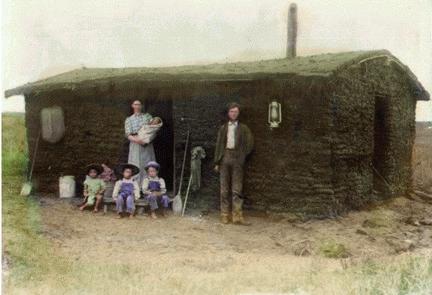
The challenge and delight for all of us is to use these ancient ideas that have worked for our ancestors and apply them in big or small ways to our immediate environment. It's not always easy as city ordinances and neighbors may balk at what looks different from what they are used to. It takes education and successful examples to make inroads into entrenched ideas of what is acceptable for our neighborhoods and communities. But, we are not talking about the sod houses of yesteryear. Instead, we have beautiful, solid structural options today that can use these fibers to the full capacity of our imagination and technology. Take it to the next level!

Sod House in Nebraska

Share/Bookmark

Thursday, May 29, 2008

Lowertown Art & Music Festival in Paducah

Memorial Day Weekend means that it's festival time in Lowertown, here in Paducah. Lowertown is a neighborhood adjacent to Paducah's historic downtown which benefited from a City initiative which designated it as a gallery district. Paducah's Artist Relocation Program has attracted artists from around the country, bringing in needed cultural and financial capital. Once a neighborhood falling into disrepair, Lowertown now attracts new residents and tourists who enjoy the restored historical homes and galleries, along with a wonderful sense of community.

The Lowertown Art & Music Festival is a chance to celebrate local talent as well as those of vendors and musicians participating from places far and near.

I worked at HeART of Healing Gallery, one of the Lowertown galleries, and had a chance to run around and see if I could find any fiber people. (See tomorrow's post for more info on HeART of Healing.) For some reason, every year during the festival, we get Paducah's worst, hot and steamy weather. Of course it rained the day after the festival was over and now it's gorgeous, crisp and beautiful. Despite the conditions, people seemed to really enjoy themselves. I watched a belly dance presentation for a bit, then went on to find the fiber folks. I found three who were all excellent.

Teresa Hays does some of the best marbling on silk that I have ever seen. It's not a technique that I am normally drawn to, unless it's executed with talent. Well, Teresa has mastered marbling. Her wonderful color palette swirls and feathers, complementing her excellent choice of designs in silk garments, scarves, purses and men's ties. Teresa lives in Franklin, Tn.


Mary Waite came all the way up from Florida and was happy to get away from the humidity down there (!!!!). She was probably one of the few who was actually enjoying the weather.

Mary weaves and her booth was displayed with gorgeous ikats, scarves and natural textures. A hard sell on a hot, humid day, but I did have a customer at HeART of Healing who was a weaver and just had to buy one of her shawls because she knew how much work went into it!


Finally, a booth with musical instruments caught my eye. When I told Chad Scott I wanted to post his work on a fiber blog, he seemed a bit surprised. Well, maybe 3-d bamboo pieces are not normally included in the fiber category, but I love it and for the purposes of this blog, bamboo will always have a welcomed place.

Drumzrguruven (he uses umlas , but I don't know how to add symbols through blogger), has a great website with more info on their drums, didgeridoos, and rainsticks. Make sure to read Chad's artist statement!

The instruments show excellent craftsmanship and design.


I had to run on back to my job, but was happy to see these and other artists making Lowertown come to life. Of course I bumped into a couple of friends:

Monica Bilak, actually did most of the organizing of the festival. Can you tell she didn't want a photo taken? "Come on, Monica! Give me that smile..."

She did it, but if you look closely, she's throwing daggers at me through her eyes. Monica was one of my first friends in Paducah. She and her husband, Paul, lived in Kenya for a few years and when they came to Paducah, Monica opened a retail store in Lowertown called Global Nomad. (My kind of store!) She also bought a lot of the things I made, just to be supportive... Since then, she decided that retail was not for her and they changed the store into a guest house called "The Mary Jane Inn". Monica and Paul also are actively involved in an important project they helped start in Kenya, Project Aids Orphan, which helps children who have been orphaned because of Aids.

Then, I saw Merle, sitting in his recycling booth:

Merle and his wife, Deb, are also Chicago transplants. Deb is also a member of Paducah Fiber Artists, and Merle works for the City as an inspector. Merle has been extremely helpful to me in my housing search, but more importantly, he is mobilizing the city into a rapidly growing recycling movement.

So, that was my little time at the festival. Paducah is a wonderful place to live. If you are an artist looking to relocate, there are still properties available in Lowertown. While most of the country is suffering a housing crisis, Paducah is experiencing revitalization with increasing property values. There are plenty of nice houses with big yards around the city for under $100K and for those of us who are struggling artists, there are also fixer uppers available from 10K on up. If you don't want to move here, but are driving nearby, know that the turn off is worth the exploration. There are plenty of treasures to discover here in Paducah!


Share/Bookmark

LinkWithin

Related Posts with Thumbnails