TAFA: The Textile and Fiber Art List

Showing posts with label Printing. Show all posts

Thursday, January 22, 2009

10% Off on New Rayela Art Textile Stamps

Floral Centerpiece, Rayela Art Textile Stamp

Every few months I get a new bag of textile stamps. It's quite the endeavor to get them sorted, cleaned, priced, and photographed. I don't do any deep cleaning, but they all get brushed with a wire brush. When they are ready, I load them on my website and offer them at a 10% discount on this blog and to my regular customers. There is usually a big rush and when it dies off, I start listing them in my Etsy and eBay stores. The advantage for me in doing this is that I save time and listing fees while customers get to enjoy "first dibs". There is one disadvantage for customers in that I don't list the dimensions- you just have to kind of guess by the price.

I also offer free shipping on orders over $100 to US addresses or $20 off of shipping to those overseas. The stamps on my website can be combined with anything listed in my Etsy or eBay stores to reach that $100.

Beautiful Art Deco Rayela Art Textile Stamp

I've written several posts on this blog about the stamps. Follow this link to read about the history and care of these wonderful carvings. Most of my customers are artists who use the stamps to print on fabric or paper with ink or batik wax and to make impressions into clay. But, the stamps are also beautiful as decorative pieces and can be hung, set into plate stands, or just laid around on shelves.

Floral Arch, Carved Wooden Textile Stamp

There are several kinds of stamps: borders, center pieces, arches, and fillers. Borders can be linked one to another to frame a piece. Center pieces stand alone as a focus point. Arches can be used to frame a smaller piece or ornament and fillers are often dots or lines that have repetitive designs. These stamps come from Afghanistan and the region (Pakistan and India) and are considered as seconds to the artisans there. As vintage pieces, they have been used and often have nicks, cracks and wax and dye residue. These flaws actually have value to those of us who like to reclaim what has already seen a life of use.
Floral Focal Point, Textile Stamp from Afghanistan

As these stamps come from Muslim workshops, rarely will you find an animal or human figure portrayed. For those, seek out Hindu stamps. Islam discourages depicting these images as a way to prevent idolatry.
If you are interested in taking advantage of this 10% offer, just go on over to my website. The instructions there should be pretty clear. As I get these stamps in a big bag, sight unseen, I never know what the mix will be. I was very pleased with this batch. There is an excellent variety of designs and most are in the mid-size range that people really seem to like. Prices are mostly in the $10-$15 range, per piece.

Do you work with these pieces? Leave a link in the comments section so we can all be inspired by these wonderful stamps!

Share/Bookmark

Tuesday, November 18, 2008

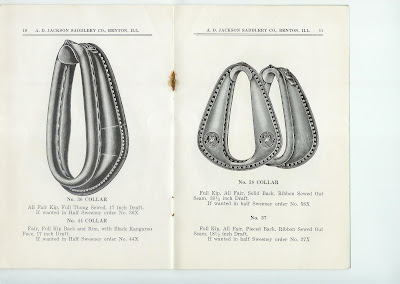
Help Needed Identifying Horse Tack on Vintage Printing Blocks


I recently acquired a bunch of printing blocks from a local Paducah resident. They are from a harness business that closed in the 1950's. Although I now live in Kentucky horse country, I have no clue as to the particulars of horse business.... The blocks were used to produce catalogs similar to the one pictured above. I was able to find information online on one of the suppliers, A.D. Jackson Saddlery, as the block, very similar to the horse collar in the above catalog has a stamp with that name on it. Fred B. McAfoos & Co. has a nice historical page which describes how the family business evolved. Today, they sell lawnmowers and outdoor power tools.

Fred B. McAfoos of Benton, IL in his harness shop

Fred B McAfoos opened his business in Benton sometime around 1918. Previously he had worked with his father and brother Ollie in a retail lumber business in Whittington Il. It is said that most of the lumber that originally built Sesser Il came from the Whittington yard. In 1918 a spark from a passing locomotive started a fire that completely destroyed the lumber yard, after that, Fred moved his family to Benton and started a new venture.

The new business was located on East Church near the C & EI railroad office and sold feed and farm stead equipment. In his first year of operation Fred sold 50 Delker Brother’s buggies, the next year he only sold 2. It was the end of an era and the beginning of the mechanization of agriculture. Feed, flour, and cream separators were the main commodities sold, much of which was delivered by horse drawn wagons. In the 30’s Fred added a harness shop, and in the 40’s moved just east of the old Webster JR High School in Benton. The harness shop finally closed in the 50’s but the feed and equipment business remained in the same location until 1968.


I listed the blocks I could identify on Etsy, but am stumped on several others. I love old things in general, but I find these blocks especially interesting and would like to get more of them if I can move the ones I got. Etsy's search system is made up of tags that describe the item, so it's important that I use the right words to describe these blocks. I imagine they will be of special interest to anyone who loves horses, Western and Southern history, and printing techniques. The blocks are still in decent shape and can be used on both paper and fabric using a brayer and inks. Maybe someday I'll have the time to play with them and see what happens.

Meanwhile, if you know what the correct names for the items below, it would be a great help to me. Leave a description in the comment section referring to the item by number. The more specific the description, the better. We have 14 keywords to use per item on Etsy, so if a horse harness has a certain function, then it would be good to know that. In my ignorance, I imagine there are items that might be for show while others for work and that there are distinctions by type as in English and Western saddles.

1

2

3


4


5

6

7


8
I also sell textile stamps from Central Asia, so if you are a printer, make sure to take a look at my selection. They are vintage but functional and a favorite among artists working with fabric, batik, clay, and paper.

Share/Bookmark

Thursday, July 10, 2008

Women of Tilonia and The Barefoot College

My friend Pam sent me this video entitled "Women of Tilonia":


She knows how much I love ralli quilts and the video shows two women preparing a quilt top for appliqué.


"Wish I could sit like that..." I thought, as I watched the video. Then, I realized I had no idea where Tilonia was. Tilonia? Well, I googled and followed links and was amazed to read on about this place in Rajasthan, India, which hosts the novel concept of a Barefoot College.


This is how they describe themselves:

"The Barefoot College is a place of learning and unlearning. It's a place where the teacher is the learner and the learner is the teacher. It's a place where NO degrees and certificates are given because in development there are no experts-only resource persons. It's a place where people are encouraged to make mistakes so that they can learn humility, curiosity, the courage to take risks, to innovate, to improvise and to constantly experiment. It's a place where all are treated as equals and there is no hierarchy.

So long as the process leads to the good and welfare of all; so long as problems of discrimination, injustice, exploitation and inequalities are addressed directly or indirectly; so long as the poor, the deprived and the dispossessed feel its a place they can talk, be heard with dignity and respect, be trained and be given the tools and the skills to improve their own lives the immediate relevance of the Barefoot College to the global poor will always be there."

The college has a focus on handicrafts with workshops in embroidery, sewing, block printing, furniture making, and other traditional crafts.


These are natural extensions of Rajasthan's rich history in all of these crafts. Friends of Tilonia was established to help market the handicrafts:
"Friends of Tilonia, Inc. is a US-based, 501(c)3 non-profit organization established to provide marketing and business development assistance to the crafts section of the Barefoot College, in Tilonia, Rajasthan, India. For more than 35 years, the Barefoot College has been working to address basic needs of the rural poor: water, health, education, energy and employment, while enrolling individuals in the processes that govern their lives.
In 1975, the lack of employment in the villages in Rajasthan forced many of the rural poor to migrate to the cities. While largely an agricultural area, many of the poor in the region were artisans engaged in various crafts. Lacking access to a broader market, these rural artisans abandoned, and still continue today to abandon their trades to seek other, more gainful means of livelihood.
The Barefoot College began promoting rural craft production to address this problem of under-employment. Assistance in improving designs and techniques, creation of marketing outlets, and access to credit have helped to restore and create new income opportunities for craftsmen and women. Training and materials provided by the College also enables women to work from home, helping them to generate income from their needlework or other handicrafts."
Their beautiful website showcases the products made by these artisans as well as photos of the producers, such as the ones I have used in this post. But, the college goes way beyond these efforts and its geographical location. They are tackling issues of malnutrition, illiteracy, health, solar power and many other fundamentals of survival most rural poor face around the world.

Then, I watched this video:

The First Women Barefoot Solar Engineers Of The World

I was absolutely floored! They are bringing rural, illiterate, middle aged women from around the world to live in Tilonia for six months to become solar engineers! As they do not share a common language, all the training is done through drawings and color coding. You have to watch the video to really understand the amazing strategy and potential impact this program has on the participants and the villages they represent.

When I was in college, I learned about Paulo Freire, a Brazilian educator who revolutionized the concept of learning, especially when working with literacy and the poor. Wikipedia states:
"More challenging is Freire's strong aversion to the teacher-student dichotomy. This dichotomy is admitted in Rousseau and constrained in Dewey, but Freire comes close to insisting that it should be completely abolished. This is hard to imagine in absolute terms, since there must be some enactment of the teacher-student relationship in the parent-child relationship, but what Freire suggests is that a deep reciprocity be inserted into our notions of teacher and student. Freire wants us to think in terms of teacher-student and student-teacher - that is, a teacher who learns and a learner who teaches - as the basic roles of classroom participation."

The Barefoot College is Freire's dream come true! What a wonderful model this place is for all who are interested in empowering the disenfranchised. When I see programs like this, my hope for the future is renewed. If you are looking for an organization to support, I would say that any support given here is money well spent.
Share/Bookmark

Tuesday, April 8, 2008

Guest Artist: Barry Singer of Fish Fanatic

Pennsylvania artist Barry Singer contacted me through my Etsy store, asking a question about my molas. I took a look at his store and was intrigued by his fish. I had not heard of Gyotaku before and really liked what I saw. The translucent result of imprinting the fish makes the image almost seem like an x-ray.

Barry was kind enough to submit an article for Fiber Focus, explaining the technique. He uses fabric paints or acrylics when printing on fabric, and both are permanent when heat set. I can see a fish quilt in the making! Barry is also an accomplished painter, showing off more of his fish in brilliant oils and watercolor. Visit his Etsy store for a whole range of fish products on fabric and paper. His website has a more extensive step-by-step illustrated guide on how to master the Gyotaku technique.


GYOTAKU on Fabric

GYOTAKU with its origins in Japan, is the process of rubbing the image of a real fish onto paper or fabric. Fabric is actually the easier of the two.

Can anyone do it? Of course, just like anyone can draw or paint. Some folks are better at it and everyone has their own style. I recently did a GYOTAKU class at the state park and 25 people attended. Ages ranged from 10 years to retired and everyone had a blast. The results were amazing. Some people just made fish-shaped blobs while others looked quite professional. One teen aged girl knocked out a dozen beauties, signed them all and proclaimed “I’ve got gifts for all my friends!”


"Barry Singer is an old man who truly enjoys life.
He has worked as an artist, teacher, and a printer." (Barry Singer)

Here’s a quick how-to:

  • First you will need a fish. There are over 30,000 species in the world, so take your pick.
  • Next rinse it off thoroughly with salt or mild detergent.
  • You may want to prop up the fins with blocks of wood or the like.
  • Use some fabric paint available at the craft store to paint the fish everywhere except the eye.

  • Choose a tight knit fabric, dark fabric for light paint and light fabric for dark paint.
  • Memorize the anatomy of the fish; because once you lay the cloth on top, you’ll be like a blind man touching all of the parts. If you miss an area, well, the image won’t transfer.
  • Carefully peel back the fabric and reveal a mirror image.

  • Now you must use a fine brush to paint the eye. Study the actual eye because if you don’t do it correctly, it just won’t look right.

  • Finally you can set the image with a hot iron using no steam.

For more details and step by step pictures, visit my web site www.gyotakuartist.com

Or buy an actual original from www.fishfanatic.etsy.com

Barry Singer paints in the eye of a striped bass made on black fabric.
The small GYOTAKU in the background are also made on cloth.

Share/Bookmark

Saturday, April 5, 2008

Those Versatile Textile Stamps


Rubber stamping and scrapbooking have become big business within the US craft industry. Fancy papers, inks, embossing supplies, and rubber and foam stamps command high prices. One can easily walk into a craft store for a couple of items and shell out a $100 bill, a far cry from the carved potato stamp days many of us played with as kids. The technique of stamping images on to a surface has been around for centuries all over the world, ranging from simple forms to highly stylized, multi-layered images that take a lifetime to perfect.


I carry wooden stamps from Afghanistan, Pakistan and the region in both my eBay and Etsy stores. Carved out of hard pear wood, they are considered seconds to the artisans who used them, but have continued use to us as artists, both in functionality and as ornaments or decorative objects.

Textile stamps have many uses. My customers buy them to imprint on fabric, paper, and clay. I even had an Italian customer buy several to use to apply henna on skin. I am also a henna artist and have not tried that yet. The paste I use is thick and it seems to me like it would blur when stamped, but she sent some photos and apparently it works. More conventional uses involve using either inks or wax to apply the design on fabric or paper.


When working with ink, thicker pasty mixes work best. It can be applied to the surface with a brayer or lightly dipped. Use a thick pad of newspaper or batting under the paper or fabric and press down firmly. Those felted table pads are excellent. Wax options for batik include paraffin mixed with beeswax, soy wax, and potato or rice starch. One of my customers, Ruth Garrison, sent a beautiful photo of fabric she stamped using soy wax:

Another customer, Justmare on Etsy, uses the stamps to imprint on clay:


As you can see, these stamps have endless uses! Here are some examples of textiles from different countries who also use stamps for printing or batiking on fabric:


This is a batiked piece of hemp which was then dyed in indigo by the Hmong, a hilltribe people from Laos, Thailand and the region. Indigo is a favorite dye in many cultures. Here is a batik textile by the Miao, the largest minority group of China:

This process used tie-dye and embroidery, but a similar effect could be done with textile blocks. Here is another Miao batiked piece that uses both free-hand painting with wax and stamps:

These fabrics are cotton batiks from Africa which have used batik stamps. Bold, bright and beautiful:


India and Indonesia have taken this cottage industry to the highest form of production in mass quantities, both for internal consumption and for export. Indian textiles often incorporate images of animals and birds. Here is an example of a cotton spread hand blocked with stamps and ink:


Indonesian batik textiles evolved into a technically challenging form of art. They developed copper stamps, tjaps, that can render superb intricacy in design. The island of Java is the center of this craft. I have been looking for a source for the tjaps, but haven't found one yet. Dharma Trading has a few available and is also a great source for batik and printing inks and supplies.


Here is an example of a Java batik:


Many fabric stores that cater to quilters now carry gorgeous cotton batik yardage. Here are a couple of pieces I made using Indonesian batiks that were stamped:


The golden fabric in these pillows I made is stamped fabric from Western Africa:


Once you own a couple of these stamps, you want more. It's just inevitable. Each one has it's own charm and function. There are border stamps, central motif stamps, running design stamps, and stamps that are just too beautiful to pass up. I've had several requests from customers for animal or bird stamps and then it recently occurred to me why I don't have any. These stamps come from Muslim artisan groups and Islam forbids portrayals of people or animals in their art. Therefore, we have floral or abstract motifs, all quite beautiful in their own right. A border stamp:


The ones I carry come in many different sizes and are priced accordingly. Some have chips or wear that can be repaired by using wood filler. The one below is an example of one which could benefit from a little filler. Carefully press in filler into the dents and sand when dry. Very easy.


Clean stamps with a stiff brush and soap. Oil them if they look dry. You should wash these thoroughly after purchasing as they have dye or ink from their previous use.

Not an artist, but like the stamps? Consider them as pieces of art in their own right. I have smaller ones on book shelves and large ones look great displayed on a plate stand or on the wall. I can ship several smaller ones in a flat rate envelope for $5 US, $9 Canada, or $11 everywhere else. A bunch fit in a flat rate box in the US for $9. I combine shipping between both stores and give free shipping to purchases over $100 in the US and cover the first $20 everywhere else. May you, too, become impassioned with these gorgeous stamps!
Share/Bookmark

LinkWithin

Related Posts with Thumbnails