TAFA: The Textile and Fiber Art List

Showing posts with label Painting. Show all posts

Thursday, February 19, 2009

Faith Ringgold: Stories and Struggle Through Art Quilts

A Family Portrait, 1997
Acrylic on canvas; painted and pieced border 79.5 x 80"
From the Series: The American Collection; #2 Private Collection

Faith Ringgold has been around for a long time now. Born in Harlem in 1930 makes her 79 years old this year. I remember when I first saw her work in a book about 20 years ago. Assuming that she was a Grandma Moses type of icon, I thought she was old back then. But, new work and children's books kept showing up on the scene. Finally, a couple of years ago, I decided to check out her website and was amazed at her body of work! She has made over 200 story quilts and has an enormous list of credits that include her children's books and other work. A friend once said that women artists only become famous when they are dead or over 70, even harder for minorities. Not true for Faith Ringgold. She has been at the forefront of many art movements in the United States for a long time. Her pioneer efforts address race issues head on, but transcend them as she also experimented with the medium itself and with how she presented her work.

Faith Ringgold identifies the 1960's as the critical time which informed her work. But, she found that although the Civil Right's movement was on everybody's mind in her circle, the art world did not reflect the changes that were taking place, the questions that were being asked. She documented the time through her paintings and then evolved into her story quilts which continued to explore issues of race, identity and gender.


We Came to America, 1997
Acrylic on canvas; painted and pieced border
74.5 x 79.5"
From the Series: The American Collection; #1
Private Collection

If one does not know her story, her work looks like it would fit in with Howard Finster and other outsider artists, folks who have the calling but no formal training. Yet, Ringgold was trained as a classical painter with an MFA and has a long list of academic and work credits. Her choice of using stories as both a quilt and as an art form helped re-define quilting in the United States, pushing forward the growth of art quilts. The IRS (the tax guys here) recognize an individual's profession by the income they make. So, a painter who doesn't sell her work but makes a living as a waitress is in fact, a waitress, according to the IRS. Faith Ringgold's example is one of long years of sweat and vision that produced a cohesive, recongnizable, individual body of work.

Church Picnic, 1988
Acrylic on canvas, fabric border
74 x 69"
The High Museum of Art, Atlanta


Le Cafe des Artistes, 1994
Acrylic on canvas, tie-dyed, pieced fabric border
79.5 x 90"
From the Series: The French Collection Part II; #11
Private Collection


Here are a couple of short clips that give a brief glimpse into the power of this woman's presence: This next clip is long, one hour and 45 minutes, showing Ringgold at a lecture where she talks about her work through a slide presentation. I almost missed it because her name was misspelled. At the end, there is an excellent question and answer period: I learned several things in this video that you might also find interesting:
  • Faith Ringgold paints her story quilts with very thin layers of acrylic paints and uses a black Sharpie for lettering.
  • She collaborates with other quilters for the sewing parts of the quilts. For about 10 years this was done with her mother who was a fashion designer.
  • Her Great-Great-Grandmother was a quilter, her taught her daughter, who taught her daughter, who taught her daughter. Faith's mother had not made a quilt since she was a child until she collaborated with Faith.
  • The quilts are often huge. One of her first was about 6 feet high by 12 feet wide. I always assumed that they were small.
  • She uses very thin batting and all of the quilts can be rolled up.
The Sunflower Quilting Bee at Arles, 1991
Acrylic on canvas, tie-dyed, pieced fabric border
74 x 80"
From the Series: The French Collection Part I; #4
Private Collection

Faith talks about the struggle of finding her voice as an artist, a Black woman in America and warns that the path is not an easy one. She said something that I would like to remember for the future, "You must know the world to understand your place in it. If you close yourself into a box you will never know who you really are." I have always felt that this is one of the keys toward living an interesting and full life- focus on the other. It is also one of the basic principles in most World religions. Empty yourself so that you might become full. At least, that is how I read this insight.

The Moroccan Holiday, 1997
Acrylic on canvas with pieced fabric border
73.75 x 92"
From the Series: The French Collection Part II; #12
Norton Museum of Art, West Palm Beach, Florida

Faith also does emphasize the need for self love and acceptance and how important it was for Black artists to finally use dark colors to reflect the color of their skin. We take so much for granted now that it is always a bit shocking to listen to the limitations artists and others had even twenty or thirty years ago. I was a bit bothered that her website did not have much recent information since 2000. It made me wonder if she is well. But, the long video above was done in the last couple of years and she looks healthy and full of vitality there. My friend may have been right about most of us not achieving fame, even after we are over 70 or dead, but my hope is that Faith Ringgold will continue to mentor us on for many more years. She pushed that door wide open so that we could walk in with confidence and tell our stories.

Note: All of the quilt images are from Faith Ringgold's website. Visit it for a full list of her work. Also visit her exercise on Racial Questions.


Click on the link under the book, not on the image:


Share/Bookmark

Thursday, September 4, 2008

Images of Labor and Rest in Art Quilts

When work becomes play and play becomes work...

September 1st was Labor Day here in the United States. The day is meant to honor all who labor by taking a day of rest. Many go on picnics, have barbecues, or just sit and watch TV. I thought I would take a look at some labor and rest images in art quilts. Art quilts are often abstract, but pictorial ones, if well executed, can depict powerful stories and evoke feelings of empathy or longing. Click on the image to go to the original site where I found it.

Just the Two of Us, Courtesy Sherry Shine

Sherry Shine specializes in the use of acrylics or thread work in her quilts. This one is part of a market series. The caption reads, "This quilt features two women at the market communicating about the fruits of their labor."


"The Farrier" by Paula Batterman-O'Dowd
Excellent use of applique gives movement, depth and adds a 3-d perspective to this quilt.


Portrait of a Textile Worker
This project is so fascinating, I have to quote from Terese Agnew's (the artist) explanation of her work:

"Portrait of a Textile Worker
makes one person among millions of unseen workers, visible. Her image was constructed with thirty thousand clothing labels stitched together over two years. The idea came from a simple observation. One day while shopping in a department store I noticed huge signs everywhere -- Calvin Klein, Liz Claiborne, Kathy Lee and so on. They were all proper names. I'd recently met two garment workers and realized that by contrast, their identity was rarely thought of and often deliberately hidden. That anonymity could be undone by assembling a view of one worker using the well-known names on apparel she produced. The portrait is based on a photograph of a young textile worker in Bangladesh by Charles Kernaghan*

The project began with a massive campaign to get the labels. Thousands of people responded, painstakingly cutting out garment tags one by one. I used the labels in numerous ways to create the image. For example, text on a contrasting background was used as a gradation, text borders were ironed back leaving a unified block of tiny words to form specific tones, names were used as segments in a line and combined with others like lines in a drawing. From twenty feet away, the composition is a representational image of a remote place. As you move closer, the illusionistic devices dissolve into labels as intimately familiar as your own clothes.

I have always been fascinated with how the work of art becomes an artwork. Twenty years ago I started out as a public sculptor. My early work included large-scale installations that engaged hundreds of people in the art making process. Their involvement demonstrated the potential for people's labor to become a form of public communication. Iron Workers and Engineers that participated in various art projects for example, contributed to the visual message in significant ways. In 1991 I started making art quilts in addition to sculpture. It is often solitary, repetitious work. In Portrait of a Textile Worker however, the repetition of thousands of other people cutting their labels is retained in the piece. It amplifies the presence of the woman we finally see."

Terese Agnew © 2005

The piece is a protest against sweat shop labor. Please visit her website to learn more.


Angeles Segura made this quilt where she is dreaming that she could dance and wear folkloric dresses. The Center for the Quilt Online has a moving interview with her where Angeles talks about how making (and selling) quilts help her combat poverty and depression in her home.

I found it much easier to locate images of rest and celebration. Remember, making a quilt is a serious time commitment! I'm sure that most people prefer to spend those hours contemplating and recording something pleasant in life, rather than all of its daily drudgery and toil.

Gone Fishin', photo courtesy of Kathy McNeil

This quilt won a couple of awards and is a tribute to the "great rivers of the United States and the young men whose dreams created a nation."

Church Picnic
Faith Ringgold must easily hold the reputation of the most famous folk art quilter. Her quilts, exhibited in major collections all over the world, record the African-American experience with a style that is all her own. Faith paints with acrylic and then embellishes the piece with quilting and other elements. Visit her website and her blog for more quilts, stories and song.

Sunday Morning, by Esterita Austin

Esterita uses paint and her own fusing techniques to achieve wonderful layers of depth and color. Her website gives more information on her workshops and other resources she offers.

Elle and Louise by Ang Meister

Running through the sand, this quilt was based on a photo of her two daughters. Meisterang's flickr photos show several of her other quilts, all using applique extensively.

Americans either work too hard or not enough. While some put in 60-80 hours a week in dedicated enterprises, others slack off and do the minimum to get their check. I have often longed for a more European system where three or four weeks of vacation allow for time off to experience new things, to step back, re-evaluate, come back to the task with new energy. Everybody is so busy! For many, work is just the means to pay life's way, but for the lucky ones, work is play and play is work.

How is it for you? Is your labor an act of love or are you caught in something you don't want to do? And, what about your creative outlets? They are a lot of work, too, but hopefully they bring a sense of accomplishment and joy in your work and play.
Share/Bookmark

Friday, August 15, 2008

That creative chick, Susan Sorrell, teaches online!

I first saw Susan Sorrell's work on Etsy, several months ago. Immediately, I found myself drawn to it. Then, when I first started Fiber Focus, I invited her to write an article. She said, "Sure, I'll try." No word. Several weeks passed and a friend invited me to join Fiber Arts/Mixed Media, a social network, in fact, a very cool group. Guess who started it? Yep, that creative chick, Susan Sorrell. I joined and then decided to form my own, more informal network, as a companion to this blog, Fiber Focus, the group. Some time passed and then I got this e-mail announcing that Susan was teaching online classes. Huh? How does that work? I e-mailed her again and asked her to explain it in an article for this blog. Which she did. Scroll down. It's below...

STOP!
First you have to look at some of this woman's work. Let's take a look at some of her sermons (Click on images for a larger picture):


Take the time to ingest the message. Susan is a Southerner (that's the lower half of the United States). Preaching is a Southern thing. As a pastor's daughter I am drawn to it, especially if it makes you think twice and is full of color and bead work. About 20 years ago I was managing an artisan's co-op in Chicago. I was sick of the traffic, or all the "issues" and decided to go on a pilgrimage. I went to Howard Finster's Paradise Garden, in Georgia. He was still alive, but barely. He was a preacher who got zapped by God and started painting. Susan definitely got zapped by something and spews out paintings and textiles. She obviously has a message. In her words, this is it:

Who Is SuSan SoRrELL???

With a needle and thread I will turn the art world on its ear.

I raise abandoned beads that people have discarded in thrift stores.

I color outside the lines….and do it with permanent markers.

I like the color red, because it is obnoxious, vibrant and loud.

Fiber art is not something you eat for breakfast….you hang it on your wall.

I am inspired by lots of artists and creative people…living and dead.

I pull my ideas out of the air like a magician.

I have a college degree in Visual Arts, so that makes me know less about how not to save money.

All my clothes are from Old Navy and have paint stains on them.

I am an artist…..watch me paint the world clueless.


Much of her work shows women or portraits challenging the world up front. Look at me in the eyes!
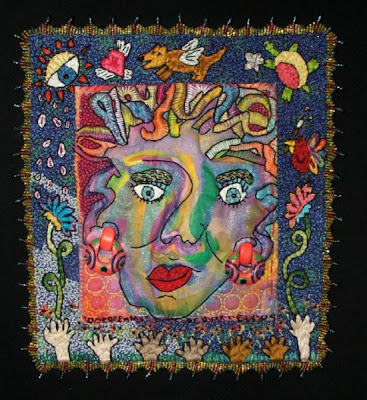


So what do you think? Can you learn something from this woman? I happen to LOVE her work, but maybe you think it's too busy, too cluttered, to full of something. Still, don't you think she could help free up that wild woman (or unlikely man) inside of you? Don't you think it could be worth a $60 or so investment to find out what demons (or unlikely angels) might be released? This is where the classes come in. Here is what she wrote:


Online Classes??
by SuSan SoRreLL

That is what people say to me when they ask me what I do for a living. First I have to explain to them what a Fiber Artist is and then how I teach classes over the Internet. “This is the wave of the future and pretty soon you will be able to do all types of classes on the web”, I tell them. People that have grown up with a computer see this a future trend, but people around my age….44….are still leery about the computer and a hacker stealing their ID. My great aunt, who is 91, just can’t get over the fact that I am making a living as an artist, plus this computer monster that has taken over the world. But now, computers are getting so simple to use that several years ago I was approached to design a Fiber Collage class for an online website. Now, I have a Masters in Art Education and had taught for 12 years in the public school system, so I saw this as an excellent opportunity not to waste this expensive diploma hanging on my wall.

Online art classes come in 2 categories, Projects and Creative Learning, in my opinion. Some classes that you can take will show you how to make a project, so you end up with the teacher’s example. (To me that is like coloring in a coloring book or following a dress pattern) The 2nd category is what I like to call Creative Learning. This is how I was trained to become an art teacher…to help the students think out of the box and try new techniques. I write my lessons like I would like a lesson plan in a classroom and shoot a lot of photos to go along with the lessons. Keeping it simple and using a lot of visuals is the way I like to do my workshops. I guess I write the lesson as if I was going to take it. I have taken many online classes and the teachers are really creative, but their lessons are wordy and don’t make sense. So, you will encounter a lot of different teaching styles out there, like you would in a classroom.

The Pros in taking an online class is you can do it on your time schedule. You don’t have to waste gas and drive anywhere. You don’t have to drag around all of your art supplies, they are right there in your studio. You can download the lessons and you have a mini book to keep of the class. You meet other students from all over the world and see how they interpret the lesson. You can experiment without feeling like you have to make your project perfect, so there is no pressure. The cost of the workshops cannot be beat!! I charge around 60.00 for a 6 weeks workshop and if I had to teach it in person I would have to charge around 350.00 a student.

Yes there are some Cons to taking an online class. No immediate feedback from your teacher and other students. No one on one, in person learning while you are working on your project. That is the biggest Con and there probably are several more, but I can’t think of any.

How I teach my online class is everyone in the class are given a password to an online forum and you can download the lesson from the forum. The forum is there for students to share, ask questions, and make comments about each lesson. I download the photos that are in the lesson, that way you can get a clear picture of what I am demonstrating. Plus, in the future I am working on having videos accompany my classes. The forum isn’t in real time, since there are students from all over world in different time zones. But if there is a new way for me to communicate with my students, I will find it. I am really big on the learning experience and want to make it a positive experience with all of the students. When the class ends, I have a Yahoo group and Flickr.com groups set up for everyone to keep sharing their work. Just because the 6 weeks might be over, doesn’t mean I am not there to help.

If you are considering on taking an online class, choose something that really interest you and you will be more apt to do the lessons. You need some motivation, but it is a really inexpensive way to try out new crafts and meet wonderful people.

Hope to see you online!!
Susan Sorrell
www.creativechick.com

I'm not going to list all the classes because I have a feeling this is a post that will be searched often. Here is the link info:

Creative Chick Studios-Online classes:
http://www.creativechick.com/classes.html


I wish I could let Susan unleash the demons/angels inside of me... Let me make this clear, though. I've never met the woman, have had very little contact with her, but all I know is that if an artist's soul speaks through their work, then that creative chick, Susan, is someone I like. I mean, look at how she ends her e-mails: "Laugh, Love and do the Hokie Pokie" I can't dance and have no clue what the hokie pokie looks like, but if I could and I did, I think I would want to try it out with her.

Disclaimer done, I need to add one more thing. Susan joined the little itsy-bitsy network I started, Fiber Focus, the group! Hubba, hubba, try-very-hard-to-dance-something! I have a good feeling that we will get to know each other better over time. A cyber-relationship I look forward to! (OK, I'll let you know if it turns into a nightmare, chuckle, chuckle...)


Now, to her links. The woman is all over the place! I've been spending a lot of time trying to learn this blogging/networking thing (with the supposed goal of promoting my store on Etsy, ha!) and there she is... I've given you some active links above, but here are more that you will have to cut and paste in your browser:

Http://www.myspace.com/creativechicksc
Blog: www.chatterbox.creativechick.com
Studio: http://www.littlehouseartstudios.com
Shop: http://creativechick.etsy.com/
www.cafepress.com/creativechick

The weirdest and funniest?
Need to get hitched quick? www.weddingsinaflash.com

Definitely an entrepreneurial woman! I will study her closely...
Following you will find her bio, but I just need to say one more thing. It's been like pulling teeth to get people to leave comments on this blog. I have no clue why. Traffic is growing and people spend an average of 5 minutes here, so that means interest is being captured. But, I look at other blogs and they have 26 or 52 comments. Why? I have no clue. But, here is something that might tweak your interest.......... Ask Susan (lowering voice to a whispered tone) about the Bigfoot sightings in her area. Let's see what answers she comes up with....


Susan Sorrell has always had a “wild imagination” growing up. Traveling all over the world with her father’s job, she has had to entertain herself with all kinds of arts and crafts. She didn’t become serious about art, until she made it her major at Winthrop University. Earning a Bachelor’s degree in Visual Design, Susan worked for a short time as a graphic artist, then decided to get her Masters in Education at Converse College, to teach art. Being around children was a great way to get her creative juices flowing, so she quit after 12 years and became a full time artist. Susan calls herself a “mixed media” artist, since she likes to dabble in a lot of different medias. She has been working with textiles since 1998 and hasn’t tired of it yet. Combining painting, sewing, beading and embellishing on fabric has opened new avenues to express her self. Her pieces are whimsical, colorful and have a personal theme. Susan likes to draw her inspirations from her life and what is happening in the world. Her recent series of work, “Southern Fried Fiber” is inspired by her “Southern” roots. Susan lives in Greenville, South Carolina,USA. To view more of Susan Sorrell work visit her website www.creativechick.com.

Share/Bookmark

Saturday, July 5, 2008

Guest Artist: Rachel Koniar of Secret Snowbird

Detail, The Wedding

Fibers were not my first love. They were in the peripheral, embroidery on a backpack, sewing a Halloween costume, dabbling there and there. The focus of all my mentors and teachers had been painting, drawing, painting.

Eve


The Battle

The joy of fibers was a backhanded thing; outside of the classroom. It didn’t become a means of expression until I moved to the shores of Lake Superior.

Pea Pod Sculpture

I was studying art education in Duluth which at the time, had enacted a smoking ban. After many previous attempts to snub the habit, it was the combination of smoke free buildings and cold Duluth winters (-20ºF not uncommon) that did it. Cigaretteless and left with the need to fidget, I turned to my knitting needles in earnest. I began knitting a pair of socks between a drawing and a ceramics class.

Rag Rug

This became the first fiber sculpture. The sock was knit down from cuff to toe on a set of five double pointed needles. As the ribbed cuff slowly emerged I was absolutely enamored with its shape. The knit tube would stand on its own when set down: a perfect ribbed cone rising from size two wooden needles. The finished product as a sock was a disappointment. It was a more satisfying form before it had a heal and toe.

Pear Cone Sculptures

My knit sculptures have all since been a variation on the sock cuff form. While I have experimented with different shapes, I always felt it was important to create works in fibers. Mostly I want to add my voice to the craft vs. art debate. Why was it that color added with paint to cloth (canvas) was Art, but color added by thread to cloth was just a quilt? Shouldn’t more embroidery be in art museums? My sculptures are to be a reminder that fibers in one’s home are Art too: the hand stitched sampler, the knit scarf, the hardanger lace, or the hand pieced quilt.

For me, the medium is never far from the message. A sculpture made from a worn out, hand made, rag rug stands as a testament to the beauty of home. To paint with stitches and not a brush is to honor the creative tradition in my maternal line. A soft felted form, is tactile and inviting not unlike a warm blanket.

Sunny Cone Sculptures

While I still paint, knitting is a daily companion. Fibers easily create the most satisfying tactile textures and forms. Who can resist the rhythmic, soothing click of knitting needles? Skeins of wool and wooden needles find their way into every room. Unfinished knit sculptures peak out from baskets and coffee tables, completed felted ones sit atop bookshelves huddled in groups, peering over the ledge. When my work surrounds me- I am home.

Wee Pods

Rachel Koniar is an artist and educator living in Minneapolis, Minnesota. She graduated from the University of Minnesota Duluth in 2005 with a Bachelor’s of Fine Arts in Art Education. Her work has been shown at The Tweed Museum of Art, Nutty Meg’s, Altered Esthetics, and The Beat. While she has taught students ages kindergarten through twelfth through out Minnesota, she is currently teaching 8th graders in Wayzata and a Textiles & Fibers class at Watershed High School in Minneapolis. She has also taught summer classes through the Minneapolis Institute of Art.


You can find Rachel's work and contact her both at her store on Etsy, Secret Snowbird or on her website, Rachel Koniar. She also has PDF patterns for some of her cone sculptures available in her Etsy store.

The Flood

Share/Bookmark

LinkWithin

Related Posts with Thumbnails
