by Catherine Salter BayarCatherine is a regular contributor to Fiber Focus.
Click on her name to see all of her posts on one page.
 My mother-in-law, doing a handcraft that she and I share – knitting
Long before I moved to Turkey in 1999, the manufacturing of hand woven rugs had begun to move out of this country to nations farther east, where labor and production costs were cheaper. I’d been familiar with this economic market reality as I traveled the world for the garment industry, which is in constant search of cheaper countries to manufacture clothing. In the same way, Turkish rug wholesalers took their production of hand woven rugs for the tourism trade or export to countries such as Pakistan or China, while mass producing machine-made carpets in Western and Central Turkey for use in the modern Turkish household. The cost of hand weaving in countries to the East is roughly a third of the cost of weaving a rug in Turkey, East or West.
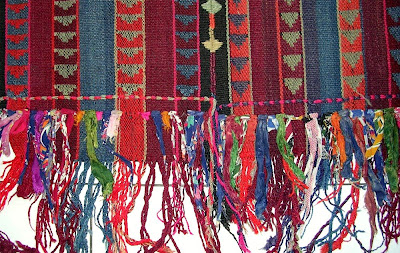
My mother-in-law’s generation used to weave, but she is in her sixties now. She and her sisters had to weave if they wanted functional or decorative textiles for their homes. Weaving was not only utilitarian, but social as well. When girls and women wove for their dowries and households, they would gather together in the afternoons after their farm chores were completed. My mother-in-law wove the kilim, below, on a narrow, easily transportable loom, in four long strips of 17” (42 cm) wide cloth, embroidered together with wool yarn.

This entirely wool piece would have taken her at least 6 months of afternoons to complete. She used the natural dyes of madder red and indigo blue to bring prosperity and protection; the triangles represent the mountains that encircle their childhood town of Derik, in the eastern province of Mardin. It was used to drape the horse her sister rode to her wedding, and then as a bedcover. The numerous fabric strips tied to the bottom, below, are ‘wishes’ from each woman in the family for a healthy, happy, abundant life for the newly married couple.
My mother-in-law thinks it’s quite absurd that we have kilims she and her sisters wove in our shop. She sees little value or beauty in them at all, and has often teased me about the threadbare but exquisitely striped kilim I insist on keeping in our bedroom, below. Perhaps someday I’ll get that big hole repaired by one of the expert reweavers here, all men for some reason, who can make it look like new, but to me it’s already perfect. I like seeing it just this way as I get out of bed each morning, as a reminder of a time when a woman would spend perhaps an entire afternoon per 1/2 inch of this finely spun wool kilim, about 3 feet wide by 5 feet long; a woman who obviously took joy in combining such bright reds, oranges, pinks, chartreuse and periwinkle. This piece was given to us by the family in Abit’s home village in Eastern Turkey. They were cleaning out storerooms and would have thrown it away! Abit gave his aunt $200 for several kilims she was discarding; she clearly thought he was foolish to give her good money for them. Word of the ‘big spender’ from the West got around the village. The next day, numerous relatives showed up with their cast-offs, amused that the boy who’d left more than 20 years ago was now making a living selling these old useless things.

These days, the easy-care machine made polyester/cotton textiles for cushions and bedding plus wool and synthetic carpets being churned out by factories all over Turkey are the preferred house wares of the Turkish middle classes (behind and beneath my bread-making sisters-in-law, below). Turkey grows its own cotton and is still predominately an agricultural country, so the wool gathered from sheep and goats now goes more to urban factories than it stays in the villages. These textiles are targeted at the domestic market, so reflect the color combinations and patterns of vintage hand woven pieces, but are prized for being modern and machine washable.

None of my seven sisters-in-law weaves, unless you count the sister who asked to be sent to a local government-run program that trains women in the art. She and I had begun collaborating on carpets of our own design, but the family decided that she should move East to marry and raise a family rather than stay in Selcuk and work for us. I know she does not regret having the adorable children in the photo below, but she does miss the chance to express her originality and talent through weaving. It is still common for women in Cappadocia in Central Turkey or in East to work at home weaving for various manufacturers. They are usually paid by the piece, though it cannot be much money for their labor based on the wholesale prices of new goods. No wholesaler would divulge how much the women make, another reason we don’t sell new rugs in our business.

My husband’s family is traditional and typical for Eastern Turkey even though they have lived in this Aegean region town since 1985. The girls are expected to be homemakers and mothers, and if they must work, they do so together in the fields and orchards, picking crops such as cotton or peaches. Abit and I do not agree with these limitations and have had countless discussions with the family, to no avail. However, most girls in Selcuk complete mandatory schooling by the age of 16, and many go on to universities. Our town is filled with women in business, medicine, law and service occupations in percentages that are similar to Eastern European countries.
 A portable loom for small rugs less than a meter (39”) wide.
The majority of women schooled in hand weaving today in Western Turkey work in ‘carpet villages’, traditional style complexes to which the tour companies take captive busloads of tourists to demonstrate how rugs are made. They make for a good show of the craft, but little do the tourists realize that most of the rugs they are being shown and sold were woven far from here, in countries with fewer regulations about child labor and fair wage laws. Most carpet villages near Selcuk pay their workers – male sellers and female weavers – a salary, not in commissions or by the piece. They usually do get healthcare and other benefits, including meals and transportation to their jobs, and work regular 8-hour days, though often 6-7 days a week during the tourist season from April to October and far fewer days in winter.
 A former carpet village of traditional style buildings near Selcuk.
The looms are dismantled, but colored yarns still hanging from the rafters.The pieces hand woven today by manufacturers have been ‘merchandised’ to cater to the buying tastes of the visitors. Traditional color combinations of reds and blues are replaced by more subtle Westernized palettes of pastels or earth tone combinations. Unlike in the West, where rugs woven in undyed natural wool colors of off-whites, browns and blacks would fit in well with most home décor, these ‘drab’ pieces would have been pitied in a Turkish village. It would have been assumed that the family did not have the skills or money to gather dyestuffs or purchase them in the local market. The traditional long, narrow rugs to fit a Turkish living room are now woven instead in standard sizes revised to reflect room proportions in Western homes. What in the West would be used as hallway runners, for instance, would have been attached to the lower walls of a Turkish salon to comfort the backs of those seated around the room on low cushions.
The predominant art of the Turkish culture, the art that has survived centuries of population migrations, the art truly inclusive and expressive of women’s emotions, desires and creativity, has been hijacked by mass commerce. This is not a story unique to Turkey of course; as countries modernize and mechanize, traditional handcrafts are less prized by the culture and fade away. Beyond the tourism-driven carpet villages, there are groups of entrepreneurs in Turkey who want to sustain traditional hand crafts and offer women the alternative to support themselves though weaving, but these enterprises may never create the same works as a woman who is weaving from her soul would.
 A strictly-for-commerce ‘new’ piece that combines multiple portions of old prayer rugs – a creative way to reinvent authentic carpets, but sold for thousands of Euros – as seen in the window of one of the most expensive carpet shops in Sultanahmet.
Has the art of weaving been completely lost to commerce here? Not quite yet, but with women no longer weaving for themselves and shopping hordes of tourists in the tight control of tour conglomerates, businesses like ours have fewer authentically Turkish-made alternatives to offer our visitors. And the uniquely expressive voices of our sisters, the weavers, are being silenced.

 Catherine Salter Bayar lives with her husband Abit in Selcuk, near Ephesus, Turkey, where they own a vintage textile shop and a water pipe & wine bar.
Visit them at www.bazaarbayar.com or www.bazaarbayar.etsy.com.
This article is a companion one to Turkish Textile Arts in Transition: A Brotherhood of Carpet Sellers

Turkish Textile Arts in Transition: A Sisterhood of Weavers



