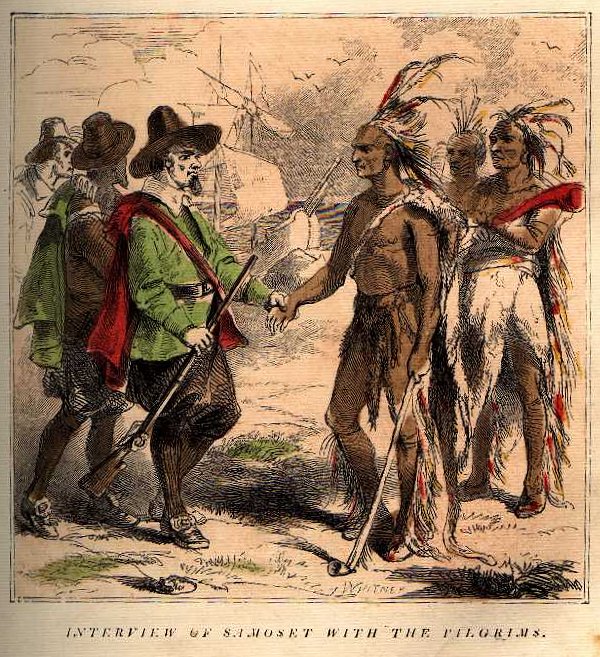
Samoset speaks English to the British colonists
Today is the last day of a long Thanksgiving weekend here in the United States. As a Sunday, many of us are recovering from too much food and from the beginning of the Holiday shopping season. Friday is called
Black Friday here, where for decades now, mobs swamp department stores in search of good deals and discounts. In response to the post I did,
Lincoln's Thanksgiving: What They Wore, a friend sent me an e-mail with the following article. It's depressing, a downer, but I feel compelled to post it.
Let me couch it with a couple of things. History is subjective. Period. Anyone recording what they see and experience do so from their perspective and that is always limited. However, in order to aspire to a "bird's eye view", stories should be told from a variety of perspectives. The story of Thanksgiving as an inter-racial bounty between whites and natives is so deeply ingrained in our American psyche that most of us will pass that on down to our kids.

I don't know what children are learning in school these days, but growing up overseas, we were fed beautiful stories about how this country developed. There were about 15 other American families in our city and the adults all made every effort to instill in us a sense of identity as an American, so we celebrated all the holidays.
I remember one Thanksgiving play we did in our church, all of us kids dressed up as pilgrims or Indians. I have a vague memory of making a silver buckle out of foil, so I think I was a pilgrim. The most vivid part of this faded memory is that there was a popcorn popper that failed to work when it was supposed to, but came to life in the wrong scene, making us all fall down with laughter. So, maybe we didn't get the historical facts down right. Do we just toss it out? I know that Thanksgiving has been a time in my life where giving thanks and honoring friends and family has been important.
 I guess we could just dump the historical side and make it a simple day of thanks. Or, maybe we can acknowledge history for all the good, the bad and the ugly it represents, and aspire towards those values we wished the Pilgrims and Native Americans shared: cultural respect, sharing of resources, and the building of community.
I've found some images that relate to the article. Click on them to visit their source.
The Real ThanksgivingQuoted from: The Hidden History of MassachusettsMuch of America's understanding of the early relationship between the Indian and the European is conveyed through the story of Thanksgiving. Proclaimed a holiday in 1863 by Abraham Lincoln, this fairy tale of a feast was allowed to exist in the American imagination pretty much untouched until 1970, the 350th anniversary of the landing of the Pilgrims. That is when Frank B. James, president of the Federated Eastern Indian League, prepared a speech for a Plymouth banquet that exposed the Pilgrims for having committed, among other crimes, the robbery of the graves of the Wampanoags. He wrote:
"We welcomed you, the white man, with open arms, little knowing that it was the beginning of the end; that before 50 years were to pass, the Wampanoag would no longer be a free people."
But white Massachusetts officials told him he could not deliver such a speech and offered to write him another. Instead, James declined to speak, and on Thanksgiving Day hundreds of Indians from around the country came to protest. It was the first National Day of Mourning, a day to mark the losses Native Americans suffered as the early settlers prospered. This true story of "Thanksgiving" is what whites did not want Mr. James to tell.
What Really Happened in Plymouth in 1621?According to a single-paragraph account in the writings of one Pilgrim, a harvest feast did take place in Plymouth in 1621, probably in mid-October, but the Indians who attended were not even invited. Though it later became known as "Thanksgiving, " the Pilgrims never called it that. And amidst the imagery of a picnic of interracial harmony is some of the most terrifying bloodshed in New World history.
The Pilgrim crop had failed miserably that year, but the agricultural expertise of the Indians had produced twenty acres of corn, without which the Pilgrims would have surely perished. The Indians often brought food to the Pilgrims, who came from England ridiculously unprepared to survive and hence relied almost exclusively on handouts from the overly generous Indians-thus making the Pilgrims the western hemisphere's first class of welfare recipients. The Pilgrims invited the Indian sachem Massasoit to their feast, and it was Massasoit, engaging in the tribal tradition of equal sharing, who then invited ninety or more of his Indian brothers and sisters-to the annoyance of the 50 or so ungrateful Europeans. No turkey, cranberry sauce or pumpkin pie was served; they likely ate duck or geese and the venison from the 5 deer brought by Massasoit. In fact, most, if not all, of the food was most likely brought and prepared by the Indians, whose 10,000-year familiarity with the cuisine of the region had kept the whites alive up to that point.
 Massasoit and Governor Carver
The Pilgrims wore no black hats or buckled shoes-these were the silly inventions of artists hundreds of years since that time. These lower-class Englishmen wore brightly colored clothing, with one of their church leaders recording among his possessions "1 paire of greene drawers." Contrary to the fabricated lore of storytellers generations since, no Pilgrims prayed at the meal, and the supposed good cheer and fellowship must have dissipated quickly once the Pilgrims brandished their weaponry in a primitive display of intimidation. What's more, the Pilgrims consumed a good deal of home brew. In fact, each Pilgrim drank at least a half gallon of beer a day, which they preferred even to water. This daily inebriation led their governor, William Bradford, to comment on his people's "notorious sin," which included their "drunkenness and uncleanliness" and rampant "sodomy"...
The Pilgrims of Plymouth, The Original ScalpersContrary to popular mythology the Pilgrims were no friends to the local Indians. They were engaged in a ruthless war of extermination against their hosts, even as they falsely posed as friends. Just days before the alleged Thanksgiving love-fest, a company of Pilgrims led by Myles

Standish actively sought to chop off the head of a local chief. They deliberately caused a rivalry between two friendly Indians, pitting one against the other in an attempt to obtain "better intelligence and make them both more diligent." An 11-foot-high wall was erected around the entire settlement for the purpose of keeping the Indians out.
Any Indian who came within the vicinity of the Pilgrim settlement was subject to robbery, enslavement, or even murder. The Pilgrims further advertised their evil intentions and white racial hostility, when they mounted five cannons on a hill around their settlement, constructed a platform for artillery, and then organized their soldiers into four companies-all in preparation for the military destruction of their friends, the Indians.
Pilgrim Myles Standish eventually got his bloody prize. He went to the Indians, pretended to be a trader, then beheaded an Indian man named Wituwamat. He brought the head to Plymouth, where it was displayed on a wooden spike for many years, according to Gary B. Nash, "as a symbol of white power." Standish had the Indian man's young brother hanged from the rafters for good measure. From that time on, the whites were known to the Indians of Massachusetts by the name "Wotowquenange, " which in their tongue meant cutthroats and stabbers.
Who Were the "Savages"?The myth of the fierce, ruthless Indian savage lusting after the blood of innocent Europeans must be vigorously dispelled at this point. In actuality, the historical record shows that the very opposite was true.
Once the European settlements stabilized, the whites turned on their hosts in a brutal way. The once amicable relationship was breeched again and again by the whites, who lusted over the riches of Indian land. A combination of the Pilgrims' demonization of the Indians, the concocted mythology of Eurocentric historians, and standard Hollywood propaganda has served to paint the gentle Indian as a tomahawk-swinging savage endlessly on the warpath, lusting for the blood of the God-fearing whites.
But the Pilgrims' own testimony obliterates that fallacy. The Indians engaged each other in military contests from time to time, but the causes of "war," the methods, and the resulting damage differed profoundly from the European variety:
- Indian "wars" were largely symbolic and were about honor, not about territory or extermination.
- "Wars" were fought as domestic correction for a specific act and were ended when correction was achieved. Such action might better be described as internal policing. The conquest or destruction of whole territories was a European concept.
- Indian "wars" were often engaged in by family groups, not by whole tribal groups, and would involve only the family members.
- A lengthy negotiation was engaged in between the aggrieved parties before escalation to physical confrontation would be sanctioned. Surprise attacks were unknown to the Indians.
- It was regarded as evidence of bravery for a man to go into "battle" carrying no weapon that would do any harm at a distance-not even bows and arrows. The bravest act in war in some Indian cultures was to touch their adversary and escape before he could do physical harm.
- The targeting of non-combatants like women, children, and the elderly was never contemplated. Indians expressed shock and repugnance when the Europeans told, and then showed, them that they considered women and children fair game in their style of warfare.
- A major Indian "war" might end with less than a dozen casualties on both sides. Often, when the arrows had been expended the "war" would be halted. The European practice of wiping out whole nations in bloody massacres was incomprehensible to the Indian.

According to one scholar, "The most notable feature of Indian warfare was its relative innocuity." European observers of Indian wars often expressed surprise at how little harm they actually inflicted. "Their wars are far less bloody and devouring than the cruel wars of Europe", commented settler Roger Williams in 1643. Even Puritan warmonger and professional soldier Capt. John Mason scoffed at Indian warfare: "[Their] feeble manner...did hardly deserve the name of fighting." Fellow warmonger John Underhill spoke of the Narragansetts, after having spent a day "burning and spoiling" their country: "no Indians would come near us, but run from us, as the deer from the dogs." He concluded that the Indians might fight seven years and not kill seven men. Their fighting style, he wrote, "is more for pastime, than to conquer and subdue enemies."
(photo: Narragans & Roger Williams)All this describes a people for whom war is a deeply regrettable last resort. An agrarian people, the American Indians had devised a civilization that provided dozens of options all designed to avoid conflict--the very opposite of Europeans, for whom all-out war, a ferocious bloodlust, and systematic genocide are their apparent life force. Thomas Jefferson--who himself advocated the physical extermination of the American Indian--said of Europe, "They [Europeans] are nations of eternal war. All their energies are expended in the destruction of labor, property and lives of their people."
Puritan HolocaustBy the mid 1630s, a new group of 700 even holier Europeans calling themselves Puritans had arrived on 11 ships and settled in Boston-which only served to accelerate the brutality against the Indians.
 Pequot
In one incident around 1637, a force of whites trapped some seven hundred Pequot Indians, mostly women, children, and the elderly, near the mouth of the Mystic River. Englishman John Mason attacked the Indian camp with "fire, sword, blunderbuss, and tomahawk." Only a handful escaped and few prisoners were taken-to the apparent delight of the Europeans:
To see them frying in the fire, and the streams of their blood quenching the same, and the stench was horrible; but the victory seemed a sweet sacrifice, and they gave praise thereof to God.
This event marked the first actual Thanksgiving. In just 10 years 12,000 whites had invaded New England, and as their numbers grew they pressed for all-out extermination of the Indian. Euro-diseases had reduced the population of the Massachusett nation from over 24,000 to less than 750; meanwhile, the number of European settlers in Massachusetts rose to more than 20,000 by 1646.
By 1675, the Massachusetts Englishmen were in a full-scale war with the great Indian chief of the Wampanoags, Metacomet. Renamed "King Philip" by the white man, Metacomet watched the steady erosion of the lifestyle and culture of his people as European-imposed laws and values engulfed them.
In 1671, the white man had ordered Metacomet to come to Plymouth to enforce upon him a new treaty, which included the humiliating rule that he could no longer sell his own land without prior approval from whites. They also demanded that he turn in his community's firearms. Marked for extermination by the merciless power of a distant king and his ruthless subjects, Metacomet retaliated in 1675 with raids on several isolated frontier towns. Eventually, the Indians attacked 52 of the 90 New England towns, destroying 13 of them. The Englishmen ultimately regrouped, and after much bloodletting defeated the great Indian nation, just half a century after their arrival on Massachusetts soil. Historian Douglas Edward Leach describes the bitter end:
"The ruthless executions, the cruel sentences... were all aimed at the same goal-unchallengeable white supremacy in southern New England. That the program succeeded is convincingly demonstrated by the almost complete docility of the local native ever since."

When Captain Benjamin Church tracked down and murdered Metacomet in 1676, his body was quartered and parts were "left for the wolves." The great Indian chief's hands were cut off and sent to Boston and his head went to Plymouth, where it was set upon a pole on the real first "day of public Thanksgiving for the beginning of revenge upon the enemy." Metacomet's nine-year-old son was destined for execution because, the whites reasoned, the offspring of the devil must pay for the sins of their father. The child was instead shipped to the Caribbean to spend his life in slavery.

As the Holocaust continued, several official Thanksgiving Days were proclaimed. Governor Joseph Dudley declared in 1704 a "General Thanksgiving" -not in celebration of the brotherhood of man-but for [God's] infinite Goodness to extend His Favors...In defeating and disappointing. .. the Expeditions of the Enemy [Indians] against us, And the good Success given us against them, by delivering so many of them into our hands...
(Governor Joseph Dudley pictured in photo at left. He was also somewhat involved in the Salem Witch Trials and was later accused by Boston merchants of being in league with smugglers and illicit traders.
Wiki)
Just two years later one could reap a ££50 reward in Massachusetts for the scalp of an Indian-demonstratin g that the practice of scalping was a European tradition. According to one scholar, "Hunting redskins became...a popular sport in New England, especially since prisoners were worth good money..."
References in The Hidden History of Massachusetts: A Guide for Black Folks (C)(C) DR. TINGBA APIDTA, ; ISBN 0-9714462-0- 2 Interview of Samoset with the Pilgrims
Thanksgiving's Day of Mourning: Plymouth Pilgrims Slaughter their Native Hosts