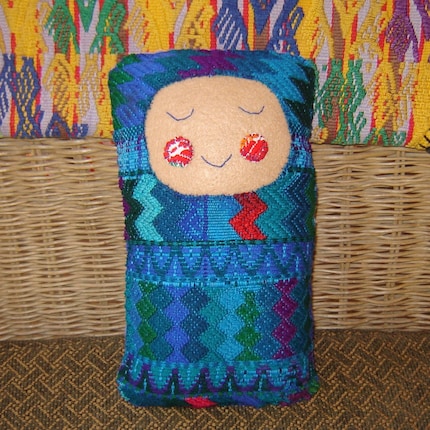
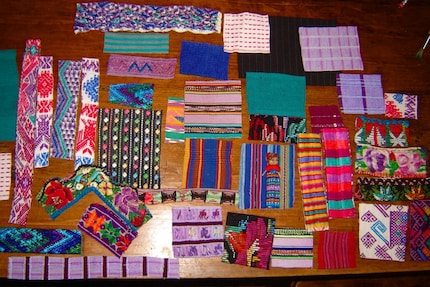
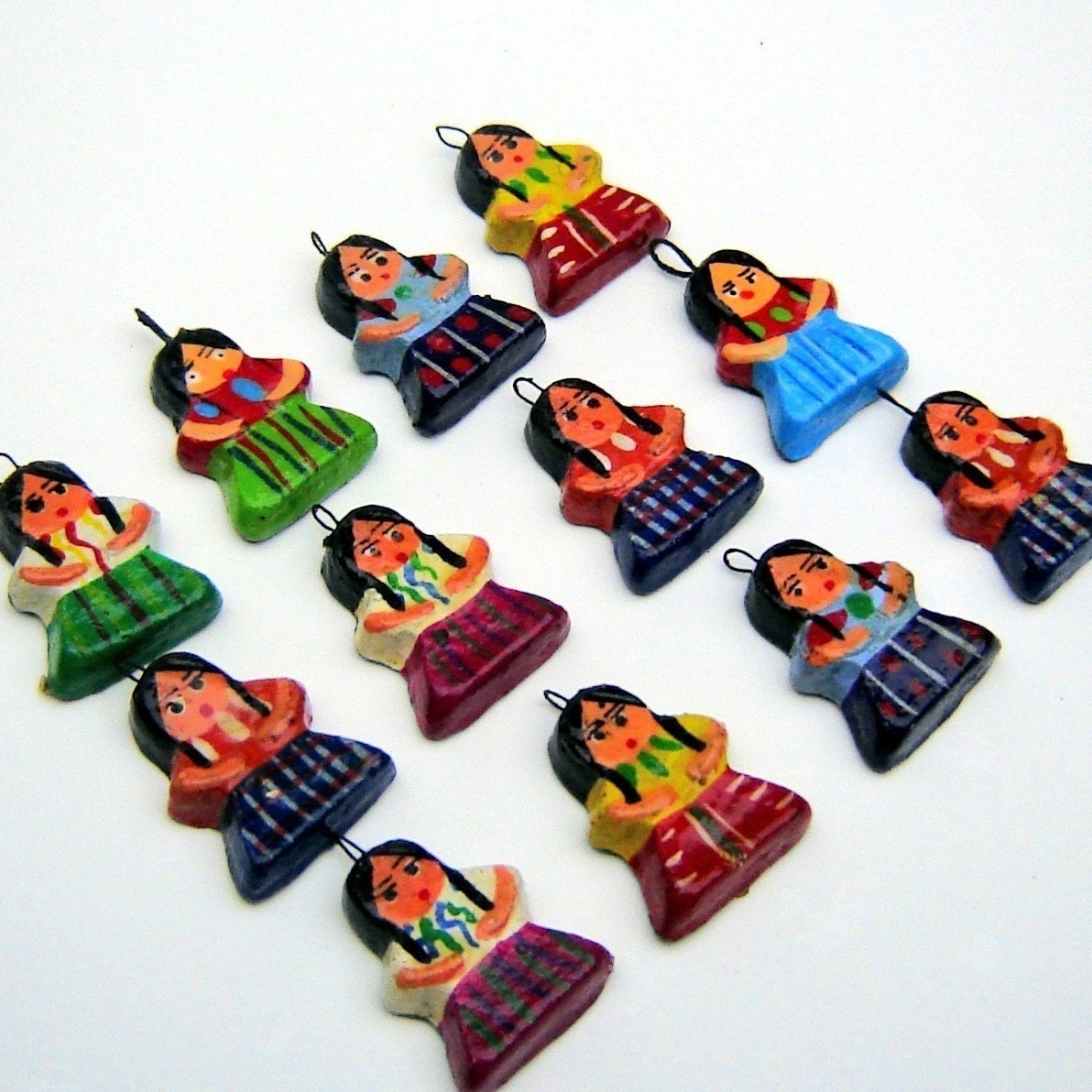
TAFA member, Whitney Taylor, (Little Mango Imports)
works with Mayan weavers in Guatemala.
Whitney with Sovesteña in Panajachel
Maria lives in a village in Guatemala. She weaves brightly colored fabrics which will make their way to the American and European markets. She also works on traditional huipiles, the blouses worn by women in her village, when she has time. Maria has been to the capital a couple of times and visits relatives in nearby towns, but mostly stays in her village and likes it that way. She knows how to read and write, has four small children, loves to laugh, and dreams of having a new fence built around her garden so the chickens will stay out of it.
Claudette also weaves. Her work often depicts contrasts between light and dark, using urban themes that reflect her life in Paris. She zooms in on a car's headlight, a hand on a door, high heels on the sidewalk... sometimes there might be splashes of red, alluding to blood or violence. Her work is not "pretty" and it will take that special collector who will want to buy it. Claudette has exhibited internationally and traveled around the world . She has no children, sometimes she drinks too much, and she definitely wishes she could stop thinking all the time.

"Big Green Barn" by TAFA member Laura Foster Nicholson
Maria and Claudette are fictional, just made up characters in my mind, but symbolic of the range of women represented by TAFA's membership. TAFA: The Textile and Fiber Art List is a project I started earlier this year. Launched in February, the membership has grown to 115 working artists and fiber related businesses. TAFA's main mission, to provide its members with access to larger markets, has at its core an intentional agenda of bringing Maria and Claudette together, sharing the same platform and audience. These two women have little in common aside from the materials they use to execute their craft. Their personal interests, how they spend their time, and the goals they have for their lives reflect not only the physical distance that separates them, but the cultural expectations their peers have of them. They do, however, share a form of sign language. If they stood side by side with their looms, they could speak to each other and learn from each other through their threads, the movements of their hands, and the final products. A language only weavers would understand.
Both also share in the need for a market that will support their work. Maria might be represented by someone like Whitney Taylor (first photo), or by TAMMACHAT Natural Textiles who work with weavers in Laos and Thailand.
Traditionally, the two weavers, Maria and Claudette, and those who represent them, would have looked for their markets in very different places. Maria does not have computer skills nor access to galleries. Her weaving would be described as a craft and would not qualify for most competitions. Claudette would have to put a portfolio together, have professional photos taken and either look for high end customers on her own or have a gallery represent her in doing so. Their markets and the words used to define who they are and what they do have been as separate as their physical worlds.

I've worked with handmade crafts from around the world for over twenty years. Even now, I struggle with what words to use when I describe a product. Is it art? Craft? Handicraft? Folk Art? Traditional? Contemporary? We are struggling with these terms on TAFA as well. The middle column has a list of labels titled "Themes and Places". Intended as an index, key words describe the mix found in TAFA's membership. We decided to use "Member Made" as a way to describe a member who makes their own work. "Cultural Textile" describes members who are representing a group. The challenge lies in keeping the list short enough to make it usable for those who visit the site and yet inclusive enough to cover the different kinds of work represented on TAFA.
Even worse: how do we describe Maria and Claudette? Is Maria an artist? Fair traders often refer to people like her as "producers". Claudette would certainly have a fit if she were labeled a crafter. The divide that has separated these two has historically come from an ethnocentric position that, I believe, is fundamentally racist, classist, and must change. Maria might actually have better technical skills than Claudette. What makes her work less valid in the art world? One might argue that she lacks imagination in design, that she is simply replicating work that has been done for centuries in her village. Yet, many contemporary weavers are not weaving powerful, moody work like Claudette's. They are interested in the materials, patterns, look of the weave itself. TAFA member Laos Essential Artistry has an interesting video which tries to address this tension between the artist, creativity, and the relationship to the product itself. In my mind, we stumble in trying to perpetuate this divide:

"Koch Snowflake Fractal"
Univeral Language Series
Univeral Language Series
by TAFA member Donna Loraine Contractor
I've worked with handmade crafts from around the world for over twenty years. Even now, I struggle with what words to use when I describe a product. Is it art? Craft? Handicraft? Folk Art? Traditional? Contemporary? We are struggling with these terms on TAFA as well. The middle column has a list of labels titled "Themes and Places". Intended as an index, key words describe the mix found in TAFA's membership. We decided to use "Member Made" as a way to describe a member who makes their own work. "Cultural Textile" describes members who are representing a group. The challenge lies in keeping the list short enough to make it usable for those who visit the site and yet inclusive enough to cover the different kinds of work represented on TAFA.
Even worse: how do we describe Maria and Claudette? Is Maria an artist? Fair traders often refer to people like her as "producers". Claudette would certainly have a fit if she were labeled a crafter. The divide that has separated these two has historically come from an ethnocentric position that, I believe, is fundamentally racist, classist, and must change. Maria might actually have better technical skills than Claudette. What makes her work less valid in the art world? One might argue that she lacks imagination in design, that she is simply replicating work that has been done for centuries in her village. Yet, many contemporary weavers are not weaving powerful, moody work like Claudette's. They are interested in the materials, patterns, look of the weave itself. TAFA member Laos Essential Artistry has an interesting video which tries to address this tension between the artist, creativity, and the relationship to the product itself. In my mind, we stumble in trying to perpetuate this divide:
Why racist and classist? Because if the same work were made by an American, a Parisian, or an Australian, it would be called art and, a key point here, the price would also reflect it. I believe that we have been passive about giving credit where it is due. We believe that it's OK for the Marias of the world to live on minimal income generated by their skill while those of us who live in the "developed" world can charge what we consider a fair wage for our work. Sure, there are many issues that affect the price point of a weaving or textile: materials used, intricacy of detail, age, the currency exchange rate, creativity, fame, and so on. But, the same debate that has raged on in the quilting arena also rages here. Quilters debate what is art or craft all the time. So, now we have "art quilts" which have their own shows and juried criteria, separate from "traditional quilts". And, again, definition often makes a big difference in price point. An Amish quilt may sell for several hundred dollars while an art quilt with the same skill level may enter the market for several thousand dollars. It's a matter of how we perceive and define our selves, our work and those around us. But, when it comes to Maria, I believe that most of us think it's OK for her to earn less because she is a peasant, lives in a hut, doesn't have much education and should just be grateful that we are helping her by buying her "stuff".
Fortunately, things are changing for Maria and other like her. Several global trends in these last twenty years have decreased the supply of cultural crafts. Industrialization, war, natural disasters and migration have all affected the production of traditional arts world wide. It used to be easy to get gorgeous, intricate embroideries from any of these villages for almost nothing. Travelers who became small importers brought these goods to market and appreciation for them grew. Now it's hard to find the older stuff and we have to pay more for current work. Less people are also making the traditional work, opting instead to work in factories or as maids or in the hospitality industry for secure pay and possible benefits. War and natural disaster have disrupted village life around the world. As less of the vintage textiles have become available, more efforts and recognition has been given to those who have the ability to perpetuate these age-old skills. We also see more exchanges happening between the Marias and Claudettes, increasing market receptivity by developing products that use the skills, appeal to elite markets and generate a higher ticket price. Escama Studio in Brazil is one such example. Low income women crochet clothing and accessories out of pop tabs:
Women like Maria are traveling more, seeing how a Claudette would interact with their work. Novica carries their purses, selling them for a couple hundred dollars each, accompanied with a photo, bio and quote by the artist. The Santa Fe International Folk Art Market sponsors traditional crafters from around the world every year. They are called "artists" on their website and literature. HandEye Magazine offers a glorious exploration of materials, techniques, and overwhelming eye candy from around the world. They make no distinction between traditional and contemporary. It's all crazy and all good. FiberArts Magazine always has a section dedicated to traditional cultural crafts, although their focus is on contemporary textile art and craft. The trend moves towards inclusion and recognition. We need this to happen in order to both preserve the knowledge the Marias have and to encourage the vision a Claudette might bring to the medium. We still have a long way to go, but all of us can help redefine what the platform is that we share with each other. It starts with exposure, by standing next to each other, and continues with the dialogue that is in our hands, that sign language that we can speak through our craft. Finally, it matures when all of us can make a decent living through our work, have our basic needs met, and know that life as a working artist can happen here, in Paris or in a village in Guatemala.

Interested in becoming a TAFA member? TAFA members all have an established web presence. They are working artists, textile or fiber related businesses, authors, collectors, or gallery owners. For more information, check out the Membership page on our site.
Fortunately, things are changing for Maria and other like her. Several global trends in these last twenty years have decreased the supply of cultural crafts. Industrialization, war, natural disasters and migration have all affected the production of traditional arts world wide. It used to be easy to get gorgeous, intricate embroideries from any of these villages for almost nothing. Travelers who became small importers brought these goods to market and appreciation for them grew. Now it's hard to find the older stuff and we have to pay more for current work. Less people are also making the traditional work, opting instead to work in factories or as maids or in the hospitality industry for secure pay and possible benefits. War and natural disaster have disrupted village life around the world. As less of the vintage textiles have become available, more efforts and recognition has been given to those who have the ability to perpetuate these age-old skills. We also see more exchanges happening between the Marias and Claudettes, increasing market receptivity by developing products that use the skills, appeal to elite markets and generate a higher ticket price. Escama Studio in Brazil is one such example. Low income women crochet clothing and accessories out of pop tabs:
Women like Maria are traveling more, seeing how a Claudette would interact with their work. Novica carries their purses, selling them for a couple hundred dollars each, accompanied with a photo, bio and quote by the artist. The Santa Fe International Folk Art Market sponsors traditional crafters from around the world every year. They are called "artists" on their website and literature. HandEye Magazine offers a glorious exploration of materials, techniques, and overwhelming eye candy from around the world. They make no distinction between traditional and contemporary. It's all crazy and all good. FiberArts Magazine always has a section dedicated to traditional cultural crafts, although their focus is on contemporary textile art and craft. The trend moves towards inclusion and recognition. We need this to happen in order to both preserve the knowledge the Marias have and to encourage the vision a Claudette might bring to the medium. We still have a long way to go, but all of us can help redefine what the platform is that we share with each other. It starts with exposure, by standing next to each other, and continues with the dialogue that is in our hands, that sign language that we can speak through our craft. Finally, it matures when all of us can make a decent living through our work, have our basic needs met, and know that life as a working artist can happen here, in Paris or in a village in Guatemala.

Alia Kate with Fatima
TAFA member, Kantara Crafts,
works with weavers in Morocco.
Interested in becoming a TAFA member? TAFA members all have an established web presence. They are working artists, textile or fiber related businesses, authors, collectors, or gallery owners. For more information, check out the Membership page on our site.