TAFA: The Textile and Fiber Art List

Showing posts with label Mongolia. Show all posts

Monday, December 15, 2008

Ethnic Nativities & Identity plus The Hyde Family

Zulu Beaded Doll Nativity
This set contains Mary, Joseph, and baby Jesus in a manger,
made by Zulu women in a co-op in Kwa Zulu, Zululand in eastern South Africa.

Ethnic nativities offer an excellent opportunity to take a look at multiculturalism and the search for identity. Christianity's roots spring from the Bible, a text that historically and culturally belonged to the people of Israel. But, the New Testament, through Christ, made the Word available to all and in the last 2000 years, Christianity has indeed spread around the globe. Much of the initial work was done through missionaries, first through the Roman Catholic Church's participation in conquering the New World and in its alliance with traders in Africa and the Orient, then through Protestant missionaries who felt called to take the Word of God to the most remote regions of the world. The Industrial Revolution and consequent developments in communication (print, radio, television, and the internet) made it even easier for Christianity to achieve access into other cultures. (The reverse is also true as other religions and belief systems have made an impact on traditionally Christian turf.) Without addressing the pros and cons of this reality (ie. the cost in terms of lives lost, wars fought, or pros such as clinics and schools built in the name of Christ), the Nativity scene is recognized throughout the world, even where Christianity is not practiced.


The scene was created by an organization called GuguCrafters,
comprised of four Zimbabwean refugees living in Cape Town, South Africa.

A basic Nativity consists of the Baby Jesus, Mary and Joseph. The baby in the manger with two figures on either side is such a familiar icon that just the shapes are enough to inform the viewer about the narrative. For example, the soda images above without the baby might be angels or choir members. Their praying hands indicate some kind of piety, but having the baby in the box with it eliminates any confusion that this is anything but a Nativity scene. This set doesn't have any ethnic tags to it. Obviously, it is recycled, but soda pop crafts are also very popular in Vietnam and increasing in other countries, including here in the United States.

An ethnic tag means that the piece is easily recognized by its technique as originating from a specific country or people. Anyone familiar with that culture will recognize the craft because it is produced in abundant quantities. Similar pieces made by different artisans can be found in the markets of that country or in specialty stores and catalogs. Here are some examples:

Peruvian Retablo Nativity
This Nativity is a retablo (diorama) scene.
Retablos are shrinelike boxes with religious scenes inside,
an art form unique to Peru.
They have evolved from the portable altars
which the Spanish conquistadores brought with them in the 16th century.

India- Textile Stamps Nativity
This Nativity is made from hand-carved wood pieces in India.
Bread Dough Nativity (Masapan), Equador
Each piece of this Nativity scene was painstakingly hand-molded from bread dough and baked until very hard by descendants of one of the original families in Ecuador who began the tradition of giving these masapan gifts to neighbors approximately 150 years ago. This technique originated in Calderón, which is a pueblo just outside of Quito in the Andes Mountains.

Arpillera Nativity from Peru

This Nativity hanging from Peru is called an arpillera, which in Spanish means burlap or sackcloth. Talented women use fabrics of many colors and textures to make this scene. They individually designed and hand-stitched every little detail.

The Peace Corps, NGO's, church groups and tourism all had an impact on how traditional handicrafts in different countries increasingly looked to the Western market (USA, Canada and Europe) for support. The fair trade movement increasingly became better at standardizing the crafts with quality control guidelines, understanding market trends and using the internet and trade shows as outlets. Christmas is a huge niche as both ornaments and nativity scenes have an audience of collectors. So, the Jewish family morphed and became represented by the cultural tags of the artisan. Jesus was not only a Jew, but also a Zulu, a Navajo, a Mexican, and an Inuit.

Elaborate Cloth and Fur Nativity $250
This Nativity set is handcrafted in Mongolia by Tsegtsmaa.
She made by hand all of the figures and animals, even using a lathe to make the wood bodies.

Part of this does come from marketing, but erasing the Baby Jesus's cultural roots also reflects a level of self-imaging where cultural bridges can be made through a story. Missionaries found early on that in order to explain the concept of Jesus they first had to try to understand the culture they were trying to impact. How do you explain "your sins will be washed away and be pure as snow" to someone who has never seen winter? Try explaining a father giving his son as a sacrifice to cannibals... Anthropoligists, linguists and Victorian travelers had a hard enough time exchanging basic information on family structures, meaning of words, and dietary practices without having to make a whole religious philosophy understood. In time, sometimes through force, sometimes through genuine interest, certain symbols have become recognized in all of the continents and at least, in all major urban areas around the world. These symbols have become a part of the larger marketplace with or without the meanings attached to them. Or, religions have synchretized into something new. Christianity was largely shaped by European theologians until the mid 1800's. American puritanism and expansionism redefined many ideas. Then, as Latin America and Africa became Christianized, they incorporated local beliefs into the larger whole. Even in the United States, Jesus was liberated from his roots by becoming African, a leader of inspiration in the Black Power movement.

Black Jesus Blesses the Children
20th Century Joe Cauchi (1918-1986 American)
Oil on Canvas

The carving below shows the Holy Family as Chinese:

This item comes from the only Christian woodcarving workshop in China, located in China's Zhejiang province, an area famous for all types of wood carving.

What does all of this mean? Is it necessarily good or bad? The manger scene is one that almost anybody can relate to: it's a happy picture. One which appeals to the basic desire of all people to see a happy mother, father and child together. Any family in any culture can find inspiration in that portrait. But, for Christians, the birth of Christ has no meaning without his subsequent death and resurrection. That's where it gets complicated. The cross is another symbol which is heavily marketed and sold, but I don't think it has as much appeal as the nativity.

Made by Yekosofati Buwembo, a disabled father in Kampala, Uganda.

Does it matter whether people understand the context of the Nativity? I'm not sure it really matters whether the baby is seen as Jewish or not. More importantly, the baby is a symbol of peace. There are two ways to get people to believe in something they can't see: through fear or through love. Christians who dig beneath the veneer of superficiality and try to live a Christlike life do it either because they are afraid of Hell or because they are attracted to God's love. The Baby Jesus is the easiest portal of entry to show the love path. And, if he looks African, Guatemalan, or Swedish, then it's even easier.


This hand-crafted Nativity set is made by a women's group in Kathmandu that seeks to help poor rural women in Nepal. The body of these dolls is made of recycled wooden products mixed with wax and dressed with corn husks.


Things can go the opposite way, too. A culture may disown something that was once theirs because others have made it distasteful to them. I'll never forget a Christmas week, back 20 years ago when I worked at Chicago Uptown Ministry. Every night for one week before Christmas, we would set up tables decked out in white linen, candles and nice plates. Each night a different church would sponsor a supper for the poor or lonely in the neighborhood. We had around 40 or 50 people a night. The church would bring all the food, prepared and ready to serve, and provide live Christmas music. We also had a little play re-enacting the manger scene for a little after dinner entertainment. We would invite different guests to read the roles in the play. I picked a tiny elderly couple out the guests and asked them if they would like to be Mary and Joseph. The woman, shocked, said, "Oh, my! No, we couldn't!!!" I asked them why and they said, "Well, because we're Jewish." Huh? That stopped me dead. I looked at them and said, "But, then... it's perfect! Mary and Joseph were Jewish, too!" I can't remember if they played the parts or not, but it turned out that the little old man used to be a crooner in the local clubs. He sang for us, song after song, Sinatra and many other oldies, still in great form. And, there, I found the spirit of Christmas. That, in all our differences and lack of understanding we can enjoy the gift of the other.

We can look at who we are, where we come from, and try to understand the impact of our cultures, beliefs, and practices on other people. But, in the end, as a Christian, I constantly remember two things: Jesus welcomed the little children and said that theirs was the kingdom of God. To me, that means that we don't have to understand deeply. We just have to have a pure heart. And, secondly, the Apostle Paul reminds us in 1 Corinthians that "Now we see through a glass darkly and then face to face." None of us knows what's really out there. Don't stress out about whether Jesus was white or black or red or yellow or a zebra. Just receive the gift of the Nativity as a gift of love.


The Hyde Family


When I was thinking about this post, I knew that I would need Nativities representing different cultures. I was both pleased and astounded to find World Nativity, a project started by the Hyde Family. Here is their mission statement:

"We are the Hyde Family.

We wanted to do a little good in the world. While contemplating what we could do as a family project to teach our children about charity and serving others, we had a very inspired thought. We started buying Nativity scenes from artisans in poor or developing countries as a means of helping the artisans generate income in a way that preserved their dignity. We thought we might buy a few Nativities, but now we have many.

Along the way, we started buying extra Nativities from artisans we found via great miracles. We sold the extras to our interested friends. We thought it would be a small project, but the response has been so high that we have sold 1,600 Nativities from 50 artisans since 2005. Profits are given 100 percent to charitable causes and micro-credit projects in Third World countries that benefit the poorest people on the planet."

Isn't that absolutely awesome? All of the nativities on this post are from their site. Click on the photos of the nativities for full descriptions of the piece. The ones with prices were available for sale while the ones without were from their personal collection. I found their narratives and vision culturally sensitive, beautifully written and am thrilled to have them as a resource. If you like cultural Nativities, you know where to go!

Share/Bookmark

Monday, June 2, 2008

Eco Housing: Baskets So Big You Can Live In Them!

Have you ever seen a basket so beautiful that you wish you could blow it up to a much bigger size, magnify it, step into it and live in it? Well, there are traditional dwellings around the world that have lived out this concept, using the natural fiber materials found in their environment to build simple to elaborate living structures. Bamboo, wood, straw, banana leaf, grasses and many other renewable materials take the basic concept in assembling a basket to that larger dimension.

In 1973, a book called Shelter was one of the first to document dwellings from around the world in one place. It is still available through Shelter Publications, which has since published a couple of other publications on the same theme. The book has over 1,000 images of yurts, huts, tents, domes, tree houses and other dwellings in their traditional environment or inspired by native cultures. The book inspired me to get others like it and to think of living spaces in a new way.

Urban and suburban sprawl in the United States have been swirling out of control for the last fifteen years. McMansions behind bars in gated communities promise isolation from crime, other undesirable outside influences, manicured lawns, uniformity, and above all, distance from nature.

Where would you rather live? Here?

A gated community in Ontario, Canada.

Or, here?

A Toraja House in Indonesia

Now there is a huge housing crisis with millions facing foreclosure, displacement, and financial ruin. The increasing cost of oil has also put a stopper into the car culture, the desire for the biggest monster on wheels possible. How many of us really need a hummer? Without downplaying the real pain many families are facing in the loss of their homes, jobs, and access to transportation, this crisis is helping give green construction and transportation businesses the boost they needed to enter mainstream markets.

Several years ago I knew I was fed up with life in Chicago. I longed to be closer to nature, my business was not doing well (retail store selling handicrafts), the cost of living was enormous, and I just wanted out. I started thinking about maybe having a bed and breakfast somewhere with a cultural theme. I knew I wanted to be somewhere in the SouthEast and started researching bed and breakfasts in that area. Everything was Victorian or cute country. Then I found some green businesses, mostly in Florida. New Mexico, California and other Western states had a ton of wonderful spas and green hospitality places with interesting architecture and commitments towards sustainability and low impact living. Sigh... All these wonderful experiments going on all over the country... but, they all need capital and acceptability from the public.

One day, I sat back and had this wonderful vision of a place I would love to be a part of. I saw this villa unfold in front of me, full of the craftsmanship I so love, people from all over the world, a place of teaching and of recovery from the city. I wrote it down, researched it, and called it the Peace Villa. I didn't pursue it, but kept it up on my website, just in case someday it would come off the shelf.

Since that time, similar ideas have been pursued by others, both in terms of personal housing and for recreational purposes. Simon Dale built a house in Wales for his family, what I consider the ultimate dream of living in a big basket.

Simon gave me permission to use his photos and text from his website, so I have a bit below.

"It was built by myself and my father in law with help from passers by and visiting friends. 4 months after starting we were moved in and cosy. I estimate 1000-1500 man hours and £3000 put in to this point. Not really so much in house buying terms (roughly £60/sq m excluding labour).

The house was built with maximum regard for the environment and by reciprocation gives us a unique opportunity to live close to nature. Being your own (have a go) architect is a lot of fun and allows you to create and enjoy something which is part of yourself and the land rather than, at worst, a mass produced box designed for maximum profit and convenience of the construction industry. Building from natural materials does away with producers profits and the cocktail of carcinogenic poisons that fill most modern buildings."

The house is much lighter and bigger on the inside than I expected:


Simon has many more photos and instructions for how to build a similar structure on his site. But, see! Isn't it just a big basket?

This is not a new idea. Variations on this can be found all over the world from time immemorial. Here is a photo, now on public domain, of a wooden yurt from Russia:

Mongul Travel sells gorgeous fabric yurts for under $4,000:


Isn't this just gorgeous? So, here you can live in a basket, covered with your favorite textile! And, look at how bright and sunny the inside is:

Many may think that living in a traditional dwelling like the ones I'm showing here, means living in discomfort, without bathrooms or other amenities, but there are many green construction businesses out there that are adapting these traditional building methods to modern needs or expectations. Bamboo is a wonderful renewable material that has lately been used in many new ways. We now have bamboo fibers that knitters, weavers and quilters can use in their work, and the construction business generates gorgeous flooring and pre-fabbed panels that offer both a durable and healthy option to the often poisonous mainstream materials. Here's a nice little video showing the construction of a bamboo house using pre-fabbed panels:


Your basket house does not have to be rustic and ethnic looking. You know the slick lacquerware found in Thailand and VietNam? Here's an example from Green Tulip Ethical Gifts:

Those who like a sleek, modern look can have it, too! Building Green has a bamboo model house designed by Danish architect, Soren Korsgaard:

If you can't or don't want to build your own basket house, consider staying in one for your next vacation. Many of the sites mentioned in this article have good links that can give you more information on other projects or resources. Again in Wales, Cae Mabon, offers such a retreat with wonderful structures like this one throughout the resort:


Heifer International
, a wonderful food aid program based here in the United States, works worldwide to alleviate hunger. They have several learning programs for adults and teen-agers and are soon opening the Hidden Villa in California:

"The ten acre campus will be located at Hidden Villa, a nonprofit environmental education center in Los Altos Hills, California (18 miles west of San Jose). Since 1945, Hidden Villa has provided learning opportunities to inspire a sustainable future."

Not only are these basket houses interesting architecturally, but they also step lightly on the earth and save resources. If built correctly, they can help us save energy, reduce our dependency on oil, and decrease the use of toxic materials. My friend, Tom Spaulding, of Angelic Organics Learning Center, recently built a new building which houses their offices and training workshops. They used straw bale building methods with naturally harvested woods for supports, creating a gorgeous structure. This is in Beloit, Wisconsin where winters are miserable and long. The building was so warm, they often wore shorts during the winter! Imagine! No heating bills in the bitter MidWest!

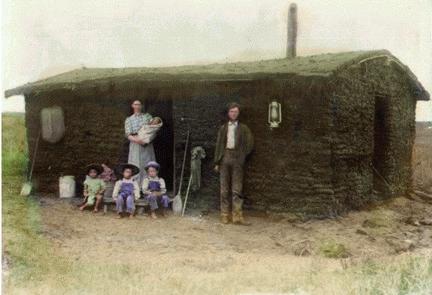
The challenge and delight for all of us is to use these ancient ideas that have worked for our ancestors and apply them in big or small ways to our immediate environment. It's not always easy as city ordinances and neighbors may balk at what looks different from what they are used to. It takes education and successful examples to make inroads into entrenched ideas of what is acceptable for our neighborhoods and communities. But, we are not talking about the sod houses of yesteryear. Instead, we have beautiful, solid structural options today that can use these fibers to the full capacity of our imagination and technology. Take it to the next level!

Sod House in Nebraska

Share/Bookmark

LinkWithin

Related Posts with Thumbnails