TAFA: The Textile and Fiber Art List

Showing posts with label Architecture. Show all posts

Thursday, December 8, 2011

Art Quilt Challenges by Donna Hussain

Monochromatic exercise, quilt by Connie Horne.

Recently a group of my quilting friends in Sacramento, California (USA) decided to form Pins and Needles, a new quilt circle that would focus on making art quilts. Most of us had mastered traditional quilting skills, but now wanted to learn about basic art and design principles such as balance, perspective and scale, concepts that painters, sculptors, and photographers apply to their work. We also wanted to use materials such as beads, stamps, mirrors, paints, and a wide range of embellishment techniques but were reluctant to experiment on our own. Group support has helped our members venture into new avenues of creativity.

Monochromatic exercise, quilt by Donna Hussain.

This past year we studied one chapter a month of The Quilting Arts Book by Patricia Bolton and made small samples of the techniques described in each assigned chapter. Circle members also participated in two major quilt projects: the making of monochromatic quilts and sewing two panoramic quilts of the Sacramento skyline.

Monochromatic exercise, quilt by Helen Burke.


Making monochromatic quilts was an exercise in value. One of our members collected paint chips from a paint store and put them in a paper bag. With eyes closed each member of our circle drew one of the paint chips from the bag. The color of the paint chip determined the color of the 9x15 inch quilt each member was required to make.  Only light and dark fabrics of the paint chip’s color could be used. The quilt design was up to the individual.  After three months all of the participants brought their monochromatic quilts to our monthly meeting.  We were thrilled with the results.

Monochromatic exercise, quilt by Kim Brownell.


Monochromatic exercise, quilt by BJ Bailey.

For the second major group project our art quilt circle decided to make a panoramic slice quilt, chosing a photo of Sacramento’s skyline taken by Evan Wisheropp (the son of one of our quilters)  to be the image we would reproduce in fabric.

Donna Hussain's working copy of the skyline.


A committee of three set the guidelines and rules for the project. Since ten quilters wanted to participate in the project, the committee decided that we should make two identical panorama quilts, five slices each.  After deciding what each of the finished quilts should measure (70 x 220 inches) the committee printed two enlargements of Evans’ photo that size.


Each paper enlargement was then cut into five vertical segments (14 x 44 inches). After outlining the basic shapes on the patterns with felt pen the committee randomly distributed the slice patterns to the quilters. We quilters were advised to pay attention to the horizontal lines on the patterns so that the slices would match up when joined together.

Each quilter also received a 4x6 inch color photo of the panoramic scene to help in the selection of fabric colors for her slice. Since we planned to hang the five slices of each quilt from a single sleeve we were told to omit a traditional quilt binding.  To cover the edges of my quilt I added ¼ inch to the pattern specifications for the quilt top (but not to the batting or back fabric), then folded the ¼ inch excess to the back of the quilt and secured it with a hem.

Sacramento Skyline I, Quilters left to right:
Lori Wisheropp, Denise Schmidt, Helen Burke, Judith Imel, Sunni Hamilton

The committee requested that the quilters work independently, not showing their quilts to others during their construction. We were given five months for the completion of the slice panels. As you can see from the pictures that accompany this article the panoramic quilts turned out to be spectacular.

Sacramento Skyline II:  Quilters left to right:
Connie Horne, Jan Soules, BJ Bailey, Donna Hussain, Kari Bauer

At our December meeting of Pins and Needles we will be choosing an art quilt book for the coming year that has exercises to help us refine our artistic skills. In addition we will be collecting suggestions for one or two group projects for 2012.

______


Note:  The images and drawings on the skyline are copyrighted and used with permission here.   Several people were involved in the process and are available if you would like to commission a similar pattern for your own photo:

Step 1: photoshot in the Yolo Causeway. Photographer; Evan Wisheropp 
Step 2: Photo manipulation: Lori Wisheropp and Sandra Torguson
Step 3. Cartoon sketch; Sandra Torguson
Step 4: Combining sketch and ghosted photo image and full size print output pattern: Lori Wisheropp
Step 5: Distribution with full size pattern and small photo for reference.


California quilter, Donna Hussain, has exhibited in major quilt shows around the country, authored books, and is a regular contributor to Fiber Focus. Click on her name to see all of her past articles. 

The photo shows Donna with her husband, Pascha.
 

Share/Bookmark

Saturday, September 11, 2010

TAFA Members Talk: Creativity Prevails in Ghana

Aba House gets a new wall, Ghana style!


by Ellie Schimelman

The village of Sumburigu is near Bolga in northern Ghana. In July three women from the village packed their bags with important things like crushed stones, dowadowa leaves and coal tar and took a very long bus ride to Accra where Belinda, the daughter of one of them joined them to travel to Aba House. Belinda was important because she was the interpreter - from fra fra to english.

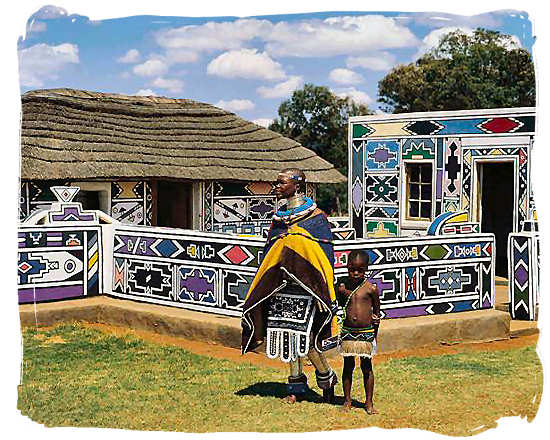
The women were essiential because they were coming to paint our wall. Anyone can paint a wall, but not the way they do it. The first day the wall was chiseled and then plastered with a mixture of sand and cold tar. Traditionally cow dung is used, but coal tar served the purpose.
At the end of the fourth day we had a spectacular painted wall full of symbols relating to life in northern Ghana.

I asked the women to sign the wall (how western of me) and they each left a handprint (how african of them).


 Signing a painted wall in Ghana.

The women's names are Adintoge, Asinsoboro, and Adompoka. Two of the women really do paint their own houses with patterns. The third woman, although she participated and worked hard, was a ringer. I wonder how you say that in fra fra. An okra mouth reported on her. She wasn't going to miss this opportunity and I don't blame her. I'm glad I didn't miss it either. And next summer........ another wall.


And for the rest of the summer the Aba House kids made paper from sugarcane leaves, books, and our newest item- jewelry from the paper.


The kids are having a gallery show in Philadelphia next February.

One day, as everyone was scattered around working, three different people were singing three different songs in three different languages. Although English is the official language in Ghana, it certainly isn't  at Aba House. But somehow, it doesn't seem to matter. Creativity prevails.

Every summer we have interesting visitors. Anna from the African museum in Brussels came to buy a fantasy coffin. She added French to our language mix. Saundra, who actually spoke English, was coming back to Ghana after being there in the Peace Corps 46 years ago. Her stories about how things use to be are fascinating.  Greenie, a first grade teacher from Chicago, worked with some of our younger kids. After she left, one of the kids asked me if I would call the United States and have another teacher come work with them. Ah, if only it was that easy.
Greenie kept a blog while at Aba House: kidconnections

And next year: definitely another workshop with the house painters - our annual African textile workshop- possibly a tour to Burkina or Mali - lots of opportunities for artists and teachers - volunteer positions or just come rent a room and enjoy the ocean view.


The Cross Cultural Collaborative is a member of TAFA, The Textile and Fiber Art List.
Visit their member profile to find out more about this wonderful project.
Share/Bookmark

Saturday, October 25, 2008

The Peace Villa: A Green Hospitality Dream Seeks Angel Investors

The Peace Villa, Travel the World in Paducah, Kentucky

Dreaming of a Peace Villa

This year is my 20th anniversary of working with handicrafts from around the world. I've managed an artisan's co-op, had three brick and mortar stores in Chicago, sublet a small space in Paducah, Kentucky (212 Broadway) and have been selling online for about nine years. The path has been a difficult one, always struggling with lack of capital and with the hard work involved of maintaining inventory, but it's also been a fascinating journey. I've met people from all over the world, have helped many small importers with their businesses, and now am part of an online community that has been inspiring and supportive.

As I look back, even with all the hurdles (I've learned almost every lesson you can learn through the School of Hard Knocks!), I still believe fervently in the importance of incorporating hand made products in our lives, of their cultural relevance, the economic development potential there is in production and marketing and most importantly of the bridges they build between people around the world.

Unfortunately, the ethnic market niche has cycled around and shrunk while competition has grown simultaneously. When I first started selling on eBay, I was one of few with certain items. Now sellers post their wares directly from Tibet, Uzbekistan and other remote (to us in the United States) places in the world. A few years ago, I began to think about a different kind of retailing, one that incorporated both the hospitality and retail industry. I spent several months studying bed and breakfasts, how they are run and marketed and found that the industry in the SouthEast corner of the United States, with Florida as an exception, basically catered to Victorian and Cottage looks, neither of which appeals to me very much. Florida and New Mexico, however, have many models that are inspired by SouthWestern, Mexican, and European decor. Further west, there are plenty of rugged cabins, yurts, and other alternative structures that are interesting and exciting. I thought that the perfect blend for me would be something that incorporated the ethnic flair and had a gallery attached. Then, I thought, why not have each room represent a different country and peacemaker (ex: India and Gandhi, South Africa and Nelson Mandela, Guatemala and Rigoberta Menchu)? The rooms would be decorated with that theme and everything in it would also be for sale. "Like your bed? It's from India. We'll ship it to you!"


The potential for creating different environments representing these places excited me. Visit an An Indian Summer and drool over all the collections of environments she has compiled! As I dreamed, the vision grew into something much larger with huts instead of rooms, acreage of space, a campus of activity and inspiration around the world. I documented some of this on my website and you are welcome to read more about the vision on a grander scale. After months of seeking partners and doing research, I shelved the idea. It resurfaces from time to time, and although I had mentioned it on my earlier post on eco-housing, I realized I hadn't really put this dream out here on the blog. Who knows? Maybe the right people will read it and the dream could come true! (Wouldn't THAT just be something?)

The Time is Right for Going Green in the Hospitality Industry
My love for craft extends itself out into the environment, for how structures can exist harmoniously with nature, blending in, enhancing, and leaving the smallest footprint possible on Planet Earth. I shudder at all the boxes we've built for ourselves and for our cities and towns, plastic covering everything. When I was researching this concept, the green movement was beginning to make its way into the hospitality industry. Now there are wonderful retreats, hotels and Bed and Breakfasts all over the world that both inspire the soul, heal the body and seek to maximize green resources for both construction materials and the operation of a building.

Google "green hotel" or "green bed and breakfast" and you will find wonderful destinations. Hacienda Nicholas in Santa Fe is one example of a beautiful place I could see myself wanting to spend some time, relaxing, recovering... And, the fact that they are environmentally conscious is a selling point in my book! But, here in the SouthEast, we see much less of that drive to go green. Residents in Paducah recently took it upon themselves to start a recycling program. Initiatives happen because people push them into existence and going green is finally making progress because it also makes financial sense in terms of saving money on the rising costs of utility bills.

Paducah, Kentucky as an Ideal Location for the Peace Villa
Paducah has been undergoing revitalization over the past five years. The Artist Relocation Program is now established and seasoned, several key buildings downtown have been renovated, and the City now has a second renovation neighborhood targeted, Fountain Avenue, where buildings and land are available at low prices in exchange for investment in rehabbing and new construction. This neighborhood is adjacent to Lower Town and very close to Downtown.

Paducah is centrally located, almost equidistant in the middle of a two-three hour triangle of St. Louis, Memphis, and Nashville. It's only a seven hour drive from Chicago or Atlanta. Because of this, tourists drive through regularly and stop at the Quilt Museum before getting back on the highway. If the city can continue to develop more magnets that will keep people here for more time, a business like the Peace Villa will just be one more added attraction.

Business Potential for Mixing Retail with Hospitality
Paducah has many of the chain hotels and a couple of bed and breakfasts, but residents of Lower Town clamor for more cafes, more places that they can walk to. I see the Peace Villa in my mind as a structure that resembles a traditional Moroccan or Spanish architecture model on the outside, with a gallery and cafe at the entrance, a large courtyard in the middle, with a swimming pool and tables. The accommodations rise up for two or three stories and there is a lovely roof garden. Can you see it?


I have found that one of the difficulties in selling ethnic textiles or crafts is that many people can't see in their minds eye how they can display them or incorporate them into their homes. In Chicago, we had several designers shop in our stores, but online, it's especially difficult to showcase a product on a low budget. In the Peace Villa, product would have visibility in many different environments and settings. Space helps sell the product, as well as having a memorable experience with it.

I can see the Peace Villa as a local hang out, a place vibrant with cultural activities, classes, presentations, live music as well as a destination that would bring more tourists to Paducah. This is a hot climate in the summer, yet there is only one public outdoor pool. Everything closes early. Nothing happens on Sundays. We could change that! We could offer a place of beauty to both locals and visitors.

Social Goals for the Peace Villa
The Peace Villa would also serve as an educational place on many different levels. The most important one for me is to continue in this work of promoting cultural dialogue and understanding. I think that this is the greatest threat to our national security: the ignorance we have of other cultures, their people and their aspirations. Lately, we have had all this press conference about whether Obama is Muslim or not. He states that he is a Christian, but why should that even matter? We lack a fundamental respect for people of other faiths and traditions that continues to instill fear and hostility. This translates into the decisions we make in our foreign policy and of how we treat our neighbors right here.


The Peace Villa can help awaken curiosity about other cultures by creating these spaces that educate about other traditions, customs and art. Schools could come and visit. We could develop presentations on the different cultures represented. And, on the green side, there is a local tech school here that has a carpentry program. Perhaps they could include the Peace Villa as a teaching tool about how to build green. The possibilities are endless!

The Dream Team for The Peace Villa
I truly believe in this dream. People are traveling less overseas as it becomes more costly and more annoying. Those who enjoy cultural travel will look for options closer to home where they can still enjoy some of the diversity or change of environment that they sought in going abroad. But, this is not a dream I can develop on my own. There needs to be a dream team and funding. I am not an architect or designer, nor have I ever had any experience in the hospitality industry. I do have twenty years of cultural knowledge, retail and marketing experience, and a passion for all of the aspects this vision embraces. I know that if the right people and the funding came into place, I could dedicate the rest of my life towards making it successful.

If you are interested in this concept, do contact me. My resume is posted on my website. I would also love comments about what the rest of you think about this idea or if you have been to similar places.

Share/Bookmark

Saturday, July 26, 2008

The Beautiful Adriene Cruz, Portland Fiber Artist

My local fiber art group, Paducah Fiber Artists, meets once a month for a pot luck, show and tell and general good fun. It's a monthly highlight for me. I arrived a bit late (as usual) to our June 2008 meeting to find this gorgeous woman sitting there. She was a guest artist from Portland, Oregon, spending a month at A.I.R. Studio located in the heart of Lowertown, our art district. Adriene Cruz embodies color, life, elegance, and texture, both in her persona as well as in her art. Her work has obvious African influence, but she incorporates pieces of textiles from around the world and their origins also add their voices to the final creation.

Adriene's website, which she claims is horribly outdated, gives continuity to her work. It is bright, decorated with borders taken from her textiles and filled with words of love and a vision of peace.

Adriene is a transplant from New York, and although her heart is still there, she has become actively involved in Portland's community life. Their local PBS station, Oregon Public Broadcasting, has a program called Art Beat, which interviews local artists and then develops curriculum based for children based that artist's story.


Adriene is there and her video will explain a lot of where she comes from, what inspires her and how she creates her pieces. If you have children or work with them, you might enjoy the three projects on Adriene's page as well as the other artists in the program. Lots of great ideas!

Her community involvement has led her to collaborative work with other artists that have permanently changed Portland's landscape. She has worked on murals, billboards and other public art. The most impressive this train stop:


The North Killingsworth Street MAX Station
Interstate Avenue at N. Kilingsworth

Portland, Oregon's public transit system, the MAX, is beautifying its stations through the designs of a variety of public artists. The North Killingsworth Street Station, which opened May 1, 2004, was developed through a mentorship between Adriene Cruz and design team artist, Valerie Otani.

Adriene's work has been published in several books and her pieces are in private collections all over the world. The Exhibits and Honors page on her website lists the many prestigious places where her work has found a home or made an impact. Has this gone to her head? Nope. Adriene's feet are planted firmly on the ground. And her struggle to survive as an artist continues as a difficult, albeit joyous, path. I had the pleasure of visiting with her a bit at the studio while she was here. Her mother was also here, from New York, and I saw where Adriene learned her spirit of giving and love. Her Mom has the warmest, softest hands I have ever felt. Her smiles radiated benevolence, eyes sparkled with life.

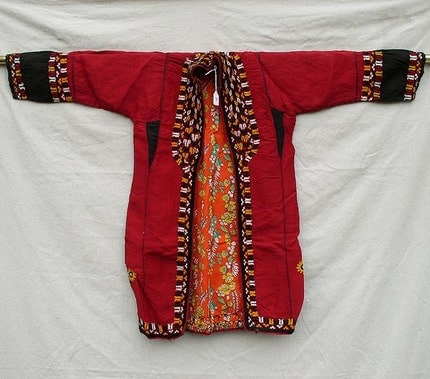
If we are chips cut off from the block, Adriene's block has been solid and good. Speaking, or writing, about cutting, Adriene has no fear in transforming textiles into something new. She bought a Turkmen coat from me very similar to the one on the left (available in my Etsy store, hint, hint), chopped it up and made a beautiful bag out of half of it. She had forgotten to bring one with her, so... no problem! Chop, chop, sew, sew, and there you go! Another accessory to complement her best art piece: her self!

Adriene used the embroidery from the side of the coat as the front flap of her bag and incorporated the embroidery along the hem and front as the strap:

I am inspired by artists and people like Adriene. They help build bridges among people and she has also contributed toward enhancing the physical space of her city. It makes me feel good to know that she is out there and the brief time I had with her here was a sunny day in Paducah!


Share/Bookmark

Thursday, July 24, 2008

Fiber Art to the Max: Tree Shaping and the Dictates of Nature

My first exposure to sculpting with living plants was through my best friend's father when I was a kid in Brazil. Our city was 30% Japanese and her father had immigrated from Japan after World War II. He spent hours with his little bonsai trees and in his garden. Over the years, my appreciation for art as it relates to nature has continued to grow. I am drawn to environments that blend in with their surroundings and that seem to have a conversation with all the elements around them. In college, I fell in love with artist and architect Friedensreich Hundertwasser.


Way before there was even a green movement, Hundertwasser explored how buildings can function as organic structures, both in design and in incorporating living plants and trees as part of the architectural dictates of the environment. Never square, buildings replicate natural mountains. Roofs are gardens, both insulating the living spaces and allowing the mind and body to breathe.

Since then, people have been experimenting with nature in a partnership of art, form and chance. My friend Pam sent me an e-mail with some images of artists who have been taking the ancient bonsai practice to another level. Most had no source information, so if anybody out there knows where these images came from, please leave a comment so we can credit them. I got a big kick out of the time, effort and patience it took from conception of the idea to its fruition.

This bicycle in a tree reminds me of my mother's cousin, Darren, who for years has been sculpting a garden and cemetery in Western Minnesota. His forest is filled with bathtubs, old cars, and other discarded household appliances that are planted with nature and slowly eroding back into the soil. Maybe my interest is partly genetic...

All knotted up...

Star of David

Arch

A living hut


Tree ladder

One of the photos did have a name on it, so I was able to trace it, Pooktre. Australian artists Peter Cook and Becky Northey have transformed their land into a living sculpture. Calling themselves tree shapers, they work on two kinds sculptural work, pieces that are eventually harvested and others that remain planted. The two photos below show Peter with a couple of his living chairs:


Pete's favorites are his trees shaped like men:

Explore their site. They seem like wonderful people. Apparently, they have never sold a piece yet, but had a show in Japan that made the bonsai community wild with excitement. They are thinking of having workshops in the future.

All of this coincides with another Canadian fiber artist that I had recently bookmarked, Alastair Heseltine. You see, to me, working with these plants and trees is fiber art in its most raw and basic form. Yet, it cannot be done without tremendous patience, skill and foresight. Heseltine also plays with tree shaping, but most of his larger pieces involve juxtaposing created structures with nature's background. Here is a living bush that is replicating a basket weave (Heseltine also makes traditional baskets):

And, here is a large sculptural piece that has been assembled by a body of water:

Many of Heseltine's pieces are functional, such as this bench, which I absolutely love:

But, his mastery of basket weaving is especially shown in this gorgeous figurative sculpture:

What I take from this as a fiber artist is that the materials are secondary to the vision. Developing our skills to their fullest potential is a life time of hard work, patience and pushing the elements to tell a new story. Hundertwasser was considered a nut in his early days. He passed away in 2000, finally receiving recognition as the visionary that he was. Most of us will never be famous or rich, but we can enjoy our craft and let it lead us to new places that right now might only live in the murky lands of our imagination.

Alastair Heseltine

Share/Bookmark

Monday, June 2, 2008

Eco Housing: Baskets So Big You Can Live In Them!

Have you ever seen a basket so beautiful that you wish you could blow it up to a much bigger size, magnify it, step into it and live in it? Well, there are traditional dwellings around the world that have lived out this concept, using the natural fiber materials found in their environment to build simple to elaborate living structures. Bamboo, wood, straw, banana leaf, grasses and many other renewable materials take the basic concept in assembling a basket to that larger dimension.

In 1973, a book called Shelter was one of the first to document dwellings from around the world in one place. It is still available through Shelter Publications, which has since published a couple of other publications on the same theme. The book has over 1,000 images of yurts, huts, tents, domes, tree houses and other dwellings in their traditional environment or inspired by native cultures. The book inspired me to get others like it and to think of living spaces in a new way.

Urban and suburban sprawl in the United States have been swirling out of control for the last fifteen years. McMansions behind bars in gated communities promise isolation from crime, other undesirable outside influences, manicured lawns, uniformity, and above all, distance from nature.

Where would you rather live? Here?

A gated community in Ontario, Canada.

Or, here?

A Toraja House in Indonesia

Now there is a huge housing crisis with millions facing foreclosure, displacement, and financial ruin. The increasing cost of oil has also put a stopper into the car culture, the desire for the biggest monster on wheels possible. How many of us really need a hummer? Without downplaying the real pain many families are facing in the loss of their homes, jobs, and access to transportation, this crisis is helping give green construction and transportation businesses the boost they needed to enter mainstream markets.

Several years ago I knew I was fed up with life in Chicago. I longed to be closer to nature, my business was not doing well (retail store selling handicrafts), the cost of living was enormous, and I just wanted out. I started thinking about maybe having a bed and breakfast somewhere with a cultural theme. I knew I wanted to be somewhere in the SouthEast and started researching bed and breakfasts in that area. Everything was Victorian or cute country. Then I found some green businesses, mostly in Florida. New Mexico, California and other Western states had a ton of wonderful spas and green hospitality places with interesting architecture and commitments towards sustainability and low impact living. Sigh... All these wonderful experiments going on all over the country... but, they all need capital and acceptability from the public.

One day, I sat back and had this wonderful vision of a place I would love to be a part of. I saw this villa unfold in front of me, full of the craftsmanship I so love, people from all over the world, a place of teaching and of recovery from the city. I wrote it down, researched it, and called it the Peace Villa. I didn't pursue it, but kept it up on my website, just in case someday it would come off the shelf.

Since that time, similar ideas have been pursued by others, both in terms of personal housing and for recreational purposes. Simon Dale built a house in Wales for his family, what I consider the ultimate dream of living in a big basket.

Simon gave me permission to use his photos and text from his website, so I have a bit below.

"It was built by myself and my father in law with help from passers by and visiting friends. 4 months after starting we were moved in and cosy. I estimate 1000-1500 man hours and £3000 put in to this point. Not really so much in house buying terms (roughly £60/sq m excluding labour).

The house was built with maximum regard for the environment and by reciprocation gives us a unique opportunity to live close to nature. Being your own (have a go) architect is a lot of fun and allows you to create and enjoy something which is part of yourself and the land rather than, at worst, a mass produced box designed for maximum profit and convenience of the construction industry. Building from natural materials does away with producers profits and the cocktail of carcinogenic poisons that fill most modern buildings."

The house is much lighter and bigger on the inside than I expected:


Simon has many more photos and instructions for how to build a similar structure on his site. But, see! Isn't it just a big basket?

This is not a new idea. Variations on this can be found all over the world from time immemorial. Here is a photo, now on public domain, of a wooden yurt from Russia:

Mongul Travel sells gorgeous fabric yurts for under $4,000:


Isn't this just gorgeous? So, here you can live in a basket, covered with your favorite textile! And, look at how bright and sunny the inside is:

Many may think that living in a traditional dwelling like the ones I'm showing here, means living in discomfort, without bathrooms or other amenities, but there are many green construction businesses out there that are adapting these traditional building methods to modern needs or expectations. Bamboo is a wonderful renewable material that has lately been used in many new ways. We now have bamboo fibers that knitters, weavers and quilters can use in their work, and the construction business generates gorgeous flooring and pre-fabbed panels that offer both a durable and healthy option to the often poisonous mainstream materials. Here's a nice little video showing the construction of a bamboo house using pre-fabbed panels:


Your basket house does not have to be rustic and ethnic looking. You know the slick lacquerware found in Thailand and VietNam? Here's an example from Green Tulip Ethical Gifts:

Those who like a sleek, modern look can have it, too! Building Green has a bamboo model house designed by Danish architect, Soren Korsgaard:

If you can't or don't want to build your own basket house, consider staying in one for your next vacation. Many of the sites mentioned in this article have good links that can give you more information on other projects or resources. Again in Wales, Cae Mabon, offers such a retreat with wonderful structures like this one throughout the resort:


Heifer International
, a wonderful food aid program based here in the United States, works worldwide to alleviate hunger. They have several learning programs for adults and teen-agers and are soon opening the Hidden Villa in California:

"The ten acre campus will be located at Hidden Villa, a nonprofit environmental education center in Los Altos Hills, California (18 miles west of San Jose). Since 1945, Hidden Villa has provided learning opportunities to inspire a sustainable future."

Not only are these basket houses interesting architecturally, but they also step lightly on the earth and save resources. If built correctly, they can help us save energy, reduce our dependency on oil, and decrease the use of toxic materials. My friend, Tom Spaulding, of Angelic Organics Learning Center, recently built a new building which houses their offices and training workshops. They used straw bale building methods with naturally harvested woods for supports, creating a gorgeous structure. This is in Beloit, Wisconsin where winters are miserable and long. The building was so warm, they often wore shorts during the winter! Imagine! No heating bills in the bitter MidWest!

The challenge and delight for all of us is to use these ancient ideas that have worked for our ancestors and apply them in big or small ways to our immediate environment. It's not always easy as city ordinances and neighbors may balk at what looks different from what they are used to. It takes education and successful examples to make inroads into entrenched ideas of what is acceptable for our neighborhoods and communities. But, we are not talking about the sod houses of yesteryear. Instead, we have beautiful, solid structural options today that can use these fibers to the full capacity of our imagination and technology. Take it to the next level!

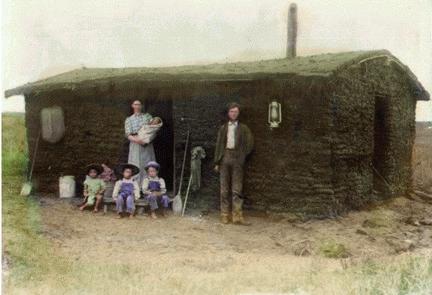
Sod House in Nebraska

Share/Bookmark

LinkWithin

Related Posts with Thumbnails