TAFA: The Textile and Fiber Art List

Showing posts with label Public Art. Show all posts

Monday, February 23, 2009

El Anatsui: Making Garbage Speak


I recently posted about Ellie's Cross Cultural Collaborative program in Ghana. She e-mailed me today about El Anatsui, an artist native of Ghana who has lived in Nigeria for many years and asked if I was familiar with his work. I wasn't. After exploring some links, I just had to share some of his work here on Fiber Focus as he embodies the essence of what I would like to see happen in this blog.

For a long time, I have felt the need help lessen the divide between "artists" and "artisans" which I believe uses ethnocentric language to categorize work that might have similar functions and skill levels yet results in a huge disparity of recognition and price point. The key, I believe, has to do with the educational level and language used by the maker in his or her description of the work. The first level of separation happens between developed and underdeveloped countries, while the second happens within those same countries, between the educated who have access to both language skills and to the markets that will support their prices.


El Anatsui has embraced the divide and consciously uses his fine art training to break out of that mold into one which addresses societal issues and the language of the people. He explains how if he chooses to work with bronze, the material is alien to the population. But, if he uses a Coke bottle, everybody knows what that is, and in knowing, they can see his work. The photos I chose for this post all resemble textiles, although Anatsui thinks of them as sculptures. He does acknowledge that he grew up among textile weavers and his father and brothers wore kinte cloths. Many of Anatsui's pieces are dimensional and free standing. The Metropolitan Museum video below has an excellent interview with the artist, where he speaks of how his pieces are assembled and how they can be displayed.


The transformation of garbage into something so beautiful is a powerful testament to how we perceive our surroundings. El Anatsui speaks of beauty as not only ocular, but as something that also has a qualitative value. A person can have physical beauty, but the inner qualities are what makes that beauty powerful and valuable. In the same way, his work has a definite beauty of composition which comes to life when the viewer understands and relates to the message.


As I was looking at his work, it occurred to me that he can only make his statement because he has a receptive audience who understands what he is trying to say. El Anatsui has the language he needs to bridge that gap between the monied institutions who can afford to house, display and purchase his work, as well as the life and cultural experience where he can communicate to the uneducated masses. Without that language, surely his special vision of the potential and message of garbage would have remained just that, garbage.


Versatility
2006
Aluminum and copper wire
Fowler Museum at UCLA, museum purchase, X2007.7.1

Africans have a long history of using garbage as a natural resource. Their tin painted suitcases, wire toys, pop can cars, tire sandals, papier mache bowls, recycled vinyl record beads and inner tube furniture have been raw materials for craft production for decades. If you are poor and you have the skills to weave, build, solder or cut, you can eek out a living with what you have around you. These crafts have had success with co-ops, fair trade groups and collectors. But, El Anatsui takes this tradition to another level. The sheer volume and size of his works make a powerful impact on the viewer. You look at it and try to imagine how many wine bottle wrappings it took to make this piece. Then you realize that this is nothing compared to what is thrown away daily.


As our natural resources begin to run out, so will the availability of certain types of garbage. Copper wire used to be thrown about and now there are stories here in the United States of houses for sale being stripped during the night of anything containing copper. What will happen when plastics, aluminum, and tin become valuable? Hopefully, it will force us to establish better recycling systems and biodegradable containers. Meanwhile, we can let El Anatsui use his garbage to speak to us. If we listen, we will see our shared histories: our past and our future.

Share/Bookmark

Monday, January 19, 2009

A Man on the Street: Dr. Martin Luther King Jr.

219 E. Martin Luther King Boulevard, Los Angeles, 2006.

A little deviation from fiber art here... I found this interesting slide show on the New York Times and thought it was worth sharing. Photographer Camilo José Vergara has been photographing urban landscapes for a couple of decades. In this series, he documents murals that include images of Dr. Martin Luther King, Jr.

Several of the murals were in Los Angeles in obvious Latino neighborhoods, interesting as historically Blacks and Latinos have experienced tension with each other, especially in situations where they competed for the same jobs. I taught ESL in a Mexican neighborhood for awhile, over 20 years ago. I drove by a large mural on the side of a Church every time I went down to the class. That mural had Dr. Martin Luther King Jr as a central figure, along with Gandhi and a couple of other peace makers. Wish I had taken a photo...

The class sought to address some of these issues as the residents of Little Village lived next to a Black neighborhood and there was great animosity between both. I'll never forget how one of my students, a gentle Mexican man in his 50's thanked me at the end of our 10 week session. He worked in a factory and had been at a machine, next to a Black man for years and they never said a word to each other. Because of the class, he decided to start greeting him and the two became friendly, even helping each other when their machines acted up. We have come a long way in 2o years, yet much work remains to be done. That work can start with a greeting...


Artist's Statement:

"In America’s poorest ghettos, the Rev. Dr. Martin Luther King Jr.’s portrait is one of the most popular subjects of public art. These images, which I have been documenting since 1977, regularly appear on the walls of the liquor stores, auto-repair shops, fast-food restaurants, mom-and-pop stores and public housing projects of Chicago, Detroit, Los Angeles, New York and many other cities across the country. The majority are the work of amateur artists. Though Dr. King is usually front and center, he is often accompanied by other inspirational figures: Nelson Mandela, John Paul II, Malcolm X, Rosa Parks, Mother Teresa, Pancho Villa. He is often accompanied by his famous phrase, “I have a dream” – a reminder that in many of the communities where these murals exist, the gulf between hope and reality remains far too wide."
- Camilo José Vergara

Visit the slide show to see all of the photos!

Share/Bookmark

Saturday, July 26, 2008

The Beautiful Adriene Cruz, Portland Fiber Artist

My local fiber art group, Paducah Fiber Artists, meets once a month for a pot luck, show and tell and general good fun. It's a monthly highlight for me. I arrived a bit late (as usual) to our June 2008 meeting to find this gorgeous woman sitting there. She was a guest artist from Portland, Oregon, spending a month at A.I.R. Studio located in the heart of Lowertown, our art district. Adriene Cruz embodies color, life, elegance, and texture, both in her persona as well as in her art. Her work has obvious African influence, but she incorporates pieces of textiles from around the world and their origins also add their voices to the final creation.

Adriene's website, which she claims is horribly outdated, gives continuity to her work. It is bright, decorated with borders taken from her textiles and filled with words of love and a vision of peace.

Adriene is a transplant from New York, and although her heart is still there, she has become actively involved in Portland's community life. Their local PBS station, Oregon Public Broadcasting, has a program called Art Beat, which interviews local artists and then develops curriculum based for children based that artist's story.


Adriene is there and her video will explain a lot of where she comes from, what inspires her and how she creates her pieces. If you have children or work with them, you might enjoy the three projects on Adriene's page as well as the other artists in the program. Lots of great ideas!

Her community involvement has led her to collaborative work with other artists that have permanently changed Portland's landscape. She has worked on murals, billboards and other public art. The most impressive this train stop:


The North Killingsworth Street MAX Station
Interstate Avenue at N. Kilingsworth

Portland, Oregon's public transit system, the MAX, is beautifying its stations through the designs of a variety of public artists. The North Killingsworth Street Station, which opened May 1, 2004, was developed through a mentorship between Adriene Cruz and design team artist, Valerie Otani.

Adriene's work has been published in several books and her pieces are in private collections all over the world. The Exhibits and Honors page on her website lists the many prestigious places where her work has found a home or made an impact. Has this gone to her head? Nope. Adriene's feet are planted firmly on the ground. And her struggle to survive as an artist continues as a difficult, albeit joyous, path. I had the pleasure of visiting with her a bit at the studio while she was here. Her mother was also here, from New York, and I saw where Adriene learned her spirit of giving and love. Her Mom has the warmest, softest hands I have ever felt. Her smiles radiated benevolence, eyes sparkled with life.

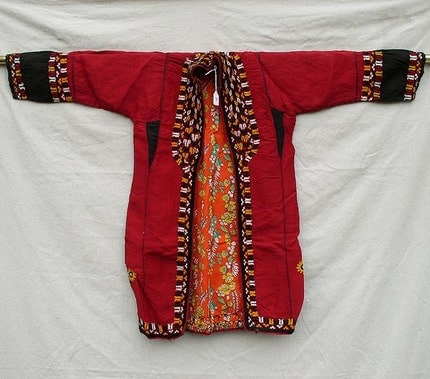
If we are chips cut off from the block, Adriene's block has been solid and good. Speaking, or writing, about cutting, Adriene has no fear in transforming textiles into something new. She bought a Turkmen coat from me very similar to the one on the left (available in my Etsy store, hint, hint), chopped it up and made a beautiful bag out of half of it. She had forgotten to bring one with her, so... no problem! Chop, chop, sew, sew, and there you go! Another accessory to complement her best art piece: her self!

Adriene used the embroidery from the side of the coat as the front flap of her bag and incorporated the embroidery along the hem and front as the strap:

I am inspired by artists and people like Adriene. They help build bridges among people and she has also contributed toward enhancing the physical space of her city. It makes me feel good to know that she is out there and the brief time I had with her here was a sunny day in Paducah!


Share/Bookmark

LinkWithin

Related Posts with Thumbnails