
TAFA: The Textile and Fiber Art List

Showing posts with label Workshops/Educational Opportunities. Show all posts

Wednesday, April 13, 2011

TAFA Market Focus: Rose Hughes

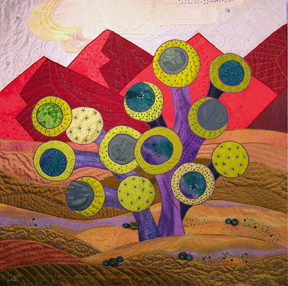
"Riding the Thermals", by Rose Hughes, 45"x45", $3,500

TAFA is having its first public event during the AQS Quilt Show in Paducah.  We are excited to introduce TAFA to the public at large and are hoping to raise funds for our new website.   We have a silent auction and raffle, both available to online participants and an exhibit and vendors.   These are ways in which you can donate to support our efforts.  This blog will feature the works and vendors in the next two weeks.  You can see all of the TAFA Market posts in one place by clicking on this link

Today's TAFA Market focus zooms in on:


Rose Hughes


When I first saw Rose's quilts on her website, my eyes popped out.  I shoved them back in and studied her compositions, choices of color, and fell in love.   RavenSpeak Quilts are about the fecundity of nature, the freedom of hills and sky, the beauty of sunsets, trees, and life.  Roundness, calling you in for comfort and a hug, her work invites me to a walk outside, to slow down and let the air move around me.

Rose will have one quilt in our TAFA Market exhibit, "Riding the Thermals", pictured above.  She describes it:

"This design was originally created for a Quilting Arts article showing the effects you get when discharging silk and velveteen and then using crayons and paint for surface design. This second version was completed and traveled as part of the special art quilt exhibit Noble Elements."

It happens to be one of my favorites and I can't wait to see it in real life.
The Raven shows up often as a symbol in Rose's quilts.  She explains it in her Artist's Statement:

"Inspiration for my quiltart is drawn from my love of the ever-changing hills that make up our landscape, and from the ravens that mirror and mock this region's boisterous, and sometimes-crazy human residents. Watching ravens, I see how they live and weave their lives among us. Keeping an eye on us, laughing at us, they point to a layer of life that often goes unnoticed. 

Poet Mary Oliver refers to these rowdy creatures as “an advertisement for the more than ordinary life.” By allowing myself to experiment with materials, techniques, and color my works are attempts to express our always wondrous, always changing landscape. 

In my work I use the idea of layers to transform fabric. I began by creating a layer of strong structural shapes that are important for their initial impact on the senses, and the suggestion they give of the landscape. 

Like a raven, stealing and hoarding the ‘shiny objects', I embellish the areas of the base quilt canvas. I use handspun yarns to create strong lines to highlight each shape, and I add whimsy, texture, and sparkle by using a variety of glass beads and magical, shiny found objects. These embellishments used in combination with hand painted, hand dyed fabrics, imported silks and selected textural layers bring each original piece to life."

Here is another example of Rose's quilts:
"Desert Tango", Art Quilt by Rose Hughes

I absolutely love her sense of color!  And, apparently other people do, too, as Rose has a busy schedule of workshops, teaching others around the United States how to see in a new way and how to translate that vision into fabric.

Rose has taken time from that full life to help out with our TAFA Team Blog, where TAFA members who have Etsy shops showcase their work.  She does this even though she has closed her Etsy shop!  Pretty generous in my book...

If you would like to purchase "Riding the Thermals" and are not coming to Paducah, you can do so via Pay Pal.  Just email me and I will give you the details.  We will ship to you after the show.  Meanwhile, explore Rose's website and take a look at her schedule of workshops.  Who knows?  Maybe she can help you see the world in a new, colorful way!



Share/Bookmark

Tuesday, March 15, 2011

Doris Florig: Weaver on a Boat, Explorer of Traditions

"Grand Isle Corn" by Doris Florig
Searching for the Ruins of an Indigo Plantation

By Doris Florig

Six years ago, each time I told  friends that my husband, Dennis, and I had decided to spend our winters on our cruising sail boat, the first thing they all said was, “so I guess you will have to give up weaving”.  Well, I knew that was not a possibility. I knew I could adjust to nomadic style looms, but, I had no idea that my knowledge of weaving would grow with such diversity. Weaving has given me the key to open the doors to connect with new people, their culture and history.

Doris learning about mud dyeing from a Carib Amerindian in Dominica.


Dennis checking the sail trim.
Most recently, while sailing the Eastern Caribbean chain, we sailed to the island of Maria-Galante, Guadeloupe. Before arriving, I looked through a French publication by the Conseil General De La Guadeloupe. It showed a photo of ruins of 17th century indigo processing vats. My experience with natural dyeing is extensive but lacking in any exposure to Indigo. I knew that this was to be the beginning of what would develop into an intensive study of INDIGO. We rented a car and set out on a quest to broaden my knowledge of the history and the processing of Indigo. 

It wasn’t as easy as I thought. Somehow I guess I was thinking there would be something very oblivious like a sign saying “Historic Site”. We found the general area, but not the site.  I approached an elderly French women on the roadside. Knowing that neither of us spoke the same language, I approached her with the photo of the ruins and a map. Well, the map was of no help. I had forgotten that people, who don’t travel, can’t relate to maps. The photo was of some help, but we didn’t connect until I pointed to the blue on her dress and said INDIGO.  I detected a slight smile and twinkle in her eye that indicated she understood. She pointed towards the sea.  So, downhill I went and quickly discovered a field with a small low stone structure, possibly an old barn. Ignoring the oxen scattered about the field, I headed toward the structure not knowing what to expect.

The oxen didn't bother Dennis.


It took a while but eventually, I realized that it could be nothing other than the foundation for the production of Indigo.


Indigo vat ruins in Guadeloupe.


The stone ruins formed three very distinct shapes approximately 12 x 12 feet which indicated to me that these were the walls of the vats. The first vat was for fermenting the indigo for a period of 24 hours. The second vat would have been used for the churning process and the third vat used for draining the fluid from the sludge used to make the dye.  The whole thing was a mystery until I saw the openings for the draining process. That was a dead give-away, I had indeed discovered the ruins from a 17th century Indigo Plantation. I felt like an amateur archeologist. The discovery of this foundation is now the beginning of my quest to fully understand and experience the process of dyeing with indigo.

Dennis discovered the remains of an old cauldron. We think it was original equipment used in  the processing.


At the next island, Domonica, we visited a Carib Reservation. They knew no history of Indigo dyeing but Dennis and I were convinced that they were cooking their Cassava bread on a broken historic cauldron.


Doris Florig is a weaver/fiber artist. She will teach natural dye classes in Jackson Hole this summer. On Aug 6 and 7, 2011 she will present a natural dye lecture and a demonstration in Fargo, North Dakota.

Visit Doris Florig's website.


Doris, in the saloon,settled into weaving her winter tapestry project, THE GATES OF NAHANNI.  The original painting for this cartoon was done by Dwayne Harty supported by the Yellowstone Yukon Conservation Project directed by Harvey Locke.


Share/Bookmark

Saturday, September 11, 2010

TAFA Members Talk: Creativity Prevails in Ghana

Aba House gets a new wall, Ghana style!


by Ellie Schimelman

The village of Sumburigu is near Bolga in northern Ghana. In July three women from the village packed their bags with important things like crushed stones, dowadowa leaves and coal tar and took a very long bus ride to Accra where Belinda, the daughter of one of them joined them to travel to Aba House. Belinda was important because she was the interpreter - from fra fra to english.

The women were essiential because they were coming to paint our wall. Anyone can paint a wall, but not the way they do it. The first day the wall was chiseled and then plastered with a mixture of sand and cold tar. Traditionally cow dung is used, but coal tar served the purpose.
At the end of the fourth day we had a spectacular painted wall full of symbols relating to life in northern Ghana.

I asked the women to sign the wall (how western of me) and they each left a handprint (how african of them).


 Signing a painted wall in Ghana.

The women's names are Adintoge, Asinsoboro, and Adompoka. Two of the women really do paint their own houses with patterns. The third woman, although she participated and worked hard, was a ringer. I wonder how you say that in fra fra. An okra mouth reported on her. She wasn't going to miss this opportunity and I don't blame her. I'm glad I didn't miss it either. And next summer........ another wall.


And for the rest of the summer the Aba House kids made paper from sugarcane leaves, books, and our newest item- jewelry from the paper.


The kids are having a gallery show in Philadelphia next February.

One day, as everyone was scattered around working, three different people were singing three different songs in three different languages. Although English is the official language in Ghana, it certainly isn't  at Aba House. But somehow, it doesn't seem to matter. Creativity prevails.

Every summer we have interesting visitors. Anna from the African museum in Brussels came to buy a fantasy coffin. She added French to our language mix. Saundra, who actually spoke English, was coming back to Ghana after being there in the Peace Corps 46 years ago. Her stories about how things use to be are fascinating.  Greenie, a first grade teacher from Chicago, worked with some of our younger kids. After she left, one of the kids asked me if I would call the United States and have another teacher come work with them. Ah, if only it was that easy.
Greenie kept a blog while at Aba House: kidconnections

And next year: definitely another workshop with the house painters - our annual African textile workshop- possibly a tour to Burkina or Mali - lots of opportunities for artists and teachers - volunteer positions or just come rent a room and enjoy the ocean view.


The Cross Cultural Collaborative is a member of TAFA, The Textile and Fiber Art List.
Visit their member profile to find out more about this wonderful project.
Share/Bookmark

Sunday, July 25, 2010

Felt Workshop by Lily Liu in Paducah

Nuno-felted Scarf by Lily Liu


Lily Liu and Susan Sadow.

I belong to a group of fiber artists that meets monthly here in Paducah.  We have the obvious name of Paducah Fiber Artists.  We have a potluck, catch up with each other and then hold a show-and-tell.  It's a highlight for me and one of my favorite peeks is to see what Lily Liu has been up to lately.  Lily has a motto that she quotes often, "Make every minute count!"  Her free minutes are often filled with tedious folding or wrapping of small objects that she makes by the thousands and then assembles into a sculpture.  Or, she crochets weirdly wonderful necklaces out of dyed nylon fishing wire.  Then, there is all the felting she does.  As a mother of two lively boys, Lily certainly makes every minute count.

Lily is offering a workshop on felt!  Make every minute count and come learn from her!

Felted vessel by Lily Liu


Felt-making Workshop

This workshop is for those interested in work with wool. It is my intent to provide you with an introduction to basic felting techniques; color blending, Nuno felting, needle felting, as well as using resist make 3D forms. You will end this workshop with samples from each technique and a project that you choose to accomplish (e.g. a nuno felt scarf, or a 3d form)

Location:  Paducah Tilghman Art Building 
Time:   Aug.2nd and 4th (Monday and Wednesday)
        Instruction 8:30 – 12:00
        Open studio 12:00 – 3:00
Fee:    Workshop $80.00 
            Material $20.00

Material fee includes a starter kit of white, black and multicolor roving, needle felt kit, a swimming noodle, etc, plus shared use of equipment listed below:

a.    Bamboo mats
b.    Bubble wraps
c.    Wash boards
d.    Murphy oil soap
e.    Drum carder

If you bring your own materials, you can register for $80.00.

Students should bring their own: A notebook, old bath towels and a pair of sharp scissors.

Space is limited so reserve early to secure your space, preferably before July 28th so I will have enough time to get material package ready.

-Lily Liu


.
Share/Bookmark

Wednesday, July 14, 2010

New Page on TAFA: Etsy Shops!

Visit TAFA! A treasure trove of textiles and fiber art!

Have you been to visit TAFA yet?   TAFA: The Textile and Fiber Arts List was launched in February and has been growing steadily into a beautiful group of textile and fiber art businesses!  I was surprised to see that about 30% of our members were also Etsy sellers.  We have decided to organize ourselves into an Etsy Team and to get the ball rolling, I set up a page on TAFA with our Etsy minis.  How fun to see us all together on one page!  The stores are divided into their main focus, although many also carry products that would fit into other categories.  Here is a sample:


Home Interiors  
Papaver Vert
Susan M. Hinckley
Vintage Renewal
Yellow Violet


Our goal?  To become THE destination for the best source of textiles and fiber art on Etsy.  Our members are both working artists and small businesses who work with cultural textiles.  You will find contemporary work and traditional techniques, old and new.  Many of us support green practices, recycling, fair trade, and other worthy causes.

Feel like shopping?  Remember, when you shop from small businesses like these, you are supporting real people, people who work very hard at making this world a beautiful place, filled with the art of all that is handmade!


 TAFA members rock!


Are you a fiber artist?  Do you work with textiles?  
.

Share/Bookmark

Tuesday, February 16, 2010

Intarsia Concept Offers A Basic Online Product Photography Course


by Tara Agacayak, Intarsia Concept Co-Founder

My partner Figen Cakir and I met through our love of art and craft which is ironic considering that our husbands work together - a fact we didn't learn until months later! With two separate businesses selling handmade, culturally-inspired products from Turkey, we naturally began projects supporting local artisans in our community. Figen runs The Knit Box, featuring natural Turkish yarn, handknits and knitting accessories. I started Citara's Handcrafted Boutique to highlight modern home and fashion products reflecting traditional Turkish techniques and motifs.
In building our online businesses, we conceived of Intarsia Concept (IC) as a venue to share our experience and learn from the experiences of others. IC is for people who want to turn what they love into what they do. For us it is our love of Turkey, art, design and culture. For you it might be rugs, quilts, tapestries ... (fill in the blank here).

One of the things we learned working in a digital environment is that selling products online is vastly different than selling them in person where visitors can see and touch our products. In person they get the full impact of color and texture. Because they are handmade, our customers understand the care that goes into each product because they can see all the detail imprinted by the artist.

But selling online is completely different. In this two-dimensional environment your potential customers are people who click away in an instant if there is nothing to keep their attention. So when we started IC, one of the first things we wanted to do was put together a course teaching basic product photography skills. We're proud to report we have finally done this with Diana Brennan from D.S. Brennan Photography. We hope that this course will not only help independent designers and artists like you take good photographs of your projects and products for the purposes of selling, but more importantly that it will also help you present your work in a way that honors the love and care with which you have created it.

Because it's not just about what you do, it is also about how you communicate that to others. Good photography is one way to broadcast your artistic message. Whether you are selling something or not, a well-photographed image speaks a thousand words.

If you're interested in attending the Basic Product Photography Course to learn how to present your work at its best, registration is now open. The self-paced e-course begins Monday, February 22nd but is only open to the first 50 students who register. As a special thank you to Fiber Focus readers, anyone who registers from this blog will receive a $5 refund with the coupon code {prodphoto10}. In addition, for each registration that comes through this community, member Catherine Salter Bayar will donate $5 to Nest, a nonprofit that gives micro-loans to female artisans.


Tara Agacayak

 Figen Cakir


Note from Rachel:  Catherine has contributed several posts on life in Turkey and her business, Bazaar Bayar.  Click here to see them.
Share/Bookmark

Tuesday, July 21, 2009

Ecological Arts by Rebecca Burgess

"The role of Ecological Arts is to create art in order to understand and revitalize natural systems. Founder Rebecca Burgess has been a teacher and artist for many years."

As an environmental educator and textile artist, I am consistently looking for ways to engage students and the public in hands-on textile arts techniques that move us one step closer to living in greater harmony with the planet.

Ecological Arts offers a series of workshops
on using natural dyes and weaving.


I created EcologicalArts in 2004 as a way to house the sustainable textile arts processes that I was both creating and learning from other artisans around the world. Inspired initially by villages like Pejeng, Bali, and Sukhonakon, Thailand, places where women grow and spin organic cotton, raise and ferment indigo, and work cooperatively to produce beautiful finished goods. These villages illuminated sustainable textile production for me. Upon returning home, I felt the calling to start my own tradition.

California Fleuristic Province, home of Ecological Arts.

I live in the California Fleuristic Province, it is among the 25 most bio-diverse places on the planet. I felt there must be species here, in my homeland, that I can use for color- and thus avoid the carbon footprint incurred from ordering all of my dyes from overseas, or even out of state. In the process, I have become a natural dye harvester, restoration gardener, and an unintentional steward. I prune, I weed, I replant, and I seed- it's all a part of the harmonious and reciprocal process. Stewardship and dye work are now hand-in-hand activities for me. My garden is both a restoration site for native and useful dye plants, and an experimentation zone of Indigo, prairie wildflowers, and pokeberry.

From plant life to yarn color, dyes by Ecological Arts.


While there are still dyes such as cochineal, and logwood, whose colors I have not found sustainably harvested substitutes for, I was able to find and create recipes for every color of my hearts desire. And, there is still a lifetime of experimentation left in the fields and hillsides of my homeland.


As a canvas for these natural colors- I connected with the local sheep ranchers, angora producers and organic cotton farmers. These relationships have given me the opportunity to economically support local fiber producers. They create some of the highest quality raw materials in the world, and yet their origins are at most 70 miles from my home!


These processes I undertake are nothing new in history, they are in fact quite ancient, and yet- I feel that every moment of creating with nature’s raw materials is a novel experience. The permutations and possibilities for what a textile artist can do with the resources within his or her community is truly stunning.


Yarns by Ecological Arts.


Rebecca Burgess graduated from UC Davis in Art History, and while in the central valley spent time studying at DQ Native American University. Searching for art outside the academic canon, she found a Native American basket weaver. The artistry, ecology, and function of the native baskets became her inspiration. While traveling throughout the United States, and Asia she found remnants of ecologically focused textile art traditions.
Through each investigation she became increasingly inspired to begin a local tradition within her own bio-region. Ecologicalarts was born in 2004. An organization dedicated to creating, reviving, and teaching, art forms that utilize resources to promote thriving eco-systems.

Rebecca is a member of the Fiber Focus Group, has a blog, website and sells on Etsy.


Find more photos like this on Fiber Focus
Share/Bookmark

Monday, June 15, 2009

A Pilgrimage to the Santa Fe International Folk Art Market


If I were to go anywhere in the world as a pilgrimage, my choice would be the Santa Fe International Folk Art Market. I can't think of another place that would be a Mecca of all my interests in culture, people and the wonderful things they make. Sure, there are many other folk art festivals that would be interesting, but this has to top them all! Every year I hope I can go and so far I haven't been able to afford the trip. You see, it's not only going there and experiencing the environment that would thrill me, but I also would want to buy, buy, buy!!!! Someday it will happen!

Meanwhile, you go. Go be my eyes and ears and report back about how much fun it was! Tell us all about the wonderful people you met and what treasures you bought. The Market will be loaded with all of the ingredients to make anyone clap with joy, dance with delight and participate to their heart's content. There will 140 artists present representing 41 countries! You can travel the world just by walking around! Workshops, ethnic foods, live music and cultural presentations combine to make this a world event in one of the most interesting cities of the world.

Here is a video from last year's market:


My biggest joy would be to interact with the artists and see them at work. The International Folk Art Market's website has a full listing of those who are scheduled to come with a bio of their work. I picked a sampling just to give you an idea of the wonderful diversity of both regions represented and the work they produce, although I have to admit that even though I love all craft forms, I do tend to gravitate towards the textiles. The photos and text belong to the Santa Fe International Folk Art's site and I am quoting a partial bio just to entice you over to their site. Click on the Artist's name to see their full page.


Peru
Artisan Committee of Centro Poblano de Chijnaya
Chijnaya Foundation
Embroidery
The Andean village of Chijnaya was born after a flood in 1963 devastated villages near Lake Titicaca. As part of the resettlement project, and through the influence of Peace Corps volunteers, the concept of having the children embroider scenes of daily life took hold. What emerged were “bordados” employing hand-dyed alpaca yarn embroideries soon captured world attention and on a ground of “bayeta” or hand-woven simple weave woolen cloth.


The Palestinian Territories
Sulafa Embroidery Shop/project of the United Nations Relief and Works Agency
Embroidery

The United Nations Relief and Works Agency runs a self-supporting embroidery program which employs over 500 refugee women in the Gaza Strip to produce articles to sell at the Sulafa Embroidery Shop, helping preserve valuable traditions and increasing family incomes.


Niger
Silver and Gemstone Jewelry

Moussa Albaka is from Niger, Africa, and as a metal-smith he designs gorgeous jewelry using sterling silver, Tuareg silver and semi-precious stones. His techniques include engraving intricate geometric designs, using decorative inlay, and a lost wax process.


Georgia
Georgian Textile Group
Embroidered, Woven and Felted
Textiles and Objects
Nino Kipshidze, founder and president of The Georgian Textile Group (GTG), has been involved in crafts since her studies at the Academy of Fine Arts. GTG is an association of artists, designers, researchers, art historians, and ethnographers working to revive and improve the quality of Georgian folk textile art and craft and to support artisans works and by creating an international market for their work.


Brazil
Tesoros Trading Company
Woodblock Prints and Chapbooks


José Borges, one of Latin America’s most celebrated folk artists, wields his knife and piece of wood in his humble workshop, attracting collectors and curators from around the world. Considered an unlettered folk poet, Jose has more than 200 cordel, or chapbook, titles to his name and is still writing.


Yuzhen Pan
China
Minority People Textile Folk Artists Cooperative of Southwest China
Weaving, Embroidery and Batik
Yuzhen’s family continues to farm in Guizhou while she lives part time in Beijing working in an embroidery workshop and selling Miao textile items at an open air market.

*****

As you can see, each artist comes with a story, a life-line that connects them to their region. It will surely be fascinating for anyone who can make it to the festival. But, I also think this is such a profoundly valuable opportunity for all of the participating artists. I have worked in multi-cultural groups for many years and remember how disturbing it was to me that each group has its own set of biases, misconceptions and stereotypes that can lead to racism and narrow-mindedness. This is not only about white people learning about the world and "helping" through their dollars, but instead, contact and interaction opens all people to a larger world filled with new opportunities. We all have the need to both give and receive, to teach and to learn, to share and to grow and this makes the world a safer, healthier and more dynamic place to live.

If you make it to the Market, please report back here and tell us how it went! Or, if you like to write, I would love to have your experiences documented in a post. Take lots of photos and share them with us! Someday I will make my pilgrimage, but until then, enjoy yours!

Visit the Santa Fé Convention and Visitors Bureau for travel info.

***

Share/Bookmark

Friday, May 8, 2009

Ricky Tims Brings Rhapsody to Paducah

Bohemian Rhapsody by Ricky Tims

This past week, I had the good fortune of meeting Ricky Tims this past week as he taught a workshop on his Rhapsody quilts at the National Quilt Museum here in Paducah. Ricky Tims has carved himself a niche in the quilting world. Recognized internationally as an artist an and educator, he is also one of the few male quilters to take such an extensive leadership role in this art form dominated by women. I first saw his quilts at a group show at the museum which showed the work of three male quilters, one of them being Ricky Tims. His stunning choice of colors, beautiful designs and immaculate stitching make them a wonder to behold.

Ricky Tims, "The Quiltin' Harley Dude"

Known for his good humor and enthusiasm, Ricky Tims can pull off flaunting "tough" symbols like riding a Harley or wearing a cowboy hat from his native Texas. At the same time, his quilts show a depth of sensitivity for beauty, color and grace. A gifted musician, his music is hauntingly beautiful and soul oriented. All of this love for raw beauty, art and nature comes together in Autumn Rock, "40 acres of heaven", a get-away for quilters in southern Colorado.

Autumn Rock, A Piece of Heaven for Quilters

The workshop Ricky Tims had here at the Quilt Museum focused on teaching students how to design and execute the technique he uses in the beautiful medallion quilts that have won so much recognition. Ricky Tims has several books out on the process, both step-by-step instructions and patterns for individual pieces. I learned most of what I know through books, but there is nothing like having the guidance and personal interest of someone who has already worked through all of the kinks and who know what short cuts will achieve the desired results.


Students learn how to break an intricate design into a simple concept.

A simple drawing breaks down a complex quilt medallion.

Several steps take the student from a small drawing to a full-size template. The large piece has been drawn out on freezer paper.

Freezer paper drawing at a Ricky Tims workshop.

The freezer paper is cut up and ironed on to the fabric. Each student had brought their own stash of fabrics that they were planning to use. It was fun to see how different each person's taste translates into a unique visual, a combination that will make a similar technique achieve very different finished pieces. Ricky Tims uses hand-dyed fabrics, vibrant in color, which produce gorgeous contrasts. He also has his own line of threads, which in the Rhapsody quilts, have a necessary and complimentary impact. Those, along with books and patterns, are available in his website shop. You can also purchase cds of his music there.

Cutting freezer paper for the Rhapsody quilts pieces.

The pieces are sewn, appliqued, and assembled on a wall board. Working in a structured manner helps keep order in a process that could easily become chaotic and overwhelming.

Sewing a piece for a Rhapsody Quilt.

Pieces assembled and pinned to a wall board.

Of course, the master knows all the tricks of how to make edges meet, how to keep them from puckering, how to make seams flow naturally, when to quilt, and how to make colors sing to each other.

The participants, all women from around the country, were engaged in their tasks, thrilled to be both with Ricky Tims and here in Paducah. I sat and talked to a few and of course, they spoke of the burdens they left at home, of the relief they felt in taking a respite where for a few days, they could dive in to their creative juices full time. I thought about how any creative task really becomes a healing agent in our turbulent world, of how something so flat as fabric can make one feel so alive, of how important the quilt industry is to our city, and of how people like Ricky Tims use their gifts to inspire so many people. It gave me a warm feeling inside, an acknowledgement once again, that this is also my path, that I really do enjoy being a part of this larger community. We come in all shapes and sizes, some clunk along with mediocre results while others fly into orbit with their talents, but we feel called to the cloth, the fiber that weaves us all together.

Rhapsody Quilt workshop with Ricky Tims at the Quilt Museum.

Links to visit:

Ricky Tims (the site is divided into his quits and music)

The National Quilt Museum (list of workshops)

Nacho Grandma's Quilts (a list of other male quilters)

Here's an excellent CBS interview with Ricky Tims, focusing on the quilt industry and its economic impact. Ricky Tims emphasizes the importance it also has in developing community.


Many thanks, Ricky,
for all you do to inspire all of us!


Share/Bookmark

LinkWithin

Related Posts with Thumbnails