TAFA: The Textile and Fiber Art List

Showing posts with label Vintage Textiles. Show all posts

Friday, November 11, 2011

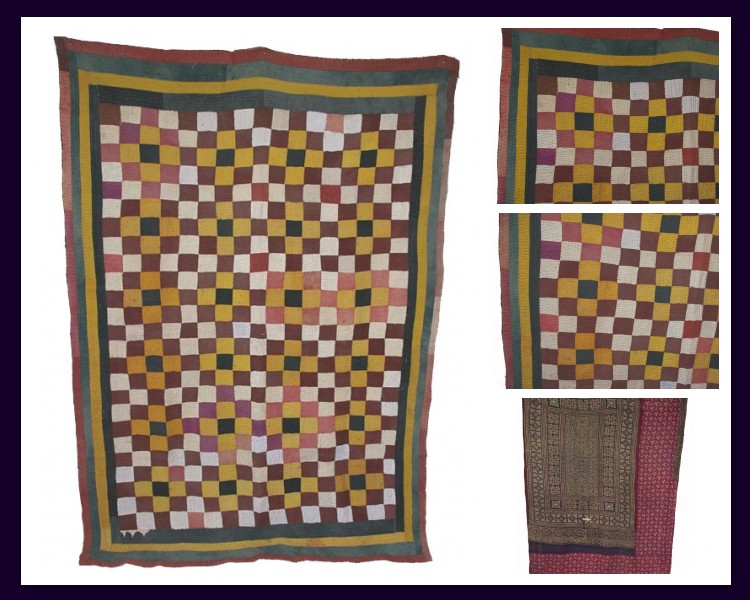
Ralli Quilts on Sale: 25% Off!

Dimensions: 82" long x 59" wide
Metric: 208.5 x 150 cm

Ralli #95, $140  (discounted to $105)

I have posted quite a bit about ralli quilts in this blog.  If you would like to learn more about them, click here to see the past posts.  Made in villages throughout India and Pakistan, ralli quilts have been a big favorite of mine and I buy them when I can.  Mothers have handed the designs down to their daughters for generations and finishing off a ralli is a communal event, much like our historical quilting bees.  Women sit around the unfinished piece, stitching the long rows that will hold it together.  I love the uneven squares, the sometimes odd choices of fabric, and the multi-functional role these pieces have served:  bed quilt, wall hanging and even as a door in the village huts...

I have five rallis left in my Etsy shop.  You can see all of them on this page:  click!  Two are simple whole cloth quilts, priced at $60 and $75.  The discount would bring them down to $45 and $56.25.  The one shown at the top of this post is the biggest one, in very good, usable condition.

This one is my favorite and the most expensive one I have ever carried:

Dimensions: 62" long x 43" wide
Metric: 157.5 x 109 cm

Ralli #93, $350  (discounted to $262.50)

Small and fragile, this ralli would have to be used as a wall hanging or as a decorative throw such as on a guest bed.  It would only cover the foot or middle of a bed.  The applique and color choices are lovely!

Another favorite is this wonky checkered ralli:

Dimensions: 78" long x 50" wide
Metric: 198 x 127 cm

Ralli #94, $135  (discounted to $101.25)

Yes, it is narrower at the bottom...  The quilt does not hang well, but it looks great thrown on to a couch or bed.  What I like best about it is the feel of the fabric.  I can't figure out what it is and assume it's some kind of polyester, but it is soft and worn and feels like silk.  Maybe an acetate?  Normally, I despise polyester, but whatever this is, it is cool, soft and pleasing to touch.

These are your five ralli choices!  All 25% off through November 24th.  I normally give free shipping on orders over $100 but will not be able to do that during the sale.  When you are through shopping, type in NOVEMBERSALE as your coupon code and Etsy will add the 25% discount to anything that is in my shop.

Wrap yourself in a ralli! 


Share/Bookmark

Saturday, November 13, 2010

The TAFA Team's Catalog of Shops: Cultural Textiles

TAFA Team member, Catherine Bayar, sells vintage textiles, knits and is setting up a workshop for women in Istanbul, Turkey.


TAFA: The Textile and Fiber Art List was launched in February, 2010.  As it has grown, now to over 200 members, so have the members who have Etsy shops.  About half of us use Etsy as our retail platform.  We decided to organize as an Etsy Team (a program Etsy has for sellers to organize under themes or locations) and set up a blog where we can talk about what is important to us and where we can show off our shops.  The blog has eight pages of shops, divided into themes and serves as our Team Shops Catalog.  Although many of us sell things that do not fit neatly into those categories, most of us do have a focus.  I am introducing each of those categories here, hoping that this will encourage you to go over there and shop, shop, shop, until you drop!  These eight pages have over 100 shops, filled with wonderful eye candy that will surely delight anyone who appreciates all the many techniques and traditions that are found in the needle and textile arts. 

Today's focus:  Cultural Textiles
 
 Afghan Tribal Arts sells vintage textiles and beads from Afghanistan and the region.  
Many of the beads are hand-carved semi-precious stones which support artisans who have been living in refugee camps for decades.
 
 
Although I love all kinds of textiles and the techniques that go with them, I have to say that my passion lies with cultural textiles, especially embroidery from Central Asia.  I quilt and embroider and sew and make all kinds of stuff, but when I see these embroideries, touch them, and think of all of the work that goes into them, my mind goes into sensory overload.  That is part of the attraction for me: the skill, the use of basic materials to create something beautiful, the textures and images created in and through fabric and thread...  The other magnet is the knowledge that these pieces come from communities where crafts are central to the cultures they represent.  They bring with them centuries of stories, of traditions, of symbolism.  They are pictures of people, most of whom face terrible difficulties in our modern world.  War, famine, global warming, deforestation, pesticide use, land grabbing, aids, and so many other devastating perils threaten communities that we have called "ethnic" or "tribal" in the past.  Along with their displacement and poverty goes their knowledge and ability to produce the textiles and crafts that tell their stories.
 
 
 Valerie Hearder, a quilter, started African Threads to help women in South Africa find new markets for their embroidery and other crafts.  She has introduced contemporary images, like the Michael Jackson icon above, along maintaining traditional ones.
 
 
An understanding dawned on development leaders in the 1970's that crafts had potential as an economic development tool.  There was a handmade revolution back then, too, with the hippie movement and all of the do-it-yourself projects that were starting to roll out to market through kits.  Remember all the macrame projects?  Cutting glass?  There is a parallel that remains true today:  people who have exposure to making things themselves appreciate handmade things from around the world.  Other reasons for interest in cultural crafts have to do with travel, support for causes, empathy, and so on.  So, way back then, the Peace Corps taught the Otavalo Indians how to knit sweaters using Scandinavian designs, other development groups began looking at how crafts could employ the people they were working, churches saw that they could also do this and the concept of fair trade came into being.  Thirty years later we continue to see efforts all over the world, formally and informally, of using craft production as a means to both preserve cultural traditions and village structures through and economic development focus.  Many of these models have brought relief closer to home.  Alabama Chanin, for example, has successfully created a business which employs women in Alabama to make gorgeous handmade clothing using sustainable practices and materials.  All of our TAFA Team members who are working with cultural textiles also have social missions which encourage economic development in the communities they represent.
 
 Indira Govindan of dharmakarmaarts is an artist who is inspired by her Indian ancestry.  ALL of the proceeds of her Etsy sales go to support a handicapped project in India.


When I started TAFA, I made the conscious choice of giving both cultural and contemporary textiles and fiber art the same importance in sharing a common platform.  One of the challenges we face when working with these textiles is that they have been perceived as less valuable than contemporary work.  A weaver in Guatemala is called a producer or artisan while a weaver in Santa Fe is referred to as a fiber artist.  All of this translates into dollars.  As these traditions disappear, we will end up having a handfull of masters or living cultural treasures and then cheap imitations that are churned out by sweat shops or machines.  Already, the places in the world where carpets are still produced have dwindled to a handful of countries.  As they industrialize and destroy traditional nomadic or village life, the need for and ability to maintain production disappears.


 MayaMam is a new effort working with a weaving group in Guatemala.


All of us who sell online have to master many skills in order to present our goods successfully: we have to become great photographers, product designers, learn how to practice good customer service, learn about shipping to places around the world, and so on.  Our Team has many levels of expertise and we have implemented a mentor program where experienced sellers can guide the newbie ones.  Yet, none of us can move forward without support from a willing customer base, you!  Whether these textiles are purchased for their beauty or for the good that they do, there is a necessary bond that connects the maker to the seller to the buyer.  There has been a strong bias on Etsy against cultural crafts because most of us who sell them are not making the product.  Yet, the makers, in these cases, are often illiterate, have no access to computers, are living in terrible conditions and they need us as a bridge to bring their work to market.


 Dr. Christi Bonds Garrett of HeArt of Healing has one of the largest mola collections in the MidWest.  As an art quilter, she also loves vintage japanese kimono which can be cut up and used in new pieces.  As a practitioner of Integrative Medicine, Christi is especially interested in the Kuna medicinal traditions and how they are documented in their molas.  The above mola shows a Kuna woman working on a weaving while she smokes her pipe.

I find it interesting how many of us in our Team who work with cultural textiles also make our own work.  This cultural exchange is not new.  Picasso, Gauguin and many others were influenced by tribal or ethnic work that made their way to Europe.  The Moors changed the art of Southern Spain and Portugal.  With all of the technological exchanges we have in our world today, we see global fusion happening in all areas of life: crafts, food, music and even in the choices we make for marriage partners and social circles.  It's a fascinating time in history.  There is a constant choice we make in what to assimilate and what gets lost in the translation.  This is where the preservation of vintage textiles are so important.  We can keep them as references to the past while we explore new ways to relate to the present and future.


My shop, Rayela, has vintage textiles from around the world and remnants which can be incorporated into new pieces.  A special love I have: ralli quilts from India and Pakistan.


Interest in cultural textiles often leads to increased knowledge about the people who made them which can then foster actual connections.  Several of our members offer cultural tours specializing in textile production.  Valerie Hearder is taking a group to South Africa in 2011.  Fiona Wright (Glitzandpieces on Etsy) sells vintage saris and textiles on Etsy, but spends most of her time on workshops and leading her cultural tours around India.


 Wouldn't a cultural tour with Fiona be something to remember forever?

It's a beautiful world and we bring some of it to you through our Cultural Textiles.  Do not hesitate to contact the shops for more information on what they are doing.  We are a social group, anxious to make connections and friendships along the way!

Click here to visit our Cultural Textiles in our TAFA Team Catalog of Shops.

And, while you are there, click on the other tabs to see our other Team member shops.  We aim to be the best in textiles and fiber art on Etsy!


Share/Bookmark

Saturday, November 6, 2010

The TAFA Team's Catalog of Shops: Jewelry and Accessories

Freeform hats and bags by Rensfibreart


TAFA: The Textile and Fiber Art List was launched in February, 2010.  As it has grown, now over 200 members, so have the members who have Etsy shops.  About half of us use Etsy as our retail platform.  We decided to organize as an Etsy Team (a program Etsy has for sellers to organize under themes or locations) and set up a blog where we can talk about what is important to us and where we can show off our shops.  The blog has eight pages of shops, divided into themes and serves as our Team Catalog.  Although many of us sell things that do not fit neatly into those categories, most of us do have a focus.  I am introducing each of those categories here, hoping that this will encourage you to go over there and shop, shop, shop, until you drop!  These eight pages have over 100 shops, filled with wonderful eye candy that will surely delight anyone who appreciates all the many techniques and traditions that are found in the needle and textile arts. 

Today's focus:  Jewelry and Apparel


Vintage Miao textile incorporated into a bag, by dazzlinglanna

Picking images for this post is not an easy task as there are so many beautiful pieces in our Jewelry and Accessories page.  This is one of the places where you can really see how people are exploring techniques and interpreting them into their own designs.  You will find functional items like scarves, bags, purses, hats, cuffs, gloves, necklaces and bracelets.  Our members are felting, dyeing, painting on silk, reclaiming old textiles and fabrics, knitting, beading, weaving and of course, sewing.

Hagar of Gilgulim recycles old ties into beautiful jewelry.


TAFA is an international organization, exemplified by our members on this page.  Hagar is Israeli, Jutamas of Dazzling Lanna lives in Thailand, Rosemary of Plumfish Creations and Renate are both in Australia, Morgen of Inkyspider  is Canadian, Marina hails from Puerto Rico, Inese is in Latvia, Dolapo of Urban Knit is in the United Kingdom, Lilou works with weavers in Cambodia and so on.  Of course, quite a few are based here in the United States.  The diversity of our members, both in the techniques they are exploring and their cultural influences makes for a fascinating collection of colors, textures, and designs.

 Lilou, a fair trade group working with weavers in Cambodia.


The big challenge for all of us is that nobody really "needs" anything we are selling.  And, in this awful economy, buyers have been tightening their belts and holding on to their money.  Yet, is not beauty something that our spirits crave?  An accessory from one of our shops will certainly cost a lot more than a bauble that is sold at Walmart.  But, the right scarf, hat or necklace can not only finish off an outfit and make it complete, but also makes a statement of support for the worldwide handmade community.  It ties us to our historical roots represented by the techniques we promote through our work.  
 

 Wraps by Inese, our TAFA member in Latvia


Click here to visit our Jewelry and Accessories Page in our TAFA Team Catalog of Shops.

And, while you are there, click on the other tabs to see our other Team member shops.  We aim to be the best in textiles and fiber art on Etsy!


All TAFA Team members are also members of TAFA: The Textile and Fiber Art List.
Interested in membership?  Click here for more information.


Share/Bookmark

Saturday, July 31, 2010

Ralli Quilts: Customer Photos and Newly Listed!

If you follow this blog, you will know that I carry ralli quilts in my Etsy shop.  I fell in love with them a couple of years ago and have been buying them whenever I can.  As a quilter, I appreciate all the work that goes into them.  I also really like textiles that have an organic, handmade feel to them.  I like mistakes, repairs that don't match, stitches that are crooked, imperfections in dyes...  That doesn't mean that I like sloppy work.  No.  But, many of the tribal or village crafts that I am drawn to have a bold, rough finish to them that tells me a story of a way of life.

So, the other day, a ralli quilt sold in my Etsy store.  I didn't realize that it was the last one I had in stock.  Here is a photo:

 Ralli quilt that sold on Etsy.

One of the things that fascinate me about the rallis is that they do not use any patterns.  They are handed down from mother to daughter.  The quilts are stitched completely by hand and some patterns become popular in a certain village so that experts can take one look and know where they come from.  Several people might work on stitching the blocks and then when it comes time to quilt it, it becomes a quilting bee, with many women helping it go quickly.  I can just see them all sitting in a circle, chatting away about local gossip.

My customer was kind enough to send me some images of how the quilt looked in her home.  How fun it is to see a "product" become a part of an environment!

 Ralli quilt used as a table cloth.

Doesn't it just look great in her home?  I never would have thought to use it on a table like that, but love the effect!  The white walls work perfectly with the quilt.  And, notice how the grey works so well with the light green in the other room.


The effect is both joyful and serene.  Truly lovely!  I really appreciate her sending me the images.  It's a nice way to show how these quilts can be incorporated into contemporary homes.  If you have bought things from my shop in the past and would like to send me some images, I would be happy to post about them, too!

So, that sale meant that I had to get busy and take some more photos and get more rallis back into the shop.  I just got several listed last night.  Click here to see what is currently in stock.  Two of the best quilts I have ever bought are in this new batch:

 Vintage ralli quilt with applique.


Both are done with cutwork applique blocks, much harder to find than the more simple pieced ones.  These are both kind of pricey, around $350, but they are gorgeous and estimated to be from the 1950's.  I also listed less expensive ones, ranging from $42-$160.  

Jump on the ralli wagon and get one for yourself!  They will cast a warm spot on your bed, couch, wall, or table!

For more ralli quilt posts on this blog, click here.


Share/Bookmark

Tuesday, October 6, 2009

How to Wear a Sari (Saree)

Vintage Sari

I am getting ready to list some vintage saris on Etsy and just happened to find a fun video on YouTube. Have you ever tried to manage all the fabric into an attractive and convincing Indian look? I have a hard time even measuring it out for the listings! Well, this video gives a little history on the saris (also spelled sarees) and shows you how to wear one in a clear step-by-step instruction:


I buy the vintage saris that I carry from a friend who travels to India every years. They are beautiful satins with intricate weaving, but most have a tear or stain. We buy them for the fabric, to cut them up into quilts or other garments. They can also be used around the house, draped over windows, four-post beds and from the ceiling. But, if you ever need to wear one, now you know how!


I am hoping to have the saris listed on Etsy within a week. To check my stock, click here.
Share/Bookmark

Thursday, September 24, 2009

Six New Ralli Quilts on Etsy!

Ralli with an unusual black background.

If you have been following this blog for awhile, you will know that I really love ralli quilts! Partly, I suppose, it is because I, too, make quilts so I can appreciate all the time and effort that goes into them. But, I think that what I really like is the organic quality most of these quilts have in their design. Completely hand sewn, one piece might have had several different women working on it. That might translate into inconsistencies in the stitching and even choice of fabrics used. Normally, one woman will make the top, but the quilting will be done by several women who will in turn get help in finishing their tops.


While many ralli quilts may have simple designs as in the one above, the color choices can be very interesting. The colors in that one remind me of Amish quilts, although the border is a signature for ralli quilts. Patterns are handed down by experience, from mother to daughter. While simplicity worked beautifully in the quilt above, the one below is an example of complex patchwork construction. Hundreds (thousands?) of tiny triangles show that the flying geese patterns are also found in Asia.

Ralli quilt with intricate flying geese pattern.


Again, the border, traditional to ralli quilts, places these geese firmly in the minds of Sindhi women. Sindhi women seem to be drawn mostly towards bright fabric colors and bold contrasts. The black fabric in the first quilt of this post is an unusual departure from the more common color palettes. The two quilts below show more common block and color choices. Both have become soft and worn with use.


Finally, some villages specialize in cutwork applique. The quilt below is a simple example of this technique, probably made by a young girl or older woman. Appliqued designs can be exquisitely detailed and fill the whole surface of the broad cloth used as a background.

Ralli quilts are wonderful as wall textiles or draped over a bed. I have kept several for myself and am happy to share these with you!

Visit my Etsy store to see my current selection. I have written several posts in this blog about these quilts, so if you would like to learn more and see more photos, click here.


*
Share/Bookmark

Monday, July 13, 2009

Vintage Weavings – to Restore or Not? by Catherine Salter Bayar

Vintage Turkish Cicim

Recently I had a great short conversation with another Fiber Focus member who mentioned she had done textile restoration for the US National Park Service. She and I agreed that vintage textiles, if repaired, should never show signs of this new work; the restorer should strive to make sure that her work is as unobtrusive as possible.

I personally love to see signs of usage in older kilims and carpets, as long as they are not in danger of completely unraveling. After all, these weavings were made to be used, not hung in a museum; wear is part of their history. But what should I do, if one of my customers disagrees with me and wants a ‘perfect’ vintage piece?

This was the case with an acquaintance who lives part of the year in our small Turkish town. I will call her G. She is an interesting, compassionate woman from a Northern European country who has been coming here to Selcuk for probably two decades now.

For the past several years, G has often visited our shop to chat when she was in town, and always purchases a piece of our handmade jewelry or a strand of beads before she left Selcuk. But each visit, she’d comment about a small old cicim I had draped over the armchair in which I sat.


“I really love that piece!” G would say, asking me about it. I knew it had been two sides of a Turkish donkey bag, though the longer ends have been unstitched. But this kilim was an interesting weaving combination I had not seen in a cicim before. Both sides use the fairly thickly spun, sturdy dyed wool typical of utilitarian cicims, but this time the weaver used the wool as the warp yarns (thick undyed cotton is more typical), then wove very thin undyed cotton through as weft yarns, creating a thin, slightly irregular ground cloth for the embroidered wool patterns worked on top.


Did the weaver just not have enough wool and opt for cheaper cotton? One end does have weft yards in the same red wool as the warp (below), but this appears to be the end where she started weaving. So maybe she was experimenting to see how this densely woven but quite thin piece would turn out.


That it is rather monochromatic is not common for a cicim either, which to me means this weaver may have had more sophisticated tastes than the usually riotously colored cicims. Or perhaps she did just not have access to more colors than this mellow red, grey, black and indigo wools and natural cotton she used. The shading variations in the ground are caused but more tightly packed sections of cotton weft yarns, an intentional play of texture I think, but we will never know her aim.


There are a few patched sections (below), though the patching is done in wool that looks exactly like the original wool yarn, making me ponder if these odd portions were also intentional and done in the original weaving? And yes, by now the edges are worn, the embroidery is a little asymmetrical and the patterns are not so well planned in spots!


In any case, I told G it was my favorite cicim and not for sale, since to me such a piece is rare and holds a special quirky charm in my eyes. Regardless, each visit she would ask me to sell it to her and each time I would decline.

This spring while I was in the US, G again came to our shop and asked my husband if she could buy the cicim. Since we happened to urgently need money that week, we decided to part with it. Abit and G agreed on a price; she gave him a deposit and took it away with her. Oh well, I thought. At least the cicim was going to someone who seemed to love it as much as I did.


But a week later, she came back to our shop and told Abit it was not worth the price they had agreed upon. She’d taken it to one of the local repair shops, and the man there had pointed out every frayed selvage, every worn spot and uneven hem, convincing her that it needed massive costly repairs. Worst of all, “He said it’s mostly cotton!” However, kilims commonly have cotton warps which don’t necessarily lessen their value. I’m positive the repairer was trying to make a big profit from a foreign customer. But she agreed with him that the cicim had to be restored completely and asked us to sell it to her for a fraction of the reasonable price Abit had asked, since it was so ‘damaged’.

As much as we needed the money, I immediately gave her deposit back to reclaim the cicim. I was horrified to think that the piece would undergo unnecessary major “surgery”. Perhaps the restorer would have done a good job on those unraveled selvages, but I was incensed that G had admired the piece for so many years, but then was so easily persuaded to find it lacking. To me, her need to have a ‘perfect’ kilim made her not worthy to have it. I’m afraid I take my kilims and carpets personally; they do become like members of the family to me.

What do you think, fiber artists and textile lovers? Should we have given in to our customers request for a cheaper price? Should older weavings be restored or left as they are? As a designer more than a business woman, I’d rather keep such an imperfect piece than make a sale.


And now we enjoy it daily, since the cicim has been retired to our garden dining table. No worries – we promise not to spill our meals on it!

For cicims I will allow you to buy, please visit www.bazaarbayar.etsy.com.


Catherine Salter Bayar lives with her husband Abit in Selcuk, near Ephesus, Turkey, where they own a vintage textile shop and a water pipe & wine bar. A regular contributor of this blog, Catherine is also a member of our Fiber Focus group. She is currently working on a book on Turkish textiles. Visit Catherine and Abit at www.bazaarbayar.com or www.bazaarbayar.etsy.com.

Become a Bazaar Bayar fan on Facebook!


Share/Bookmark

Sunday, July 13, 2008

Guest Artist: Jeanne Connolly of Vintage Renewal

Vintagerenewal.com is a green online furniture boutique specializing in blending both classic and modern furniture and fabrics to create wonderfully unique upholstered art pieces. Vintage Renewal is based in Denver and works as a one-woman-show in a wonderful art studio downtown called The Other Side Arts. My boutique idea began through the sheer love of renewing and repurposing other people’s furniture castaways, coupled with an absolute obsession with vintage fabrics. I am also inspired by fashion styles of past decades, current trends, different cultures, antique furniture, and vintage craft books. I look for frames or existing objects that can be recovered and are given a new lease on life. I am proud to say that I practice green upholstery design.

What do I mean when I say, “green upholstery design”? It’s simple; the very act of recovering an existing frame is a green act in itself! There are so many wonderful vintage furniture castaways in thrift stores, on Craig’s list, at estate sales, and even free in alleys that are dying at a second chance to be in vogue again. I look for pieces with great lines when shopping for my furniture boutique. I simply ignore whatever ugly upholstery and unattractive paint colors they might have when I search for a great vintage piece to revamp. This can all be changed later on. It’s very easy to restyle or redesign a chair once I find a piece that I love. By using some creativity, I can plump up different areas of the chair or stool by adding or removing cotton and restyle the cushion or remove an ugly outdated skirt for a fresh new look. To continue being green when stripping the chair down to its basic frame, I look for anything that can be reused inside. The springs are usually salvageable and just need to be rebuilt and retied for many more years of life. The foam can come back to life in most cases by using an industrial steamer to steam the life back into it. It actually rises up right in front of my eyes! If it doesn’t rise up, than it’s time to replace it with a new piece.

Most vintage frames can be re-glued if they are wobbly and need some stabilizing. Once I have a sturdy frame and a strong core I can have some fun.

My next green step is to shop for vintage fabric or recycled fabric to cover our existing frame. There are many places to find these goodies right under our noses. Some resources are etsy.com, ebay.com, local thrift stores and estate sales. I don’t just stop at uncut fabric when I search online or in thrift stores. I like to get creative and find fabric scraps that can be patch-worked together like in this piece:

Or a great pair of vintage drapes can be repurposed like this piece (the gold part used to be a pair of drapes):

Finally, I never forget about cool vintage bedspreads. This was one of my first pieces and is a good example (back view shown):

Here's an example of one of my re-styling makeovers:

Before


After


The owner and sole operator of Vintage Renewal is Jeanne Connolly, Upholstery Artist and Designer. At this time Vintage Renewal does not do custom work since I find most joy in the designing and restyling of my own found objects. I do hope that you continue to visit me online as I add new pieces to my websites monthly. Visit me at
www.vintagerenewal.com or www.vintagerenewal.etsy.com for many more green upholstery designs. Shipping is free for all Vintage Renewal pieces, so log on today!

Vintage Renewal is also a member of Fiber Focus on Ning.
Share/Bookmark

Sunday, June 29, 2008

Turkish Textile Arts in Transition: A Sisterhood of Weavers


by Catherine Salter Bayar
Catherine is a regular contributor to Fiber Focus.
Click on her name to see all of her posts on one page.

My mother-in-law, doing a handcraft that she and I share – knitting

Long before I moved to Turkey in 1999, the manufacturing of hand woven rugs had begun to move out of this country to nations farther east, where labor and production costs were cheaper. I’d been familiar with this economic market reality as I traveled the world for the garment industry, which is in constant search of cheaper countries to manufacture clothing. In the same way, Turkish rug wholesalers took their production of hand woven rugs for the tourism trade or export to countries such as Pakistan or China, while mass producing machine-made carpets in Western and Central Turkey for use in the modern Turkish household. The cost of hand weaving in countries to the East is roughly a third of the cost of weaving a rug in Turkey, East or West.

My mother-in-law’s generation used to weave, but she is in her sixties now. She and her sisters had to weave if they wanted functional or decorative textiles for their homes. Weaving was not only utilitarian, but social as well. When girls and women wove for their dowries and households, they would gather together in the afternoons after their farm chores were completed. My mother-in-law wove the kilim, below, on a narrow, easily transportable loom, in four long strips of 17” (42 cm) wide cloth, embroidered together with wool yarn.

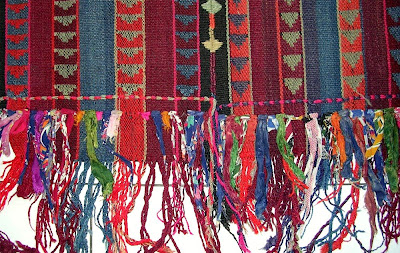
This entirely wool piece would have taken her at least 6 months of afternoons to complete. She used the natural dyes of madder red and indigo blue to bring prosperity and protection; the triangles represent the mountains that encircle their childhood town of Derik, in the eastern province of Mardin. It was used to drape the horse her sister rode to her wedding, and then as a bedcover. The numerous fabric strips tied to the bottom, below, are ‘wishes’ from each woman in the family for a healthy, happy, abundant life for the newly married couple.
My mother-in-law thinks it’s quite absurd that we have kilims she and her sisters wove in our shop. She sees little value or beauty in them at all, and has often teased me about the threadbare but exquisitely striped kilim I insist on keeping in our bedroom, below. Perhaps someday I’ll get that big hole repaired by one of the expert reweavers here, all men for some reason, who can make it look like new, but to me it’s already perfect. I like seeing it just this way as I get out of bed each morning, as a reminder of a time when a woman would spend perhaps an entire afternoon per 1/2 inch of this finely spun wool kilim, about 3 feet wide by 5 feet long; a woman who obviously took joy in combining such bright reds, oranges, pinks, chartreuse and periwinkle. This piece was given to us by the family in Abit’s home village in Eastern Turkey. They were cleaning out storerooms and would have thrown it away! Abit gave his aunt $200 for several kilims she was discarding; she clearly thought he was foolish to give her good money for them. Word of the ‘big spender’ from the West got around the village. The next day, numerous relatives showed up with their cast-offs, amused that the boy who’d left more than 20 years ago was now making a living selling these old useless things.

These days, the easy-care machine made polyester/cotton textiles for cushions and bedding plus wool and synthetic carpets being churned out by factories all over Turkey are the preferred house wares of the Turkish middle classes (behind and beneath my bread-making sisters-in-law, below). Turkey grows its own cotton and is still predominately an agricultural country, so the wool gathered from sheep and goats now goes more to urban factories than it stays in the villages. These textiles are targeted at the domestic market, so reflect the color combinations and patterns of vintage hand woven pieces, but are prized for being modern and machine washable.

None of my seven sisters-in-law weaves, unless you count the sister who asked to be sent to a local government-run program that trains women in the art. She and I had begun collaborating on carpets of our own design, but the family decided that she should move East to marry and raise a family rather than stay in Selcuk and work for us. I know she does not regret having the adorable children in the photo below, but she does miss the chance to express her originality and talent through weaving. It is still common for women in Cappadocia in Central Turkey or in East to work at home weaving for various manufacturers. They are usually paid by the piece, though it cannot be much money for their labor based on the wholesale prices of new goods. No wholesaler would divulge how much the women make, another reason we don’t sell new rugs in our business.

My husband’s family is traditional and typical for Eastern Turkey even though they have lived in this Aegean region town since 1985. The girls are expected to be homemakers and mothers, and if they must work, they do so together in the fields and orchards, picking crops such as cotton or peaches. Abit and I do not agree with these limitations and have had countless discussions with the family, to no avail. However, most girls in Selcuk complete mandatory schooling by the age of 16, and many go on to universities. Our town is filled with women in business, medicine, law and service occupations in percentages that are similar to Eastern European countries.

A portable loom for small rugs less than a meter (39”) wide.

The majority of women schooled in hand weaving today in Western Turkey work in ‘carpet villages’, traditional style complexes to which the tour companies take captive busloads of tourists to demonstrate how rugs are made. They make for a good show of the craft, but little do the tourists realize that most of the rugs they are being shown and sold were woven far from here, in countries with fewer regulations about child labor and fair wage laws. Most carpet villages near Selcuk pay their workers – male sellers and female weavers – a salary, not in commissions or by the piece. They usually do get healthcare and other benefits, including meals and transportation to their jobs, and work regular 8-hour days, though often 6-7 days a week during the tourist season from April to October and far fewer days in winter.

A former carpet village of traditional style buildings near Selcuk.
The looms are dismantled, but colored yarns still hanging from the rafters.


The pieces hand woven today by manufacturers have been ‘merchandised’ to cater to the buying tastes of the visitors. Traditional color combinations of reds and blues are replaced by more subtle Westernized palettes of pastels or earth tone combinations. Unlike in the West, where rugs woven in undyed natural wool colors of off-whites, browns and blacks would fit in well with most home décor, these ‘drab’ pieces would have been pitied in a Turkish village. It would have been assumed that the family did not have the skills or money to gather dyestuffs or purchase them in the local market. The traditional long, narrow rugs to fit a Turkish living room are now woven instead in standard sizes revised to reflect room proportions in Western homes. What in the West would be used as hallway runners, for instance, would have been attached to the lower walls of a Turkish salon to comfort the backs of those seated around the room on low cushions.

The predominant art of the Turkish culture, the art that has survived centuries of population migrations, the art truly inclusive and expressive of women’s emotions, desires and creativity, has been hijacked by mass commerce. This is not a story unique to Turkey of course; as countries modernize and mechanize, traditional handcrafts are less prized by the culture and fade away. Beyond the tourism-driven carpet villages, there are groups of entrepreneurs in Turkey who want to sustain traditional hand crafts and offer women the alternative to support themselves though weaving, but these enterprises may never create the same works as a woman who is weaving from her soul would.

A strictly-for-commerce ‘new’ piece that combines multiple portions of old prayer rugs – a creative way to reinvent authentic carpets, but sold for thousands of Euros – as seen in the window of one of the most expensive carpet shops in Sultanahmet.

Has the art of weaving been completely lost to commerce here? Not quite yet, but with women no longer weaving for themselves and shopping hordes of tourists in the tight control of tour conglomerates, businesses like ours have fewer authentically Turkish-made alternatives to offer our visitors. And the uniquely expressive voices of our sisters, the weavers, are being silenced.


Catherine Salter Bayar lives with her husband Abit in Selcuk, near Ephesus, Turkey, where they own a vintage textile shop and a water pipe & wine bar.

Visit them at www.bazaarbayar.com or www.bazaarbayar.etsy.com
.

This article is a companion one to
Turkish Textile Arts in Transition: A Brotherhood of Carpet Sellers
Share/Bookmark

LinkWithin

Related Posts with Thumbnails