TAFA: The Textile and Fiber Art List

Showing posts with label Travel. Show all posts

Tuesday, February 28, 2012

Tucson with Joyce

Joyce Levy, Tubac, Arizona

I got back from a month of being on the road with Abdul.  We were mostly in Tucson for the Gem and Bead Show.  Several days were spent going and coming through vast, unpopulated areas of the Western Desert states: Texas, New Mexico and then Arizona.  Lots of scenes like this:


That cross is there for a reason:  it's not easy to survive on the desert.  Well, that one was probably from a car accident, but still....  no water scares me.  Once in Tucson, my opinion did not get much better.  Big gusts of winds would lift up the dust and spread it everywhere.  I felt dirty all of the time.  Our hotel was filthy with no upgrades since the 1950's.  (Never stay at the Howard Johnson's, known as HoJo, if you can help it!)  Pipes broke, flooding and soaking the stinky carpeting.  I was not a happy nomad.  We had to set up the show and I hadn't seen much of the city.  When I did, it was at night, dark and scary looking.  

Tucson at Night

Tucson has observatories and a bunch of military things going on, I was told, so there are city ordinances about how much light can be on at night.  I would not like to go for a walk around the block on my own...  

Then, my friend, Joyce, rescued me from despair.  She lives in Skokie, a Chicago suburb, and her father lives in Tucson.  Every year she comes out at about this time and spends a month with him.  I got to bop around with them for a couple of afternoons, and, although I am no convert to the desert, they showed me some lovely areas.  

On the first afternoon, we went to see an exhibit at the Tucson Museum of Art,  Frida Kahlo: Through the Lens of Nickolas Murray.  He had been a lover of hers and his photos of both her and Diego Rivera are spectacular!  There was also an accompanying display of Mexican garments that was lovely.  Joyce bought me a small decoupage of Frida which now hangs on my bathroom wall, a memory of a fine afternoon in Tucson!  We ate a sumptuous lunch at a cafe right next to the museum, indoor gardens, chirping birds and all of that wonderful SouthWestern decor.

From there we went to Sidney's (Joyce's father's) apartment.  He is 90 but looks and acts like he just turned 60.  He lives in one of those modern senior places that has a swimming pool and wonderful amenities.  Both Joyce and Sidney commissioned work from me in the past and I was finally able to see his pieces in their final destinations:

Rachel Biel and Sidney Levy

Here we stand in front of "Sidney's Ties" a weaving I made for Sidney of the ties he had worn for so many years as a professor.  You can see close-ups of the piece and the process on my blog:  Sidney's Ties.  Joyce had commissioned quilts made out of t-shirts worn by her brother, Bruce, who had an untimely death due to cancer.  Sidney had one of them and it was great fun to see it on his bed:

Sidney Levy with his memory quilt honoring his son, Bruce.

You can read about the other quilts on my blog as well:  The Bruce Quilt.  We swam and visited and by then it was time to take me back to the hotel from hell.

They rescued me a few days later for a little road trip.  Destination:  Tubac, Arizona!  Currently populated by about 100 families, the small town dedicates itself to a life of art.  The businesses are all galleries, cafes, and support services, making it a tourist destination out in the desert.  There was a huge festival going on when we went there, so that was perfect for the three of us, all art lovers.  But, first, we made a detour and saw the San Xavier Mission, just outside of Tucson.  The official site does not have any images of the church, very Franciscan of them, eh?  This google search has a bunch, but really, you have to experience it to really "see" it.  Layers upon layers of detail and texture cover the inside of the church.  You stand in the middle and just look around in awe.  I didn't even try to capture it on my camera.  The outside, though, was beautiful in its simplicity:

San Xavier Mission

Again, those inspiring SouthWestern lines:


Back to Tubac...  We had planned to meet up with Fran Siegal and her husband, Andy, who are TAFA members.  They live in New York and were also in Tucson for the show.  Finding them was not such an easy task and took up some of our time.  

Fran Siegal and Andy with me in the middle.
By then we were hot (but not sweaty!) so we sat at a cafe and had some refreshments.  The art town of Tubac is well planned with parking around the periphery and everything else within walking distance.  We explored a bit of the booths, did a bit of shopping and by then the afternoon had ended.


Joyce, Me and Sidney.

So, Joyce brought some spice into my Tucson time.  It was all very interesting and I enjoyed seeing the new landscapes, but when we were driving back towards my part of the country, I felt my spirits lift: back to the green, lush trees of the SouthEast!  I am truly living where I should be.

It was so wonderful to spend time with Joyce and her father and to meet Fran and Andy.  Joyce is a fountain of knowledge and always great fun to be with and now that I have met her father, I see that she is a chip off of the old block.  Precious people!


Share/Bookmark

Tuesday, March 15, 2011

Doris Florig: Weaver on a Boat, Explorer of Traditions

"Grand Isle Corn" by Doris Florig
Searching for the Ruins of an Indigo Plantation

By Doris Florig

Six years ago, each time I told  friends that my husband, Dennis, and I had decided to spend our winters on our cruising sail boat, the first thing they all said was, “so I guess you will have to give up weaving”.  Well, I knew that was not a possibility. I knew I could adjust to nomadic style looms, but, I had no idea that my knowledge of weaving would grow with such diversity. Weaving has given me the key to open the doors to connect with new people, their culture and history.

Doris learning about mud dyeing from a Carib Amerindian in Dominica.


Dennis checking the sail trim.
Most recently, while sailing the Eastern Caribbean chain, we sailed to the island of Maria-Galante, Guadeloupe. Before arriving, I looked through a French publication by the Conseil General De La Guadeloupe. It showed a photo of ruins of 17th century indigo processing vats. My experience with natural dyeing is extensive but lacking in any exposure to Indigo. I knew that this was to be the beginning of what would develop into an intensive study of INDIGO. We rented a car and set out on a quest to broaden my knowledge of the history and the processing of Indigo. 

It wasn’t as easy as I thought. Somehow I guess I was thinking there would be something very oblivious like a sign saying “Historic Site”. We found the general area, but not the site.  I approached an elderly French women on the roadside. Knowing that neither of us spoke the same language, I approached her with the photo of the ruins and a map. Well, the map was of no help. I had forgotten that people, who don’t travel, can’t relate to maps. The photo was of some help, but we didn’t connect until I pointed to the blue on her dress and said INDIGO.  I detected a slight smile and twinkle in her eye that indicated she understood. She pointed towards the sea.  So, downhill I went and quickly discovered a field with a small low stone structure, possibly an old barn. Ignoring the oxen scattered about the field, I headed toward the structure not knowing what to expect.

The oxen didn't bother Dennis.


It took a while but eventually, I realized that it could be nothing other than the foundation for the production of Indigo.


Indigo vat ruins in Guadeloupe.


The stone ruins formed three very distinct shapes approximately 12 x 12 feet which indicated to me that these were the walls of the vats. The first vat was for fermenting the indigo for a period of 24 hours. The second vat would have been used for the churning process and the third vat used for draining the fluid from the sludge used to make the dye.  The whole thing was a mystery until I saw the openings for the draining process. That was a dead give-away, I had indeed discovered the ruins from a 17th century Indigo Plantation. I felt like an amateur archeologist. The discovery of this foundation is now the beginning of my quest to fully understand and experience the process of dyeing with indigo.

Dennis discovered the remains of an old cauldron. We think it was original equipment used in  the processing.


At the next island, Domonica, we visited a Carib Reservation. They knew no history of Indigo dyeing but Dennis and I were convinced that they were cooking their Cassava bread on a broken historic cauldron.


Doris Florig is a weaver/fiber artist. She will teach natural dye classes in Jackson Hole this summer. On Aug 6 and 7, 2011 she will present a natural dye lecture and a demonstration in Fargo, North Dakota.

Visit Doris Florig's website.


Doris, in the saloon,settled into weaving her winter tapestry project, THE GATES OF NAHANNI.  The original painting for this cartoon was done by Dwayne Harty supported by the Yellowstone Yukon Conservation Project directed by Harvey Locke.


Share/Bookmark

Tuesday, August 10, 2010

TAFA Members Talk: Valerie Hearder of African Threads

Valerie Hearder presenting at a talk and showing a traditional  beaded skin apron worn as a wedding skirt by the Ndebele in South Africa.


In an effort to give a voice to TAFA members, I am running a series here on Fiber Focus called, "TAFA Members Talk".  Valerie Hearder is both a working artist, making art quilts and giving workshops on various quilting techniques and a small importer.  She works with women's groups throughout South Africa, focusing on embroidery projects, but offering traditional Zulu and Ndbele crafts as well.  Valerie responded to two questions I posted as a spring board for discussion, one on fair trade and the other on travel.

 Telephone wire baskets by Zulu craftsmen. 
Coloured wire is recycled into gorgeous baskets.


How do you define fair trade or what is green?  What support do you have in your community?  How do you educate consumers on product and pricing?  Do you think you can compete well against mainstream, commercial products?  Where do see the fair trade/green movement going in the next 10 years?

Valerie:  
I have defined my business by fair trade principles as a social entrepreneur. It’s my personal code of wanting to create a fair income for women that guides me, not fair trade certification.
I know other textile importers in my small community and we talk a lot and share marketing ideas. I am into the concept of “wikinomics” which is based on helping each other and sharing information. Sharing just seems natural to me as a quilt maker.  I don’t see my fair trade friends as “the competition”. The more we work together and help each other, the more we all succeed and that has a positive impact on women in the third world.  


 Valerie Hearder: "I bought this jug and mug from this potter
in Johannesburg last year. 
I use them everyday and they remind me of Africa."


I educate my customers by presenting an informative web site and by giving illustrated talks about the conditions and realities of the maker’s lives that I buy from.  It's very important to educate customers about how their shopping choices has a huge impact on someone's life in the third world. I don’t have a shop but do small shows, talks and on-line sales. My new web site should be launched in about mid-August. www.africanthreads.ca  I do think that I can compete with mainstream commercial products: people are interested in the story behind the work and the stories sell the works. Customers are more aware that they are connecting with and supporting women's empowerment in the third world and can feel good about getting something beautiful as well.
How do I educate buyers about pricing?  I tell them that when they see something cheap from the third world they can be sure that maker got a pittance. I explain that I buy outright at fair prices for the makers, and take all the risk if the product doesn't sell.
I have an amazing network of supporters for African textiles and crafts in the quilting community and also through the Grandmothers-to-Grandmothers Campaign. This movement has over 250 groups of active women in Canada who really care about women in Africa. What I’m doing is a natural fit with them as I give 15% of my profits to this group to support Grandmothers in Africa.

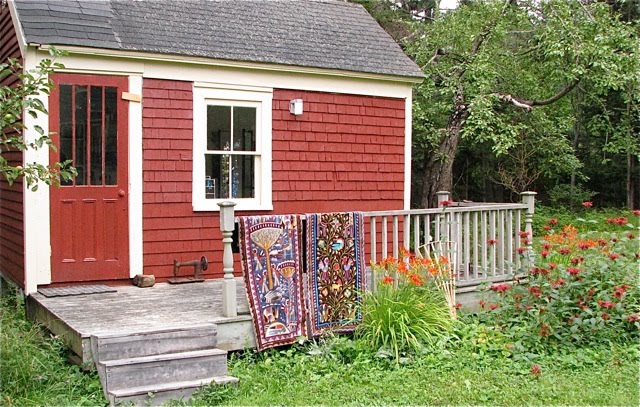
Valerie Hearder: "This is my little store house. 
It was the old "summer kitchen" which was built onto our house 
in about 1850.  It sits between 2 apple trees."


Where and how often do you travel?  What do you love/hate about it?  What challenges do you face culturally?  Is your local community interested in what you do?  What are the greatest lessons learned for you?  What are your long term goals?

Valerie:

It’s become more stressful to travel but now that I’ve developed a strong working relationship with women’s groups in South Africa I travel more frequently there. It's part of fair trade to visit and know the people I buy from. I’ve also just launched a new project to lead a cultural tour to South Africa next year.

Valerie Hearder's suitcase: "This is my suitcase on my trip last 
year to South Africa. I packed a bag full of embroidery 
threads that has been donated by lots of different women 
in Canada. I distributed the threads to various women's
sewing groups I visited during my 6 weeks in South Africa."

Interested in going to South Africa with Valerie? Visit her blog for more information.


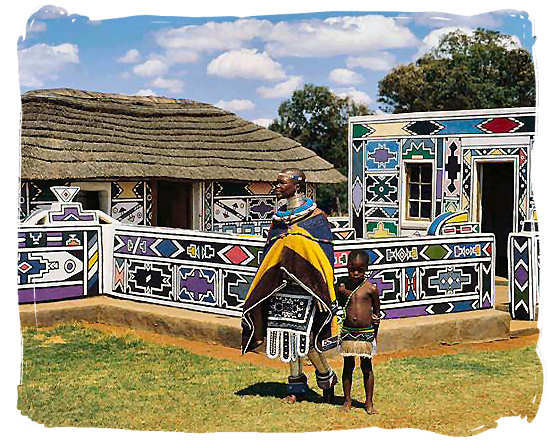
"Ndebele Painted village that we'll visit on my tour 
next year."  Valerie Hearder of African Threads.


Visit Valerie's member post on TAFA to see all her links: facebook fan page, shop on Etsy, and more!

Zulu doll maker from rural KwaZulu Natal, South Africa.
Dolls available through African Threads.


Share/Bookmark

Wednesday, July 1, 2009

"Traveling This Summer? Sew A Money Belt!" by Donna Hussain

Pickpocket

All travelers worry about the safety of their credit cards, tickets, passports, travelers checks, and cash. Wearing a money belt for valuables under your clothing when traveling is a foil to pickpockets, purse snatchers, and careless loss, like a wallet dropping out of a pocket when you place your jacket in the overhead bin of a plane.

A home-made money belt is easy to sew and inexpensive to make. Surprisingly, it is also comfortable to wear. My husband does not limit the use of his money belt to travel, but wears it daily. He keeps only a few bills in his pockets knowing that he has extra cash and credit cards in his money belt for unexpected expenses.

Money Belt by Donna Hussain
(Zipper open to show possible contents...)

To sew a money belt, follow the directions below.

Supplies:
A 12-inch all purpose non-separating zipper
11½ inches x 18 inches of soft, durable, 100% cotton bottomweight fabric
3/4 yard elastic waistband, 1 to 2 inches wide

Money Belt Supplies

1. Fold the cotton fabric in half lengthwise. Center the zipper on the cut edge. Make a mark on the cut edge of the money belt fabric at the start of the zipper opening and at the end of the zipper opening.

Marking the zipper location.

2. Remove the zipper. Stitch the raw edges of the folded fabric together on your sewing machine. The stitch line should be about ½ inch from the raw edges. Use your regular stitch-length from the fabric edge to the first mark, back stitch ¼ inch, then forward stitch ¼ inch. Stop.
Change the stitch length to long stitches (for later easy removal). Sew to the second mark. Stop.
Change the stitch length back to regular stitch length. Sew ¼ inch forward, ¼ inch backward, then forward again to the fabric edge.
(The backstitching helps lock the seam on each end of the zipper.)

Sewing the seam

3. Press the seam allowance open.

Seam allowance pressed open


4. Place the zipper wrong side up over the sewn seam line using your marks on the fabric as a placement guide. Baste the upper half of the zipper to the upper flap of the open seam allowance. Make sure that your basting stitches penetrate the flap only, not the money belt itself.
Baste the lower half of the zipper to the lower flap of the seam allowance. Check to make sure that your basting stitches do not go into the fabric of the money belt tube.

Baste the zipper to the seam allowance flaps

5. Machine stitch the zipper to the seam allowance (flaps only).

6. Turn the money belt tube inside out. The zipper is now hidden from view. Cut the seam directly over the zipper with sharp scissors or a seam ripper to expose the zipper. Check that the zipper opens and closes with ease.

7. Adjust the money belt tube so that the zipper is aligned near the top. Press the money belt flat.

Pressed money belt

8.
Prepare to hem the raw edges at the sides of the money belt. Do so by turning the raw edges of the fabric ½ inch to the inside of the tube for a hem. Press.
Before machine stitching to close the sides of the money belt, insert one inch of the elastic waistband into one end of the money belt at zipper level. When stitching the side seam closed the elastic will be stitched in place. Do not cut the elastic to size or sew the second side seam until the eventual user tries on the money belt to measure the length of elastic needed for comfort.
For durability sew three rows of stitching on the right and left sides of the money belt. A row of stitching is also advisable along the bottom fold. It does not matter that the rows of stitching are visible. After all, the belt will be worn underneath clothing.

Money belt stitching


9. For family travel abroad a money belt made with two pockets joined by elastic, one worn in the back, one covering the belly, is helpful. Items you need infrequently, like passports and tickets, can be stored in the pocket worn in the back. The front pocket is handy for easy access to cash and credit cards.


Happy Travels!


California quilter, Donna Hussain, has exhibited in major quilt shows around the country, authored books, and is a regular contributor to Fiber Focus. Click on her name to see all of her past articles.


The photo shows Donna with her husband, Pascha.


*
Share/Bookmark

Monday, June 15, 2009

A Pilgrimage to the Santa Fe International Folk Art Market


If I were to go anywhere in the world as a pilgrimage, my choice would be the Santa Fe International Folk Art Market. I can't think of another place that would be a Mecca of all my interests in culture, people and the wonderful things they make. Sure, there are many other folk art festivals that would be interesting, but this has to top them all! Every year I hope I can go and so far I haven't been able to afford the trip. You see, it's not only going there and experiencing the environment that would thrill me, but I also would want to buy, buy, buy!!!! Someday it will happen!

Meanwhile, you go. Go be my eyes and ears and report back about how much fun it was! Tell us all about the wonderful people you met and what treasures you bought. The Market will be loaded with all of the ingredients to make anyone clap with joy, dance with delight and participate to their heart's content. There will 140 artists present representing 41 countries! You can travel the world just by walking around! Workshops, ethnic foods, live music and cultural presentations combine to make this a world event in one of the most interesting cities of the world.

Here is a video from last year's market:


My biggest joy would be to interact with the artists and see them at work. The International Folk Art Market's website has a full listing of those who are scheduled to come with a bio of their work. I picked a sampling just to give you an idea of the wonderful diversity of both regions represented and the work they produce, although I have to admit that even though I love all craft forms, I do tend to gravitate towards the textiles. The photos and text belong to the Santa Fe International Folk Art's site and I am quoting a partial bio just to entice you over to their site. Click on the Artist's name to see their full page.


Peru
Artisan Committee of Centro Poblano de Chijnaya
Chijnaya Foundation
Embroidery
The Andean village of Chijnaya was born after a flood in 1963 devastated villages near Lake Titicaca. As part of the resettlement project, and through the influence of Peace Corps volunteers, the concept of having the children embroider scenes of daily life took hold. What emerged were “bordados” employing hand-dyed alpaca yarn embroideries soon captured world attention and on a ground of “bayeta” or hand-woven simple weave woolen cloth.


The Palestinian Territories
Sulafa Embroidery Shop/project of the United Nations Relief and Works Agency
Embroidery

The United Nations Relief and Works Agency runs a self-supporting embroidery program which employs over 500 refugee women in the Gaza Strip to produce articles to sell at the Sulafa Embroidery Shop, helping preserve valuable traditions and increasing family incomes.


Niger
Silver and Gemstone Jewelry

Moussa Albaka is from Niger, Africa, and as a metal-smith he designs gorgeous jewelry using sterling silver, Tuareg silver and semi-precious stones. His techniques include engraving intricate geometric designs, using decorative inlay, and a lost wax process.


Georgia
Georgian Textile Group
Embroidered, Woven and Felted
Textiles and Objects
Nino Kipshidze, founder and president of The Georgian Textile Group (GTG), has been involved in crafts since her studies at the Academy of Fine Arts. GTG is an association of artists, designers, researchers, art historians, and ethnographers working to revive and improve the quality of Georgian folk textile art and craft and to support artisans works and by creating an international market for their work.


Brazil
Tesoros Trading Company
Woodblock Prints and Chapbooks


José Borges, one of Latin America’s most celebrated folk artists, wields his knife and piece of wood in his humble workshop, attracting collectors and curators from around the world. Considered an unlettered folk poet, Jose has more than 200 cordel, or chapbook, titles to his name and is still writing.


Yuzhen Pan
China
Minority People Textile Folk Artists Cooperative of Southwest China
Weaving, Embroidery and Batik
Yuzhen’s family continues to farm in Guizhou while she lives part time in Beijing working in an embroidery workshop and selling Miao textile items at an open air market.

*****

As you can see, each artist comes with a story, a life-line that connects them to their region. It will surely be fascinating for anyone who can make it to the festival. But, I also think this is such a profoundly valuable opportunity for all of the participating artists. I have worked in multi-cultural groups for many years and remember how disturbing it was to me that each group has its own set of biases, misconceptions and stereotypes that can lead to racism and narrow-mindedness. This is not only about white people learning about the world and "helping" through their dollars, but instead, contact and interaction opens all people to a larger world filled with new opportunities. We all have the need to both give and receive, to teach and to learn, to share and to grow and this makes the world a safer, healthier and more dynamic place to live.

If you make it to the Market, please report back here and tell us how it went! Or, if you like to write, I would love to have your experiences documented in a post. Take lots of photos and share them with us! Someday I will make my pilgrimage, but until then, enjoy yours!

Visit the Santa Fé Convention and Visitors Bureau for travel info.

***

Share/Bookmark

Saturday, October 25, 2008

The Peace Villa: A Green Hospitality Dream Seeks Angel Investors

The Peace Villa, Travel the World in Paducah, Kentucky

Dreaming of a Peace Villa

This year is my 20th anniversary of working with handicrafts from around the world. I've managed an artisan's co-op, had three brick and mortar stores in Chicago, sublet a small space in Paducah, Kentucky (212 Broadway) and have been selling online for about nine years. The path has been a difficult one, always struggling with lack of capital and with the hard work involved of maintaining inventory, but it's also been a fascinating journey. I've met people from all over the world, have helped many small importers with their businesses, and now am part of an online community that has been inspiring and supportive.

As I look back, even with all the hurdles (I've learned almost every lesson you can learn through the School of Hard Knocks!), I still believe fervently in the importance of incorporating hand made products in our lives, of their cultural relevance, the economic development potential there is in production and marketing and most importantly of the bridges they build between people around the world.

Unfortunately, the ethnic market niche has cycled around and shrunk while competition has grown simultaneously. When I first started selling on eBay, I was one of few with certain items. Now sellers post their wares directly from Tibet, Uzbekistan and other remote (to us in the United States) places in the world. A few years ago, I began to think about a different kind of retailing, one that incorporated both the hospitality and retail industry. I spent several months studying bed and breakfasts, how they are run and marketed and found that the industry in the SouthEast corner of the United States, with Florida as an exception, basically catered to Victorian and Cottage looks, neither of which appeals to me very much. Florida and New Mexico, however, have many models that are inspired by SouthWestern, Mexican, and European decor. Further west, there are plenty of rugged cabins, yurts, and other alternative structures that are interesting and exciting. I thought that the perfect blend for me would be something that incorporated the ethnic flair and had a gallery attached. Then, I thought, why not have each room represent a different country and peacemaker (ex: India and Gandhi, South Africa and Nelson Mandela, Guatemala and Rigoberta Menchu)? The rooms would be decorated with that theme and everything in it would also be for sale. "Like your bed? It's from India. We'll ship it to you!"


The potential for creating different environments representing these places excited me. Visit an An Indian Summer and drool over all the collections of environments she has compiled! As I dreamed, the vision grew into something much larger with huts instead of rooms, acreage of space, a campus of activity and inspiration around the world. I documented some of this on my website and you are welcome to read more about the vision on a grander scale. After months of seeking partners and doing research, I shelved the idea. It resurfaces from time to time, and although I had mentioned it on my earlier post on eco-housing, I realized I hadn't really put this dream out here on the blog. Who knows? Maybe the right people will read it and the dream could come true! (Wouldn't THAT just be something?)

The Time is Right for Going Green in the Hospitality Industry
My love for craft extends itself out into the environment, for how structures can exist harmoniously with nature, blending in, enhancing, and leaving the smallest footprint possible on Planet Earth. I shudder at all the boxes we've built for ourselves and for our cities and towns, plastic covering everything. When I was researching this concept, the green movement was beginning to make its way into the hospitality industry. Now there are wonderful retreats, hotels and Bed and Breakfasts all over the world that both inspire the soul, heal the body and seek to maximize green resources for both construction materials and the operation of a building.

Google "green hotel" or "green bed and breakfast" and you will find wonderful destinations. Hacienda Nicholas in Santa Fe is one example of a beautiful place I could see myself wanting to spend some time, relaxing, recovering... And, the fact that they are environmentally conscious is a selling point in my book! But, here in the SouthEast, we see much less of that drive to go green. Residents in Paducah recently took it upon themselves to start a recycling program. Initiatives happen because people push them into existence and going green is finally making progress because it also makes financial sense in terms of saving money on the rising costs of utility bills.

Paducah, Kentucky as an Ideal Location for the Peace Villa
Paducah has been undergoing revitalization over the past five years. The Artist Relocation Program is now established and seasoned, several key buildings downtown have been renovated, and the City now has a second renovation neighborhood targeted, Fountain Avenue, where buildings and land are available at low prices in exchange for investment in rehabbing and new construction. This neighborhood is adjacent to Lower Town and very close to Downtown.

Paducah is centrally located, almost equidistant in the middle of a two-three hour triangle of St. Louis, Memphis, and Nashville. It's only a seven hour drive from Chicago or Atlanta. Because of this, tourists drive through regularly and stop at the Quilt Museum before getting back on the highway. If the city can continue to develop more magnets that will keep people here for more time, a business like the Peace Villa will just be one more added attraction.

Business Potential for Mixing Retail with Hospitality
Paducah has many of the chain hotels and a couple of bed and breakfasts, but residents of Lower Town clamor for more cafes, more places that they can walk to. I see the Peace Villa in my mind as a structure that resembles a traditional Moroccan or Spanish architecture model on the outside, with a gallery and cafe at the entrance, a large courtyard in the middle, with a swimming pool and tables. The accommodations rise up for two or three stories and there is a lovely roof garden. Can you see it?


I have found that one of the difficulties in selling ethnic textiles or crafts is that many people can't see in their minds eye how they can display them or incorporate them into their homes. In Chicago, we had several designers shop in our stores, but online, it's especially difficult to showcase a product on a low budget. In the Peace Villa, product would have visibility in many different environments and settings. Space helps sell the product, as well as having a memorable experience with it.

I can see the Peace Villa as a local hang out, a place vibrant with cultural activities, classes, presentations, live music as well as a destination that would bring more tourists to Paducah. This is a hot climate in the summer, yet there is only one public outdoor pool. Everything closes early. Nothing happens on Sundays. We could change that! We could offer a place of beauty to both locals and visitors.

Social Goals for the Peace Villa
The Peace Villa would also serve as an educational place on many different levels. The most important one for me is to continue in this work of promoting cultural dialogue and understanding. I think that this is the greatest threat to our national security: the ignorance we have of other cultures, their people and their aspirations. Lately, we have had all this press conference about whether Obama is Muslim or not. He states that he is a Christian, but why should that even matter? We lack a fundamental respect for people of other faiths and traditions that continues to instill fear and hostility. This translates into the decisions we make in our foreign policy and of how we treat our neighbors right here.


The Peace Villa can help awaken curiosity about other cultures by creating these spaces that educate about other traditions, customs and art. Schools could come and visit. We could develop presentations on the different cultures represented. And, on the green side, there is a local tech school here that has a carpentry program. Perhaps they could include the Peace Villa as a teaching tool about how to build green. The possibilities are endless!

The Dream Team for The Peace Villa
I truly believe in this dream. People are traveling less overseas as it becomes more costly and more annoying. Those who enjoy cultural travel will look for options closer to home where they can still enjoy some of the diversity or change of environment that they sought in going abroad. But, this is not a dream I can develop on my own. There needs to be a dream team and funding. I am not an architect or designer, nor have I ever had any experience in the hospitality industry. I do have twenty years of cultural knowledge, retail and marketing experience, and a passion for all of the aspects this vision embraces. I know that if the right people and the funding came into place, I could dedicate the rest of my life towards making it successful.

If you are interested in this concept, do contact me. My resume is posted on my website. I would also love comments about what the rest of you think about this idea or if you have been to similar places.

Share/Bookmark

LinkWithin

Related Posts with Thumbnails