TAFA: The Textile and Fiber Art List

Showing posts with label South Africa. Show all posts

Monday, April 11, 2011

TAFA Market Focus: Crossroads Trade

Palestinian Embroidered Pillow by Crossroads Trade


TAFA is having its first public event during the AQS Quilt Show in Paducah.  We are excited to introduce TAFA to the public at large and are hoping to raise funds for our new website.   We have a silent auction and raffle, both available to online participants and an exhibit and vendors.   These are ways in which you can donate to support our efforts.  This blog will feature the works and vendors in the next two weeks.  You can see all of the TAFA Market posts in one place by clicking on this link

Today's TAFA Market focus zooms in on:

Crossroads Trade


Otomi Embroidery (Mexico) from Crossroads Trade

Kate Harris is coming all the way from Massachusetts to be a vendor in our TAFA Market!  Her car will be loaded down with gorgeous textiles and treasures from around the world: molas, African embroideries, Wounaan baskets, Palestinian pillows and much more!  I have worked with ethnic textiles and crafts for over 20 years and Kate's selection and commitment to quality are among the best I have ever seen.  Extra bonus:  Crossroads Trade is committed to fair trade.  These products represent traditions and people who have honed skills over the centuries, many whom now live in precarious and dangerous parts of the world.  Embroidery, weaving and sewing allow communities to maintain the traditional structures of their communities without having to leave their homes for work in factories or meaningless labor.


Kuna Mola: Monkeys, Bananas and A Hammock from Crossroads Trade

I always find it interesting how simple and similar materials can generate such different results.  For example, the first image in this post is of a Palestinian embroidered pillow.  The following image is a South African embroidery, both using black cotton fabric as the background.  But, look at the results!  The Palestinians excel at cross stitch, boldly emphasizing negative and positive spaces.  The South African embroidery uses running stitches, almost calling pointillism into mind. 

South African Embroidery, "Cow", from Crossroads Trade

All of these cultural textiles are easily recognizable to those of us who are familiar with them.  We can easily point out which countries or communities they represent.  However, as with everything in life, styles also evolve.  For example, certain mola makers become famous world-wide for their individual techniques and themes.  And, contact with people like Kate has also inspired groups to adapt their traditional crafts to products which can be marketed worldwide.  We then end up seeing two kinds of product:  collectible pieces by artists within the communities and production pieces artisans who don't necessarily have the "muse".  This means that there are huge variations of prices within similar kinds of pieces.  One mola might be $35 while another might be $350.  Kate will have that range with her, both low and high ticket items.


Arpillera from Lima, Peru, Crossroads Trade

Many quilters and sewers like to use unfinished textiles or vintage remnants to incorporate into their own pieces.  A mola, for example, can be sewn into a quilt, a bag, a pillow, on to a jean jacket, or if you want to "go" Kuna, make a blouse for yourself, too!  (The Kuna women wear them on the front and back of their floral, puffy-sleeved blouses.)  Take a look at Crossroads Trade and if you see anything on the website that you would like Kate to bring, you can send her a message through her site or leave a comment here.  Kate is bringing mostly textiles, but she also has gorgeous Wounaan and Emberá baskets from Panama.


Wounaan and Emberá baskets from Panama, Crossroads Trade

I don't know about you, but I do know that I will have a hard time looking at Kate's things and not getting them all slobbered up with drool.  I'll have to wear a bib or something....    (Excuse the 4th grade humor....  just lost a bit of control!)  And, I am super excited to meet Kate.  We have talked once on the phone and I just know that the stories will be flying.  It will be a great time at our TAFA Market and I do hope that you can join us!


"Peace", Israeli Applique from Crossroads Trade


Share/Bookmark

Saturday, November 13, 2010

The TAFA Team's Catalog of Shops: Cultural Textiles

TAFA Team member, Catherine Bayar, sells vintage textiles, knits and is setting up a workshop for women in Istanbul, Turkey.


TAFA: The Textile and Fiber Art List was launched in February, 2010.  As it has grown, now to over 200 members, so have the members who have Etsy shops.  About half of us use Etsy as our retail platform.  We decided to organize as an Etsy Team (a program Etsy has for sellers to organize under themes or locations) and set up a blog where we can talk about what is important to us and where we can show off our shops.  The blog has eight pages of shops, divided into themes and serves as our Team Shops Catalog.  Although many of us sell things that do not fit neatly into those categories, most of us do have a focus.  I am introducing each of those categories here, hoping that this will encourage you to go over there and shop, shop, shop, until you drop!  These eight pages have over 100 shops, filled with wonderful eye candy that will surely delight anyone who appreciates all the many techniques and traditions that are found in the needle and textile arts. 

Today's focus:  Cultural Textiles
 
 Afghan Tribal Arts sells vintage textiles and beads from Afghanistan and the region.  
Many of the beads are hand-carved semi-precious stones which support artisans who have been living in refugee camps for decades.
 
 
Although I love all kinds of textiles and the techniques that go with them, I have to say that my passion lies with cultural textiles, especially embroidery from Central Asia.  I quilt and embroider and sew and make all kinds of stuff, but when I see these embroideries, touch them, and think of all of the work that goes into them, my mind goes into sensory overload.  That is part of the attraction for me: the skill, the use of basic materials to create something beautiful, the textures and images created in and through fabric and thread...  The other magnet is the knowledge that these pieces come from communities where crafts are central to the cultures they represent.  They bring with them centuries of stories, of traditions, of symbolism.  They are pictures of people, most of whom face terrible difficulties in our modern world.  War, famine, global warming, deforestation, pesticide use, land grabbing, aids, and so many other devastating perils threaten communities that we have called "ethnic" or "tribal" in the past.  Along with their displacement and poverty goes their knowledge and ability to produce the textiles and crafts that tell their stories.
 
 
 Valerie Hearder, a quilter, started African Threads to help women in South Africa find new markets for their embroidery and other crafts.  She has introduced contemporary images, like the Michael Jackson icon above, along maintaining traditional ones.
 
 
An understanding dawned on development leaders in the 1970's that crafts had potential as an economic development tool.  There was a handmade revolution back then, too, with the hippie movement and all of the do-it-yourself projects that were starting to roll out to market through kits.  Remember all the macrame projects?  Cutting glass?  There is a parallel that remains true today:  people who have exposure to making things themselves appreciate handmade things from around the world.  Other reasons for interest in cultural crafts have to do with travel, support for causes, empathy, and so on.  So, way back then, the Peace Corps taught the Otavalo Indians how to knit sweaters using Scandinavian designs, other development groups began looking at how crafts could employ the people they were working, churches saw that they could also do this and the concept of fair trade came into being.  Thirty years later we continue to see efforts all over the world, formally and informally, of using craft production as a means to both preserve cultural traditions and village structures through and economic development focus.  Many of these models have brought relief closer to home.  Alabama Chanin, for example, has successfully created a business which employs women in Alabama to make gorgeous handmade clothing using sustainable practices and materials.  All of our TAFA Team members who are working with cultural textiles also have social missions which encourage economic development in the communities they represent.
 
 Indira Govindan of dharmakarmaarts is an artist who is inspired by her Indian ancestry.  ALL of the proceeds of her Etsy sales go to support a handicapped project in India.


When I started TAFA, I made the conscious choice of giving both cultural and contemporary textiles and fiber art the same importance in sharing a common platform.  One of the challenges we face when working with these textiles is that they have been perceived as less valuable than contemporary work.  A weaver in Guatemala is called a producer or artisan while a weaver in Santa Fe is referred to as a fiber artist.  All of this translates into dollars.  As these traditions disappear, we will end up having a handfull of masters or living cultural treasures and then cheap imitations that are churned out by sweat shops or machines.  Already, the places in the world where carpets are still produced have dwindled to a handful of countries.  As they industrialize and destroy traditional nomadic or village life, the need for and ability to maintain production disappears.


 MayaMam is a new effort working with a weaving group in Guatemala.


All of us who sell online have to master many skills in order to present our goods successfully: we have to become great photographers, product designers, learn how to practice good customer service, learn about shipping to places around the world, and so on.  Our Team has many levels of expertise and we have implemented a mentor program where experienced sellers can guide the newbie ones.  Yet, none of us can move forward without support from a willing customer base, you!  Whether these textiles are purchased for their beauty or for the good that they do, there is a necessary bond that connects the maker to the seller to the buyer.  There has been a strong bias on Etsy against cultural crafts because most of us who sell them are not making the product.  Yet, the makers, in these cases, are often illiterate, have no access to computers, are living in terrible conditions and they need us as a bridge to bring their work to market.


 Dr. Christi Bonds Garrett of HeArt of Healing has one of the largest mola collections in the MidWest.  As an art quilter, she also loves vintage japanese kimono which can be cut up and used in new pieces.  As a practitioner of Integrative Medicine, Christi is especially interested in the Kuna medicinal traditions and how they are documented in their molas.  The above mola shows a Kuna woman working on a weaving while she smokes her pipe.

I find it interesting how many of us in our Team who work with cultural textiles also make our own work.  This cultural exchange is not new.  Picasso, Gauguin and many others were influenced by tribal or ethnic work that made their way to Europe.  The Moors changed the art of Southern Spain and Portugal.  With all of the technological exchanges we have in our world today, we see global fusion happening in all areas of life: crafts, food, music and even in the choices we make for marriage partners and social circles.  It's a fascinating time in history.  There is a constant choice we make in what to assimilate and what gets lost in the translation.  This is where the preservation of vintage textiles are so important.  We can keep them as references to the past while we explore new ways to relate to the present and future.


My shop, Rayela, has vintage textiles from around the world and remnants which can be incorporated into new pieces.  A special love I have: ralli quilts from India and Pakistan.


Interest in cultural textiles often leads to increased knowledge about the people who made them which can then foster actual connections.  Several of our members offer cultural tours specializing in textile production.  Valerie Hearder is taking a group to South Africa in 2011.  Fiona Wright (Glitzandpieces on Etsy) sells vintage saris and textiles on Etsy, but spends most of her time on workshops and leading her cultural tours around India.


 Wouldn't a cultural tour with Fiona be something to remember forever?

It's a beautiful world and we bring some of it to you through our Cultural Textiles.  Do not hesitate to contact the shops for more information on what they are doing.  We are a social group, anxious to make connections and friendships along the way!

Click here to visit our Cultural Textiles in our TAFA Team Catalog of Shops.

And, while you are there, click on the other tabs to see our other Team member shops.  We aim to be the best in textiles and fiber art on Etsy!


Share/Bookmark

Tuesday, August 10, 2010

TAFA Members Talk: Valerie Hearder of African Threads

Valerie Hearder presenting at a talk and showing a traditional  beaded skin apron worn as a wedding skirt by the Ndebele in South Africa.


In an effort to give a voice to TAFA members, I am running a series here on Fiber Focus called, "TAFA Members Talk".  Valerie Hearder is both a working artist, making art quilts and giving workshops on various quilting techniques and a small importer.  She works with women's groups throughout South Africa, focusing on embroidery projects, but offering traditional Zulu and Ndbele crafts as well.  Valerie responded to two questions I posted as a spring board for discussion, one on fair trade and the other on travel.

 Telephone wire baskets by Zulu craftsmen. 
Coloured wire is recycled into gorgeous baskets.


How do you define fair trade or what is green?  What support do you have in your community?  How do you educate consumers on product and pricing?  Do you think you can compete well against mainstream, commercial products?  Where do see the fair trade/green movement going in the next 10 years?

Valerie:  
I have defined my business by fair trade principles as a social entrepreneur. It’s my personal code of wanting to create a fair income for women that guides me, not fair trade certification.
I know other textile importers in my small community and we talk a lot and share marketing ideas. I am into the concept of “wikinomics” which is based on helping each other and sharing information. Sharing just seems natural to me as a quilt maker.  I don’t see my fair trade friends as “the competition”. The more we work together and help each other, the more we all succeed and that has a positive impact on women in the third world.  


 Valerie Hearder: "I bought this jug and mug from this potter
in Johannesburg last year. 
I use them everyday and they remind me of Africa."


I educate my customers by presenting an informative web site and by giving illustrated talks about the conditions and realities of the maker’s lives that I buy from.  It's very important to educate customers about how their shopping choices has a huge impact on someone's life in the third world. I don’t have a shop but do small shows, talks and on-line sales. My new web site should be launched in about mid-August. www.africanthreads.ca  I do think that I can compete with mainstream commercial products: people are interested in the story behind the work and the stories sell the works. Customers are more aware that they are connecting with and supporting women's empowerment in the third world and can feel good about getting something beautiful as well.
How do I educate buyers about pricing?  I tell them that when they see something cheap from the third world they can be sure that maker got a pittance. I explain that I buy outright at fair prices for the makers, and take all the risk if the product doesn't sell.
I have an amazing network of supporters for African textiles and crafts in the quilting community and also through the Grandmothers-to-Grandmothers Campaign. This movement has over 250 groups of active women in Canada who really care about women in Africa. What I’m doing is a natural fit with them as I give 15% of my profits to this group to support Grandmothers in Africa.

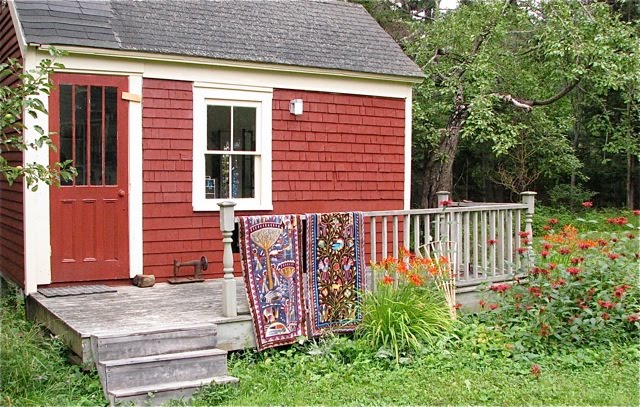
Valerie Hearder: "This is my little store house. 
It was the old "summer kitchen" which was built onto our house 
in about 1850.  It sits between 2 apple trees."


Where and how often do you travel?  What do you love/hate about it?  What challenges do you face culturally?  Is your local community interested in what you do?  What are the greatest lessons learned for you?  What are your long term goals?

Valerie:

It’s become more stressful to travel but now that I’ve developed a strong working relationship with women’s groups in South Africa I travel more frequently there. It's part of fair trade to visit and know the people I buy from. I’ve also just launched a new project to lead a cultural tour to South Africa next year.

Valerie Hearder's suitcase: "This is my suitcase on my trip last 
year to South Africa. I packed a bag full of embroidery 
threads that has been donated by lots of different women 
in Canada. I distributed the threads to various women's
sewing groups I visited during my 6 weeks in South Africa."

Interested in going to South Africa with Valerie? Visit her blog for more information.


"Ndebele Painted village that we'll visit on my tour 
next year."  Valerie Hearder of African Threads.


Visit Valerie's member post on TAFA to see all her links: facebook fan page, shop on Etsy, and more!

Zulu doll maker from rural KwaZulu Natal, South Africa.
Dolls available through African Threads.


Share/Bookmark

Monday, December 15, 2008

Ethnic Nativities & Identity plus The Hyde Family

Zulu Beaded Doll Nativity
This set contains Mary, Joseph, and baby Jesus in a manger,
made by Zulu women in a co-op in Kwa Zulu, Zululand in eastern South Africa.

Ethnic nativities offer an excellent opportunity to take a look at multiculturalism and the search for identity. Christianity's roots spring from the Bible, a text that historically and culturally belonged to the people of Israel. But, the New Testament, through Christ, made the Word available to all and in the last 2000 years, Christianity has indeed spread around the globe. Much of the initial work was done through missionaries, first through the Roman Catholic Church's participation in conquering the New World and in its alliance with traders in Africa and the Orient, then through Protestant missionaries who felt called to take the Word of God to the most remote regions of the world. The Industrial Revolution and consequent developments in communication (print, radio, television, and the internet) made it even easier for Christianity to achieve access into other cultures. (The reverse is also true as other religions and belief systems have made an impact on traditionally Christian turf.) Without addressing the pros and cons of this reality (ie. the cost in terms of lives lost, wars fought, or pros such as clinics and schools built in the name of Christ), the Nativity scene is recognized throughout the world, even where Christianity is not practiced.


The scene was created by an organization called GuguCrafters,
comprised of four Zimbabwean refugees living in Cape Town, South Africa.

A basic Nativity consists of the Baby Jesus, Mary and Joseph. The baby in the manger with two figures on either side is such a familiar icon that just the shapes are enough to inform the viewer about the narrative. For example, the soda images above without the baby might be angels or choir members. Their praying hands indicate some kind of piety, but having the baby in the box with it eliminates any confusion that this is anything but a Nativity scene. This set doesn't have any ethnic tags to it. Obviously, it is recycled, but soda pop crafts are also very popular in Vietnam and increasing in other countries, including here in the United States.

An ethnic tag means that the piece is easily recognized by its technique as originating from a specific country or people. Anyone familiar with that culture will recognize the craft because it is produced in abundant quantities. Similar pieces made by different artisans can be found in the markets of that country or in specialty stores and catalogs. Here are some examples:

Peruvian Retablo Nativity
This Nativity is a retablo (diorama) scene.
Retablos are shrinelike boxes with religious scenes inside,
an art form unique to Peru.
They have evolved from the portable altars
which the Spanish conquistadores brought with them in the 16th century.

India- Textile Stamps Nativity
This Nativity is made from hand-carved wood pieces in India.
Bread Dough Nativity (Masapan), Equador
Each piece of this Nativity scene was painstakingly hand-molded from bread dough and baked until very hard by descendants of one of the original families in Ecuador who began the tradition of giving these masapan gifts to neighbors approximately 150 years ago. This technique originated in Calderón, which is a pueblo just outside of Quito in the Andes Mountains.

Arpillera Nativity from Peru

This Nativity hanging from Peru is called an arpillera, which in Spanish means burlap or sackcloth. Talented women use fabrics of many colors and textures to make this scene. They individually designed and hand-stitched every little detail.

The Peace Corps, NGO's, church groups and tourism all had an impact on how traditional handicrafts in different countries increasingly looked to the Western market (USA, Canada and Europe) for support. The fair trade movement increasingly became better at standardizing the crafts with quality control guidelines, understanding market trends and using the internet and trade shows as outlets. Christmas is a huge niche as both ornaments and nativity scenes have an audience of collectors. So, the Jewish family morphed and became represented by the cultural tags of the artisan. Jesus was not only a Jew, but also a Zulu, a Navajo, a Mexican, and an Inuit.

Elaborate Cloth and Fur Nativity $250
This Nativity set is handcrafted in Mongolia by Tsegtsmaa.
She made by hand all of the figures and animals, even using a lathe to make the wood bodies.

Part of this does come from marketing, but erasing the Baby Jesus's cultural roots also reflects a level of self-imaging where cultural bridges can be made through a story. Missionaries found early on that in order to explain the concept of Jesus they first had to try to understand the culture they were trying to impact. How do you explain "your sins will be washed away and be pure as snow" to someone who has never seen winter? Try explaining a father giving his son as a sacrifice to cannibals... Anthropoligists, linguists and Victorian travelers had a hard enough time exchanging basic information on family structures, meaning of words, and dietary practices without having to make a whole religious philosophy understood. In time, sometimes through force, sometimes through genuine interest, certain symbols have become recognized in all of the continents and at least, in all major urban areas around the world. These symbols have become a part of the larger marketplace with or without the meanings attached to them. Or, religions have synchretized into something new. Christianity was largely shaped by European theologians until the mid 1800's. American puritanism and expansionism redefined many ideas. Then, as Latin America and Africa became Christianized, they incorporated local beliefs into the larger whole. Even in the United States, Jesus was liberated from his roots by becoming African, a leader of inspiration in the Black Power movement.

Black Jesus Blesses the Children
20th Century Joe Cauchi (1918-1986 American)
Oil on Canvas

The carving below shows the Holy Family as Chinese:

This item comes from the only Christian woodcarving workshop in China, located in China's Zhejiang province, an area famous for all types of wood carving.

What does all of this mean? Is it necessarily good or bad? The manger scene is one that almost anybody can relate to: it's a happy picture. One which appeals to the basic desire of all people to see a happy mother, father and child together. Any family in any culture can find inspiration in that portrait. But, for Christians, the birth of Christ has no meaning without his subsequent death and resurrection. That's where it gets complicated. The cross is another symbol which is heavily marketed and sold, but I don't think it has as much appeal as the nativity.

Made by Yekosofati Buwembo, a disabled father in Kampala, Uganda.

Does it matter whether people understand the context of the Nativity? I'm not sure it really matters whether the baby is seen as Jewish or not. More importantly, the baby is a symbol of peace. There are two ways to get people to believe in something they can't see: through fear or through love. Christians who dig beneath the veneer of superficiality and try to live a Christlike life do it either because they are afraid of Hell or because they are attracted to God's love. The Baby Jesus is the easiest portal of entry to show the love path. And, if he looks African, Guatemalan, or Swedish, then it's even easier.


This hand-crafted Nativity set is made by a women's group in Kathmandu that seeks to help poor rural women in Nepal. The body of these dolls is made of recycled wooden products mixed with wax and dressed with corn husks.


Things can go the opposite way, too. A culture may disown something that was once theirs because others have made it distasteful to them. I'll never forget a Christmas week, back 20 years ago when I worked at Chicago Uptown Ministry. Every night for one week before Christmas, we would set up tables decked out in white linen, candles and nice plates. Each night a different church would sponsor a supper for the poor or lonely in the neighborhood. We had around 40 or 50 people a night. The church would bring all the food, prepared and ready to serve, and provide live Christmas music. We also had a little play re-enacting the manger scene for a little after dinner entertainment. We would invite different guests to read the roles in the play. I picked a tiny elderly couple out the guests and asked them if they would like to be Mary and Joseph. The woman, shocked, said, "Oh, my! No, we couldn't!!!" I asked them why and they said, "Well, because we're Jewish." Huh? That stopped me dead. I looked at them and said, "But, then... it's perfect! Mary and Joseph were Jewish, too!" I can't remember if they played the parts or not, but it turned out that the little old man used to be a crooner in the local clubs. He sang for us, song after song, Sinatra and many other oldies, still in great form. And, there, I found the spirit of Christmas. That, in all our differences and lack of understanding we can enjoy the gift of the other.

We can look at who we are, where we come from, and try to understand the impact of our cultures, beliefs, and practices on other people. But, in the end, as a Christian, I constantly remember two things: Jesus welcomed the little children and said that theirs was the kingdom of God. To me, that means that we don't have to understand deeply. We just have to have a pure heart. And, secondly, the Apostle Paul reminds us in 1 Corinthians that "Now we see through a glass darkly and then face to face." None of us knows what's really out there. Don't stress out about whether Jesus was white or black or red or yellow or a zebra. Just receive the gift of the Nativity as a gift of love.


The Hyde Family


When I was thinking about this post, I knew that I would need Nativities representing different cultures. I was both pleased and astounded to find World Nativity, a project started by the Hyde Family. Here is their mission statement:

"We are the Hyde Family.

We wanted to do a little good in the world. While contemplating what we could do as a family project to teach our children about charity and serving others, we had a very inspired thought. We started buying Nativity scenes from artisans in poor or developing countries as a means of helping the artisans generate income in a way that preserved their dignity. We thought we might buy a few Nativities, but now we have many.

Along the way, we started buying extra Nativities from artisans we found via great miracles. We sold the extras to our interested friends. We thought it would be a small project, but the response has been so high that we have sold 1,600 Nativities from 50 artisans since 2005. Profits are given 100 percent to charitable causes and micro-credit projects in Third World countries that benefit the poorest people on the planet."

Isn't that absolutely awesome? All of the nativities on this post are from their site. Click on the photos of the nativities for full descriptions of the piece. The ones with prices were available for sale while the ones without were from their personal collection. I found their narratives and vision culturally sensitive, beautifully written and am thrilled to have them as a resource. If you like cultural Nativities, you know where to go!
Share/Bookmark

Sunday, August 3, 2008

Wola Nani: A Caring Response to AIDS

A friend of mine in Chicago, Karen Muir of Zulu Crafts, used to import these wonderful paper machie bowls from South Africa. I sold them on eBay and carried them in our Chicago gallery. I no longer have them, but Wola Nani, the fair trade organization that made them, continues to produce them through their income generation program. Wola Nani describes their mission:

"As society’s most vulnerable members, HIV is especially cruel to the poor. Khayelitsha, for example, a sprawling township 26km from Cape Town, has an HIV rate of 22%, the highest rate in the Cape Flats. One in three mothers will pass on their infection to their baby – most will die in their first year with few surviving to the age of five. With health services already stretched to the limit and unemployment at nearly 50%, making extreme economic hardship a daily reality, Wola Nani is working to fill the gap that leaves people with HIV & AIDS particularly exposed.

Through a counseling and case management approach, coupled with skills training and income generation opportunities, they can attain the necessary skills to help themselves achieve a better quality of life. Complementary holistic family and community support includes support groups, child health monitoring and day care, plus home based care to help families look after their loved ones living with the disease.

HIV and AIDS does not just touch individuals and families, it is a community issue. Only through education, awareness and understanding of HIV amongst the wider community can the culture of silence surrounding HIV be broken and the discrimination accompanying ignorance be eliminated. Myths and misconceptions surrounding HIV and AIDS not only breed fear of, and stigma against, people living with HIV and their families, but play a fundamental role in accelerating the spread of the virus.

Through Wola Nani’s outreach program of AIDS education workshops and awareness initiatives, staff work within the township communities to raise awareness, provide education and disseminate information. In this way, Wola Nani works towards improving community acceptance of people with HIV and AIDS, combating discrimination and developing community based responses to prevention, support and care.

Wola Nani’s focus on women and their children does not exclude men but has developed in response to where the need for the organization's services is greatest. However, all HIV+ persons regardless of gender, race, age or religious belief are welcome."

The paper machie bowls are made from discarded runs of food product labels commonly found in South Africa: sardine cans, corn, and other foods. They are donated by large factories which are supportive of the project. The bowls are sturdy, well made, light and covered with several layers of a protective lacquer. Perfect for storing dry goods, fruit and knick knacks, they are so attractive that many buy them as folk art. The bowls are one of many other crafts produced by Wola Nani. They also do bead work, make picture frames, and an assortment of other small crafts. Wola Nani does accept orders for corporate gifts or specialized retail designs.

South Africa has been devastated by the AIDS virus. The number of children orphaned by the disease is immeasurable. And, those living with the virus are often ostracized, lose their jobs and face a terrible future of loneliness and sickness. Projects like Wola Nani do help on the financial side, but even more importantly, they offer a community of acceptance where the participants can develop relationships, have the educational resources they need to understand their options, and their self-esteem is improved by feeling like they are contributing back to society with their labor.

Wola Nani does not have a web store, but their products are available through many fair trade stores. A couple of them include Ganesha Fair Trade in the UK and Global Goods in the US. Wola Nani's website does, however, offer much more information on their projects with stories of some of their project participants. "Wola Nani" means "we embrace and develop each other" in Xhosa. You can be certain that in purchasing these bowls, your dollars, pounds, euros, and yen will serve as that much needed wola nani between those of us who have our health and a community who has experienced profound suffering. Wola Nani is a place of hope!


Share/Bookmark

LinkWithin

Related Posts with Thumbnails