TAFA: The Textile and Fiber Art List

Showing posts with label Christmas Ornaments. Show all posts

Monday, December 8, 2008

Shop NOVICA! Christmas Ornaments from Around the World


NOVICA, one of my favorite online shops, advertises itself as "in association with National Geographic". Their website doesn't really explain how they are associated, except that if you look at it, the layout, products and tone reflects something National Geographic would endorse.

NOVICA's mission is also pretty generic. It starts with, "We want to give artists and artisans around the world a global platform to express their true artistic talents and to spur their creativity. And, we want to provide you with access to unique, hard-to-find items at great values that only the Internet infrastructure can allow..." Although it is a member of Co-op America, NOVICA does not seem to ally itself with the fair trade movement in a specific way. Despite all of this, NOVICA's model is about as fair as you can get. I used to buy wholesale from them when I had my brick and mortar store and now Fiber Focus is an affiliate, supporting the concept through ads they potentially generate a commission.

The movie clip at the top of this post is a good illustration of the impact NOVICA has had on the lives of the many artists and artisans it works with around the world. Every item on its website tells the story of the person who made it. Many started out as individuals and went on to grow their businesses into collectives. For this post, I thought it would be fun to look at some of the ornaments made from some of their suppliers around the world. This is a small sampling and I only picked fiber ones. There are also lovely pieces made from wood, clay and glass.

India


Beaded ornaments, 'Burgundy Heart' (set of 5)

Beaded ornaments, 'Burgundy Heart'

(set of 5)

Velvet hearts in a deep wine color speak of a timeless love. Covered with glittering zardozi embroidery, beadwork and diminutive flowers, the hand-crafted ornaments are luxurious. Parvez A. Warsi crafts the beautiful set of five to showcase traditional Indian arts. Warsi includes a drawstring pouch; its colors may vary.


Ornaments, 'Glittering Joy' (set of 6)

Ornaments, 'Glittering Joy' (set of 6)


Affan welcomes the holiday season with a glittering set of ornaments that includes a star, a tree, a heart, a boot, a butterfly and a fleur-de-lis. The organza ornaments are sewn by hand and feature India's legendary zardozi embroidery shaping festive motifs. Zardozi art first came to light during the reign of emperor Akbar in the Middle Ages, and it is characterized by the artistic use of laid stitch with golden thread known as zari.


Beaded ornaments, 'Golden Partridge' (set of 6)

Beaded ornaments, 'Golden Partridge'

(set of 6)

Glittering zardozi embroidery and fine beadwork distinguish a set of ornaments by Parvez A. Warsi. He crafts a set of six colorful partridges that twirl on golden strings.


Beaded ornaments, 'Christmas Spirit' (set of 4)

Beaded ornaments, 'Christmas Spirit'

(set of 4)

Sparkling beads highlight the fascinating allure of the zardozi embroidery that embellishes these four Christmas ornaments. Zardozi is renowned for its intricate patterns, once embroidered with fine threads of gold or silver. Nowadays it is executed with fine silk threads and is known as zari. This set features four different designs and will adorn with distinctive charm. Please note color shades and/or motifs may vary slightly since these products are entirely hand-crafted.


Indonesia


Natural fiber ornaments, 'Angels' (set of 4)

Natural fiber ornaments, 'Angels'

(set of 4)

Wearing wide-brimmed hats, four Balinese angels showcase nature's gifts. Woven by hand, they are crafted of bamboo, screw pine, water hyacinth and agel grass. Palm leaf and tamanu, the fruit of the beauty leaf tree, adorn this set of ornaments by Dwi Astuti and Kusbudiyanto. Because each is individually crafted of natural fibers, colors and motifs may vary slightly.


Natural fiber ornaments, 'Pink Java Angels' (set of 4)

Natural fiber ornaments,

'Pink Java Angels' (set of 4)

Four Javanese angels celebrate nature's gifts dressed in bright green costumes. Woven by hand, they are crafted of bamboo, screw pine, water hyacinth and agel grass. Palm leaf and tamanu, the fruit of the beauty leaf tree, adorn this set of ornaments by Dwi Astuti and Kusbudiyanto. Coconut shell buttons complete their elegant attires. Because each is individually crafted of natural fibers, colors and motifs may vary slightly.


Peru


Gourd ornaments, 'Jungle Greetings' (set of 6)

Gourd ornaments, 'Jungle Greetings'

(set of 6)

The natural, organic artistry that comes from the Peruvian jungles becomes an original set of ornaments with the art of Rocio Davila Rojas. They are carved by hand from tutuma gourds featuring balsa wood and cotton trim. The natural gourds may vary slightly in shape and size.


Cotton ornaments, 'Peach Christmas Balloons' (set of 3)

Cotton ornaments, 'Peach Christmas Balloons' (set of 3)


Enjoying the view from the sky, celebrants shout Christmas greetings to those below. Margarita and Martha fashion a trio of novel and beautiful Christmas ornaments. The colorful peach hot air balloons feature straw baskets that carry tiny travelers in Andean dress. Because each ornament is individually crafted, colors may vary slightly.


Ornaments, 'Festive Huancavelica Couple' (pair)

Ornaments,

'Festive Huancavelica Couple'

(pair)

Mercedes Benavides celebrates the festive traditions of the Huancavelica region with an endearing pair of tree ornaments. Dressed in traditional costumes, they are expertly crafted by hand. The cholito (young man) and cholita (young woman) smile the radiant smile of the festive season.


Applique ornaments, 'Joyous Bells' (set of 6)

Applique ornaments, 'Joyous Bells' (set of 6)

Festive bells bring the Christmas spirit to the Andes in this charming set by Maria Ramos Sanchez. Children welcome the holiday season as they stroll along with their llamas across the Andean highland. Each scene is eloquently detailed in arpillera, where fabric cutouts are sewn into a wondrous collage over a cotton background. The bells feature a wool border ending in a loop, for hanging. Please note, Ramos uses different fabrics for the arpillera compositions, which can result in a slight difference in color.


Thailand


Cotton ornaments, 'Christmas Stockings' (set of 12)

Cotton ornaments,

'Christmas Stockings' (set of 12)

Embroidered by artisans from Thai Tribal Crafts, twelve bright stockings await Christmas Eve. The handmade ornaments are representative of the textile traditions of the Hmong people, who long ago immigrated to northern Thailand.


Cotton ornaments, 'Tribal Stars' (set of 12)

Cotton ornaments, 'Tribal Stars'

(set of 12)

Embroidered by artisans from Thai Tribal Crafts, stars and flowers appear in precise symmetry on twelve handmade ornaments. The work is representative of the textile traditions of the Hmong people, who long ago immigrated to northern Thailand.


Lots of people collect ornaments. And, how meaningful it can be to attach a person's story to something that is collectible! I haven't wrapped my gifts traditionally in years. Why spend all that money on wrapping paper and bows and ribbons that will end up in the garbage? Instead, I like to use newspaper or some other recycled paper or a scarf or fabric or anything else that can be used and top it off with a handmade ornament. Sure, some of these ornaments are going to be more expensive than the ones made by sweatshops (although most are really quite affordable!), so make the ornament your gift along with a loaf of banana bread or something tasty.

Whatever you decide to do in this lean year, do take a tour of NOVICA's wonderful catalog. You can enter through any of the above ornaments (you are not committing to buy if you click on the button...) and travel by type of item or country. Have fun!

Share/Bookmark

Thursday, December 4, 2008

Buy Local vs. Fair Trade: An Ethical Shopper’s Dilemma

Buy Local? Support Fair Trade? What to do?


by Tex Dworkin, Global Exchange Director of Marketing

Another gift giving season is upon us and it’s time to decide on a shopping strategy. In one ear you’re encouraged to shop locally, in the other ear you hear about the benefits of choosing Fair Trade gifts. So which strategy is best, and is one better than the other? To answer a question with a question, who says you have to choose? The ‘Buy Local’ and Fair Trade movements both have their benefits.
One World, Many Cultures Gift Basket

One way to honor the bumper sticker mantra “Think Globally Act Locally” is to support your local businesses. Why buy cheese from Europe when there’s a dairy farm down the road producing double creamy Gouda that will knock your socks off? Buying local refers to choosing locally made products and soliciting locally owned businesses, which have environmental and social benefits. Products made locally have a smaller carbon footprint than products shipped from overseas, and thus are less of a strain on the environment. Shoppers who buy locally travel less distances to shop, which also reduces the carbon footprint. Local businesses produce more income and jobs for local communities than large retail chains do, and are more likely to utilize local services, such as advertising and banking. Supporting local businesses preserves the economic diversity of our communities and the unique character of our neighborhoods.

Rwandan Peace Ornaments

Sounds great, right? But what about choosing Fair Trade, another moral purchasing strategy?

Fair Trade is an economic model that ensures products are made by producers who receive a living wage, work in healthy, safe conditions and in many cases, employ environmentally sustainable processes. Fair Trade also tackles the issue of child slavery by guaranteeing that there is no abuse of child labor.
Knits from Nepal

In a world economy where globalization is king and profits are queen, small-scale producers are left without resources or hope for their future. Children are forced to work instead of receiving an education and local environments suffer from the ‘profits now’ mentality that damage environments for future generations. Fair Trade helps exploited producers escape from this vicious cycle of poverty. The Fair Trade system benefits over 800,000 Farmers organized into cooperatives and unions in 48 countries. Revenue from Fair Trade cooperatives is used on a variety of community projects, including training of producers in organic and sustainable farming techniques, building houses, schools and clinics and guaranteeing health care for the whole community.

So now it’s time to decide…buy local or Fair Trade? It’s important to note that choosing Fair Trade products can actually help your local merchants survive in this sluggish economy. Prices for cheap imports made in sweatshop factories outside of the US are usually so low that local merchants have difficulty competing on price. So during a time when consumers are looking to cut costs wherever possible, cheap knock offs made in sweatshops often outsell locally made products, even though the quality is drastically lower.

Kippot, Jewish Head Coverings

Whichever you decide, the good news is that the ‘Buy Local’ and Fair Trade movements both have tremendous benefits. They support environmentally sustainable solutions, and layers of middlemen are left out of each economic model, helping to ensure that a fair percentage of profits actually reach the producers. Fair Trade and locally made products are often handcrafted with care, resulting in a higher quality product than the mass-produced sweatshop products available in big box stores, and in both cases, the preservation of cultural heritage is a by-product of doing business.

If you’re married to the idea of buying locally, remember that some items are not grown locally, like cocoa. Cocoa trees are only grown in tropical regions of Africa, Asia, South and Central America. So if you’re looking for socially conscious chocolate in the US, consider chocolate made locally with Fair Trade Certified cocoa. That way, you can support your local chocolate maker AND Fair Trade cocoa producers around the world.

Beyond chocolate, there are lots of other instances where products from the Fair Trade and Buy Local movements are harmoniously combined to create special products all their own. One example is from Handmade Expressions, a sourcing partner for socially and environmentally responsible products based in Austin, Texas. They sell their handmade copper alloy bells to local artists who incorporate the ethically produced crafts into their artwork that is then sold locally.

Eco-Globe String Lights

Some proponents of the buy local movement consider choosing Fair Trade products an ethical challenge because products imported to the US have a bigger carbon footprint than locally produced products. In an op-ed piece for Western M, Steve Brooks, the acting head of Oxfam Cymru points out that “if everyone in the United Kingdom switched one 100W light bulb to a low energy equivalent, CO² emissions would be reduced in one year by 4.7 times the amount saved by boycotting fresh fruit and vegetables from sub-Saharan Africa.” If this is true, then perhaps the carbon footprint issue is not such a big deal after all. If you’re not buying that, and you’re shopping for a coffee lover, consider Grounds for Change, the first coffee roaster in the nation to complete the rigorous third-party certification process necessary to obtain the CarbonFree® Certified Product label. To get a product certified CarbonFree®, a company must submit the item to a third-party process that formally scrutinizes the carbon emissions associated with every step in production from the country of origin to your cup.

Hmong Ornaments

Whether you choose local or Fair Trade products or a combination of the two this holiday, what’s most important is to shift your spending from mass produced products made in sweatshops to ethically produced products. According to the US Census Bureau of the Department of Commerce, US retail e-commerce sales reached $29.3 billion in the fourth quarter of 2006, and e-commerce sales accounted for just 2.8% of total retail sales, so you do the math. That’s a lot of dough! Wal-Mart alone reported $340 billion of sales revenue back in their 2006 financial report. Yet the Fair Trade Federation, the US’s network of Fair Trade businesses, reported $160+ million in total member sales in 2006, a tiny crumb compared to the overall US retail pie. If just 5% of US Wal-Mart customers shift their spending to Fair Trade products this holiday season, imagine the positive impact it could have on our environment and producers’ lives?

In November 2008 a McNeil/Lehrer report estimated US retail spending at 55 billion dollars. How much of that spending is on ethically produced products is up to you, so this holiday, remember that it’s not about buying more, but rather buying differently, and every dollar you spend is a statement about how you want this world to be.

Note: All of the products shown in this post have been made following fair trade guidelines and can be found in the Global Exchange online store.

Resources

Buy Local:

http://www.globalexchange.org/campaigns/buylocal/

http://www.buylocalday.org/index.php


Fair Trade:

www.fairtradefederation.org


www.fairtraderesourcenetwork.org

www.transfairusa.org

www.globalexchange.org/campaigns/fairtrade/cocoa/retailers.html


Share/Bookmark

Monday, September 15, 2008

La Chapina Huipil Crafts Expands Etsy Store: Guatemalan Supplies!


It's not easy to find your niche on Etsy- the competition is fierce! But, some sellers find their market and are able to grow their stores into healthy operations. I've had the pleasure of watching Erin Stoy of La Chapina Huipil Crafts do exactly that! I asked Erin to share her experience as I think she has hit on the key to making a living through online sales: balance your handmade creations with complementary supplies. Look around your environment and see what you can find that others might want!

Other key lessons to learn from Erin: clear photos, affordable prices, healthy selection (her store is stocked with over 200 items right now), and good descriptions.

When I joined Etsy in May of this year, my plan was simply to continue selling my hand-sewn crafts made from recycled Guatemalan textiles. I'd had success doing that off-Etsy for the previous seven months, especially with my Christmas ornaments and personalized art for kids' rooms. However, with sales in my new shop starting off slowly, I began to brainstorm ways I could expand my product offerings. I noticed that the top sellers on Etsy were almost all suppliers, and that certainly made sense: Etsy is a market full of creative people wanting to buy interesting things with which they can make their own arts and crafts! So instead of trying to compete solely based on my handicrafts, I began my search in the local markets and shops here in Antigua, Guatemala, for textiles to sell as supplies. I'd already been selling bags full of my textile scraps, so this was the next logical step, and I began offering cintas (hand-woven hair ribbons) and squares of textile fabric, along with the occasional whole huipil (traditional hand-woven blouse worn by indigenous women and girls in Guatemala).


It took a change in mindset to make the move to sell something unrelated to textiles, as the name of my shop was and is "La Chapina Huipil Crafts". At first the idea of this change made me uncomfortable, as if I were abandoning my original vision, but then I came across a great little shop that sold ceramic beads made in Guatemala and Peru. I loved these little beads and charms, and I knew many of my customers would, too. Tiny Guatemalan people in traditional dress, little animals, fruits and veggies, and skulls (for Day of the Dead!) are just some of the styles of beads I now regularly stock in my shop.


Once I started selling beads, I found myself really wanting to try my own hand at making jewelry for the shop. However, jewelry is one of the most saturated categories on Etsy, so I needed to make a niche for myself. I found a local source for beads made of tagua, which grows in the South American rainforest and is an excellent and eco-friendly alternative to ivory. Using dyed beads and slices made from tagua seeds and nuts, I've had a great time making some simple jewelry, and the fact that it is environmentally friendly fits with my previous emphasis on recycled materials.


A few months into my expansion, three of my ten shop sections are dedicated to supplies. Some of my best sellers are different sizes and styles of Guatemalan worry dolls, ceramic beads, and lovely small prints -- great as scrapbooking embellishments -- by a local watercolor artist. I also carry some wood items like miniature handpainted masks and fruit.


Although huipiles are no longer the sole focus of my shop, they still have a special place among the other Latin American crafts and supplies. Offering supplies has greatly increased sales (though lowering the average selling price per item) and brought in many new customers who are not necessarily interested in the items I make myself. And perhaps most importantly, the search for new supplies is a lot of fun !


Erin Stoy of La Chapina Huipil Crafts is an American whoʼs lived in Guatemala for over a year, caring for the daughter she and her husband are in the process of adopting. During her time in Guatemala,she has developed a passion for Mayan textiles. She has been selling arts and crafts she makes from used huipiles (traditional, hand-woven Guatemalan blouses) since October 2007. Her blog is http://huipil-crafts.blogspot.com and her Etsy shop is http://lachapina.etsy.com.
Share/Bookmark

Wednesday, May 28, 2008

Guest Artist: Erin Stoy of La Chapina Huipil Crafts

Used huipil Erin purchased in Santiago Atitlan's market.

Erin Stoy
is an American who’s lived in Guatemala for over a year, caring for the daughter she and her husband are in the process of adopting. The case has been frought with difficulties, making their stay an unusually long one. Despite the financial and emotional stress of the situation, Erin is grateful that – as Azucena’s legal foster mother in Guatemala – she and her husband have had the opportunity to have their little girl with them since the age of eight months. Another positive thing to come from the experience has been Erin’s new passion for Guatemalan textiles; she has been selling arts and crafts she makes from used huipiles (traditional, hand-woven Guatemalan blouses) since October 2007.

Erin with Azucena in Nov '07.

In August of 2007, a local orphanage was raided here in Guatemala, and political tensions surrounding international adoption were running very high. Agencies began suggesting that fostering parents, like us, stay inside with our kids until things calmed down. Rumors abounded that the police were going to question any gringos they saw with Guatemalan children. So for close to two months, I only left the apartment with our daughter, Azucena, a handful of times.

Market in Santiago Atitlan

As one would imagine, being confined to apartment grounds with a toddler for that long was challenging. Eager for something to do while Azucena napped or played on her own, I started looking at craft blogs for inspiration. I hand-sewed about 20 stuffed animals and little dolls out of Azucena’s outgrown baby clothes and, later, felt. It was a fun diversion from the stressful reality of our situation.

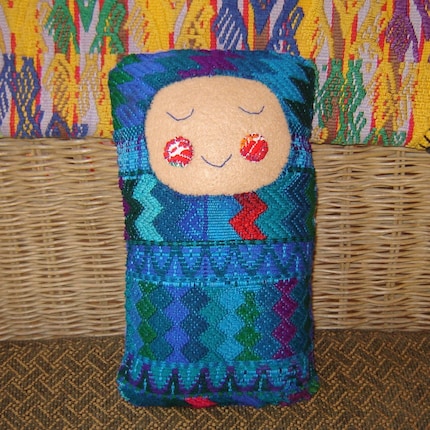
Baby Doll

I had long thought something really pretty could be made from the embroidered collars of huipiles. Once I got the sewing bug, I started visiting a shop here in Antigua that frequently had used collars and other huipil scraps for sale. The first things I made were some pillows that featured collars from Chichicastenango; I embroidered Spanish words like “esperanza” (hope) and “amistad” (friendship) within the circle formed by the collar.

One of the pillows Erin made from a huipil collar from Chichi.

For my next project, I purchased several small of bags of huipil scraps in order to make Christmas ornaments for some family members back home. Afterwards, I posted photos of the ornaments on my personal blog, and the next thing I knew, I had people leaving comments saying they wanted to buy sets for their own families. An online friend who was coming to Guatemala kindly offered to transport any items I sold back to the US for shipping through the USPS. I accepted and was thrilled to have the opportunity to earn some money to help with the many expenses we were incurring by having to maintain households in both the US and Guatemala. Largely through word of mouth throughout the online adoption world, I ended up selling about $2500 worth of Christmas ornaments over the next couple months.

Christmas ornaments.

After Christmas, I began making new items from the huipil fabric, including animals, simple baby dolls, fabric magnets inspired by Semana Santa street carpets, and personalized art for children’s rooms. Lately I’ve been doing more collages. This spring, I moved the craft items from my personal blog to a separate crafts blog and opened a shop on Etsy. I hope to continue making and selling arts and crafts from these beautiful used Guatemalan textiles; they are too lovely not to be re-purposed and enjoyed. Maybe I’ll even get a sewing machine when I get back to the States!

Christmas ornaments.

Erin’s work as can be seen on huipil-crafts.blogspot.com and lachapina.etsy.com.
Share/Bookmark

LinkWithin

Related Posts with Thumbnails