| Little printing stamps from India |
Saturday, August 20, 2011
New listings on Etsy! Vintage printing stamps from India!
Sunday, December 27, 2009
20% Off on Textile Stamps!
The stamps are my best selling item on Etsy. I buy them from a friend who imports from Afghanistan, sight unseen, and normally offer them here and on my website at 10% off before I start listing them. This time, several factors led me to increase the offer to 20% off:
- The stamps in this batch are more worn than usual.
- Many of them have wax and dye residue that will demand extra cleaning.
- I have a new camera and the photos I took are crappy.
- Most artists prefer the smaller stamps and this batch was mostly large sizes.
20% Off on Textile Stamps!
Friday, June 26, 2009
New Textile Stamps Listed on Etsy!
I just listed several new textile stamps in my Etsy store. These are from Afghanistan, seconds from textile workshops there and carved out of pear wood.
Textile stamps have many uses for artists. Originally made for printing on fabric with ink or wax resist, they can also be used on paper or imprinted into clay. Make sure you have a soft padding under your fabric or paper when you press down. This will give you a clearer image.
As these stamps have been used, they might have nicks, damage or wear. Most artists who buy them, like the distressed look this produces. But, for a cleaner imprint, the stamps can be repaired using wood filler. Scrub them well before use as they have ink or wax residue from their prior use. Keep them lightly oiled when not in use. Cover with Vaseline before imprinting into clay.
The stamps are also beautiful in their own right! I have many laying around my house just because I like looking at them. Larger ones can be displayed using plate hangers or stands.
*
New Textile Stamps Listed on Etsy!
Wednesday, February 11, 2009
Cross Cultural Collaborative: Textile Workshop in Ghana!
Fiber Artists!!!
Come join us in Ghana!
Aug. 2 - 15, 2009!!!!
by Ellie Schimelman
Ghana is known for it's rich history of art and culture and although it has adapted some Western ways, Ghana still has spectacular festivals to celebrate it's heritage. Part of each festival is a durbar which is comparable to a parade where all the important people, like chiefs, dress in their regalia. This is where you can see Kente cloth in all its glory. Even if you don't know anything about Kente, when you see it you know that it is special.
Each year we organize a workshop at our cultural center in a suburb of Accra where participants can learn to weave Kente, stamp adinkra, learn about Asafo, do tie and dye, batik and other fabric decorations which are taught by master artisans. This is a unique opportunity to experience African textiles in the context of their culture. Participants visit galleries, museums, cloth markets, crafts villages and dealers in antiquities.
Many traditional approaches to cloth are being lost because young artisans want to be modern and don't want to do the tedious work required to be authentic. There is a saying in Africa that each time an elder dies a library is lost... and each time a traditional artisan dies a technique is lost. There was a time when it would take a Kente weaver 3 months to weave a piece. Now, many weavers rush to get cloth ready for the 5 day market. Another reason we offer this workshop is to show indigenous artisans that their traditions have value and should be continued.
Sometimes the Ghanaian artist will find a modern way to work with the traditional techniques. An example of this is making the symbols on adinkra cloth using silk screen. This is certainly much faster than the traditional stamping of the symbols onto the cloth. Each way has a different look and it's up to the buyer to decide which one they prefer.
A man wearing adinkra cloth in Ghana.
There is no doubt that there are universal connections in art. In reference to African cloth, all you have to do is look at the quilts of the Gee's Bend artists. African cloth has always had symbolic meaning. Men and women taken from Africa to the diaspora had memories of cloth designs and the meanings they carried. It's easy to see how African American story quilts retain traces of African fabric techniques.
If you'd like details about the textile workshop please download a brochure at http://www.culturalcollaborative.org and any questions can be directed to aba@culturalcollaborative.org
If you come to Ghana, we'll give you an African name. Many people are named after the day of the week on which they were born. Aba is a female born on Thursday.
About Ellie Schimelman:
I graduated from the Rhode Island School of Design with a minor in apparel design and a major in art education. Always drawn to African art, I decided to see it in Africa and by a process of elimination chose to start in Ghana. I had really wanted to go to South Africa, but because of Apartheid, decided not to. Ghana was a good choice... English is the official language and the culture is intact.
One thing led to another, and now 20 some years later, I am the director of Cross Cultural Collaborative, with a mud house next to the ocean, about 50 Ghanaian children who call me Mami and a mission to introduce people from different cultures to each other through the language of art. The photo shows Aba House which has eight guest rooms.
My fantasy is to someday visit every African country....
Keep in touch with us through our blog!
Cross Cultural Collaborative: Textile Workshop in Ghana!
Thursday, January 22, 2009
10% Off on New Rayela Art Textile Stamps
Every few months I get a new bag of textile stamps. It's quite the endeavor to get them sorted, cleaned, priced, and photographed. I don't do any deep cleaning, but they all get brushed with a wire brush. When they are ready, I load them on my website and offer them at a 10% discount on this blog and to my regular customers. There is usually a big rush and when it dies off, I start listing them in my Etsy and eBay stores. The advantage for me in doing this is that I save time and listing fees while customers get to enjoy "first dibs". There is one disadvantage for customers in that I don't list the dimensions- you just have to kind of guess by the price.
I also offer free shipping on orders over $100 to US addresses or $20 off of shipping to those overseas. The stamps on my website can be combined with anything listed in my Etsy or eBay stores to reach that $100.
I've written several posts on this blog about the stamps. Follow this link to read about the history and care of these wonderful carvings. Most of my customers are artists who use the stamps to print on fabric or paper with ink or batik wax and to make impressions into clay. But, the stamps are also beautiful as decorative pieces and can be hung, set into plate stands, or just laid around on shelves.
As these stamps come from Muslim workshops, rarely will you find an animal or human figure portrayed. For those, seek out Hindu stamps. Islam discourages depicting these images as a way to prevent idolatry.
Do you work with these pieces? Leave a link in the comments section so we can all be inspired by these wonderful stamps!
10% Off on New Rayela Art Textile Stamps
Monday, December 15, 2008
Ethnic Nativities & Identity plus The Hyde Family
Ethnic nativities offer an excellent opportunity to take a look at multiculturalism and the search for identity. Christianity's roots spring from the Bible, a text that historically and culturally belonged to the people of Israel. But, the New Testament, through Christ, made the Word available to all and in the last 2000 years, Christianity has indeed spread around the globe. Much of the initial work was done through missionaries, first through the Roman Catholic Church's participation in conquering the New World and in its alliance with traders in Africa and the Orient, then through Protestant missionaries who felt called to take the Word of God to the most remote regions of the world. The Industrial Revolution and consequent developments in communication (print, radio, television, and the internet) made it even easier for Christianity to achieve access into other cultures. (The reverse is also true as other religions and belief systems have made an impact on traditionally Christian turf.) Without addressing the pros and cons of this reality (ie. the cost in terms of lives lost, wars fought, or pros such as clinics and schools built in the name of Christ), the Nativity scene is recognized throughout the world, even where Christianity is not practiced.

A basic Nativity consists of the Baby Jesus, Mary and Joseph. The baby in the manger with two figures on either side is such a familiar icon that just the shapes are enough to inform the viewer about the narrative. For example, the soda images above without the baby might be angels or choir members. Their praying hands indicate some kind of piety, but having the baby in the box with it eliminates any confusion that this is anything but a Nativity scene. This set doesn't have any ethnic tags to it. Obviously, it is recycled, but soda pop crafts are also very popular in Vietnam and increasing in other countries, including here in the United States.
An ethnic tag means that the piece is easily recognized by its technique as originating from a specific country or people. Anyone familiar with that culture will recognize the craft because it is produced in abundant quantities. Similar pieces made by different artisans can be found in the markets of that country or in specialty stores and catalogs. Here are some examples:
This Nativity hanging from Peru is called an arpillera, which in Spanish means burlap or sackcloth. Talented women use fabrics of many colors and textures to make this scene. They individually designed and hand-stitched every little detail.
The Peace Corps, NGO's, church groups and tourism all had an impact on how traditional handicrafts in different countries increasingly looked to the Western market (USA, Canada and Europe) for support. The fair trade movement increasingly became better at standardizing the crafts with quality control guidelines, understanding market trends and using the internet and trade shows as outlets. Christmas is a huge niche as both ornaments and nativity scenes have an audience of collectors. So, the Jewish family morphed and became represented by the cultural tags of the artisan. Jesus was not only a Jew, but also a Zulu, a Navajo, a Mexican, and an Inuit.
Elaborate Cloth and Fur Nativity $250
This Nativity set is handcrafted in Mongolia by Tsegtsmaa. She made by hand all of the figures and animals, even using a lathe to make the wood bodies.
Part of this does come from marketing, but erasing the Baby Jesus's cultural roots also reflects a level of self-imaging where cultural bridges can be made through a story. Missionaries found early on that in order to explain the concept of Jesus they first had to try to understand the culture they were trying to impact. How do you explain "your sins will be washed away and be pure as snow" to someone who has never seen winter? Try explaining a father giving his son as a sacrifice to cannibals... Anthropoligists, linguists and Victorian travelers had a hard enough time exchanging basic information on family structures, meaning of words, and dietary practices without having to make a whole religious philosophy understood. In time, sometimes through force, sometimes through genuine interest, certain symbols have become recognized in all of the continents and at least, in all major urban areas around the world. These symbols have become a part of the larger marketplace with or without the meanings attached to them. Or, religions have synchretized into something new. Christianity was largely shaped by European theologians until the mid 1800's. American puritanism and expansionism redefined many ideas. Then, as Latin America and Africa became Christianized, they incorporated local beliefs into the larger whole. Even in the United States, Jesus was liberated from his roots by becoming African, a leader of inspiration in the Black Power movement.
The carving below shows the Holy Family as Chinese:

Things can go the opposite way, too. A culture may disown something that was once theirs because others have made it distasteful to them. I'll never forget a Christmas week, back 20 years ago when I worked at Chicago Uptown Ministry. Every night for one week before Christmas, we would set up tables decked out in white linen, candles and nice plates. Each night a different church would sponsor a supper for the poor or lonely in the neighborhood. We had around 40 or 50 people a night. The church would bring all the food, prepared and ready to serve, and provide live Christmas music. We also had a little play re-enacting the manger scene for a little after dinner entertainment. We would invite different guests to read the roles in the play. I picked a tiny elderly couple out the guests and asked them if they would like to be Mary and Joseph. The woman, shocked, said, "Oh, my! No, we couldn't!!!" I asked them why and they said, "Well, because we're Jewish." Huh? That stopped me dead. I looked at them and said, "But, then... it's perfect! Mary and Joseph were Jewish, too!" I can't remember if they played the parts or not, but it turned out that the little old man used to be a crooner in the local clubs. He sang for us, song after song, Sinatra and many other oldies, still in great form. And, there, I found the spirit of Christmas. That, in all our differences and lack of understanding we can enjoy the gift of the other.
We can look at who we are, where we come from, and try to understand the impact of our cultures, beliefs, and practices on other people. But, in the end, as a Christian, I constantly remember two things: Jesus welcomed the little children and said that theirs was the kingdom of God. To me, that means that we don't have to understand deeply. We just have to have a pure heart. And, secondly, the Apostle Paul reminds us in 1 Corinthians that "Now we see through a glass darkly and then face to face." None of us knows what's really out there. Don't stress out about whether Jesus was white or black or red or yellow or a zebra. Just receive the gift of the Nativity as a gift of love.
The Hyde Family

When I was thinking about this post, I knew that I would need Nativities representing different cultures. I was both pleased and astounded to find World Nativity, a project started by the Hyde Family. Here is their mission statement:
"We are the Hyde Family.
We wanted to do a little good in the world. While contemplating what we could do as a family project to teach our children about charity and serving others, we had a very inspired thought. We started buying Nativity scenes from artisans in poor or developing countries as a means of helping the artisans generate income in a way that preserved their dignity. We thought we might buy a few Nativities, but now we have many.
Along the way, we started buying extra Nativities from artisans we found via great miracles. We sold the extras to our interested friends. We thought it would be a small project, but the response has been so high that we have sold 1,600 Nativities from 50 artisans since 2005. Profits are given 100 percent to charitable causes and micro-credit projects in Third World countries that benefit the poorest people on the planet."
Isn't that absolutely awesome? All of the nativities on this post are from their site. Click on the photos of the nativities for full descriptions of the piece. The ones with prices were available for sale while the ones without were from their personal collection. I found their narratives and vision culturally sensitive, beautifully written and am thrilled to have them as a resource. If you like cultural Nativities, you know where to go!
Ethnic Nativities & Identity plus The Hyde Family

Tuesday, November 18, 2008
Help Needed Identifying Horse Tack on Vintage Printing Blocks
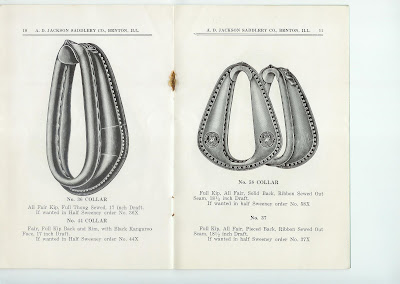
I recently acquired a bunch of printing blocks from a local Paducah resident. They are from a harness business that closed in the 1950's. Although I now live in Kentucky horse country, I have no clue as to the particulars of horse business.... The blocks were used to produce catalogs similar to the one pictured above. I was able to find information online on one of the suppliers, A.D. Jackson Saddlery, as the block, very similar to the horse collar in the above catalog has a stamp with that name on it. Fred B. McAfoos & Co. has a nice historical page which describes how the family business evolved. Today, they sell lawnmowers and outdoor power tools.
Fred B McAfoos opened his business in
I listed the blocks I could identify on Etsy, but am stumped on several others. I love old things in general, but I find these blocks especially interesting and would like to get more of them if I can move the ones I got. Etsy's search system is made up of tags that describe the item, so it's important that I use the right words to describe these blocks. I imagine they will be of special interest to anyone who loves horses, Western and Southern history, and printing techniques. The blocks are still in decent shape and can be used on both paper and fabric using a brayer and inks. Maybe someday I'll have the time to play with them and see what happens.
Meanwhile, if you know what the correct names for the items below, it would be a great help to me. Leave a description in the comment section referring to the item by number. The more specific the description, the better. We have 14 keywords to use per item on Etsy, so if a horse harness has a certain function, then it would be good to know that. In my ignorance, I imagine there are items that might be for show while others for work and that there are distinctions by type as in English and Western saddles.
Help Needed Identifying Horse Tack on Vintage Printing Blocks
Sunday, August 24, 2008
New Textile Stamps In! 10% Discount Offer on Direct Purchases
I photograph the stamps front and back and write the number and price on the back. The discount saves me labor and cost by not having to spend time or money on the listing. Dimensions are not given. Those of you who are familiar with the stamps will know that very small ones are about 1" in diameter and go for $5 and the biggest ones are up to 14" wide and go for $25 or $30.
This is how it works: Go to my website and look at the thumbnails. I just loaded 60 new blocks at the top of that page. I will list another 60 or so in a couple of weeks when I have the rest photographed. E-mail me back with the numbers you are interested in. Because there is no shopping cart, all hell kind of breaks loose in the beginning. I go through the requests as they come in, notify of availability, buyer confirms what she or he wants, then I send a paypal invoice. So, although an image might be sold it might still be there. I try to clean them out as quickly as possible, but it gets kind of crazy.
Returns: You can return any stamp you don't want for a refund on its price. I do not refund shipping.
Shipping: I use the USPS flat rate envelopes and boxes, which really save a lot of money for these heavy blocks! I can usually fit two or three of the medium ones in a $5 envelope and can fit quite a few in a $9 box. Shipping overseas can be pretty expensive, but usually does not go over $40. Fortunately for those of you who are shopping in Euros and Pounds, you are getting an extra deal with dollar being so low... (sob, sob...)
Further Discounts: Purchases in the United States over $100 get free shipping. I will cover the first $20 in overseas orders that are over $100. You can combine other purchases from my stores on eBay or Etsy to reach that $100 (and you don't have to stick to just the stamps), but you do have to go through their check out processes. If you go through them (I have a bunch of stamps listed in both stores) and are charged shipping fees even though your purchase total is over $100, I will refund your fees when I print the shipping label on Pay Pal.
I have several of them around my house as objects. My fantasy is to tile a whole wall with them!
Are you using textile stamps in your work? Leave us a link in the comments below so we can see what you are doing with them! And, now.... let the madness begin!
New Textile Stamps In! 10% Discount Offer on Direct Purchases
Wednesday, June 11, 2008
Some Textile Stamps and Excellent Customer Service
Yesterday I experienced a first. I sell textile blocks to fiber and paper artists, and a good deal to ceramic artists as well. I got a package from one of my best clay people customers, JustMare, and thought, "Uh, oh... Wonder what's coming back!" Sunken heart...
Well, we all know what customer service means, right? This time the meaning was flipped upside down and a customer was giving ME a service of recognition! I opened the package and there was a gift from this customer, expressing how pleased she is with me as a seller! My eyes fell out of their sockets! In all the years that I've been selling, I've never had someone do this!
JustMare says: "Hi Rachel, Just a little something to let you know how much I enjoy doing business with you. The pendant was made with one of your textile blocks. Best Regards! Mare"
Now, how about that!?? It confirms for me that choosing this form of business is not the same as your run-of-the-mill capitalism (although I definitely am one of those, who also believes there should be social safety nets...). This gesture was also a reminder that we are all people on the sending and receiving ends- the product sold and money received are just a couple of aspects of these transactions. Sometimes I feel like I am posting product and text and just shooting it off into space. There is a difference from selling or discussing topics face-to-face and selling or posting online. Yet, every now and then, those real connections bring me back down to earth and I land on solid ground.
Now, the only way I can reciprocate is to say, "Go visit this woman's store! She is a customer, but she is also a seller. And, if she is like this as a customer, imagine how incredible she must be as a seller!"
Here are some of her samplings from her Etsy store, Justmare:


Justmare's Shop Announcement: Welcome to my Etsy shop! My unique stoneware pottery is created in my Pine, AZ studio. Feel free to convo me with any questions or comments about my wares. See my profile for my shipping and other store policies.
bzzzzzzzzzzzzzzzzzzzzzzzzzzzzzzzzzzzzzzzzzzzzzzz
The hard working Honey Bees provide us with one out of every three bites of food we eat, through their pollination of our crops. Over the past few years, we’ve lost 25% of the Western Honey Bee population, posing a serious risk to our food source. I will donate 20% of the proceeds from the sales in my Help the Honey Bee category to the Honey Bee Research Fund at UC Davis. For more information about the plight of our Honey Bees and ways that you can help check out http://helpthehoneybees.com
bzzzzzzzzzzzzzzzzzzzzzzzzzzzzzzzzzzzzzzzzzzzzzzz
Some Textile Stamps and Excellent Customer Service