
TAFA: The Textile and Fiber Art List

Showing posts with label Canadian artist. Show all posts

Tuesday, August 10, 2010

TAFA Members Talk: Valerie Hearder of African Threads

Valerie Hearder presenting at a talk and showing a traditional  beaded skin apron worn as a wedding skirt by the Ndebele in South Africa.


In an effort to give a voice to TAFA members, I am running a series here on Fiber Focus called, "TAFA Members Talk".  Valerie Hearder is both a working artist, making art quilts and giving workshops on various quilting techniques and a small importer.  She works with women's groups throughout South Africa, focusing on embroidery projects, but offering traditional Zulu and Ndbele crafts as well.  Valerie responded to two questions I posted as a spring board for discussion, one on fair trade and the other on travel.

 Telephone wire baskets by Zulu craftsmen. 
Coloured wire is recycled into gorgeous baskets.


How do you define fair trade or what is green?  What support do you have in your community?  How do you educate consumers on product and pricing?  Do you think you can compete well against mainstream, commercial products?  Where do see the fair trade/green movement going in the next 10 years?

Valerie:  
I have defined my business by fair trade principles as a social entrepreneur. It’s my personal code of wanting to create a fair income for women that guides me, not fair trade certification.
I know other textile importers in my small community and we talk a lot and share marketing ideas. I am into the concept of “wikinomics” which is based on helping each other and sharing information. Sharing just seems natural to me as a quilt maker.  I don’t see my fair trade friends as “the competition”. The more we work together and help each other, the more we all succeed and that has a positive impact on women in the third world.  


 Valerie Hearder: "I bought this jug and mug from this potter
in Johannesburg last year. 
I use them everyday and they remind me of Africa."


I educate my customers by presenting an informative web site and by giving illustrated talks about the conditions and realities of the maker’s lives that I buy from.  It's very important to educate customers about how their shopping choices has a huge impact on someone's life in the third world. I don’t have a shop but do small shows, talks and on-line sales. My new web site should be launched in about mid-August. www.africanthreads.ca  I do think that I can compete with mainstream commercial products: people are interested in the story behind the work and the stories sell the works. Customers are more aware that they are connecting with and supporting women's empowerment in the third world and can feel good about getting something beautiful as well.
How do I educate buyers about pricing?  I tell them that when they see something cheap from the third world they can be sure that maker got a pittance. I explain that I buy outright at fair prices for the makers, and take all the risk if the product doesn't sell.
I have an amazing network of supporters for African textiles and crafts in the quilting community and also through the Grandmothers-to-Grandmothers Campaign. This movement has over 250 groups of active women in Canada who really care about women in Africa. What I’m doing is a natural fit with them as I give 15% of my profits to this group to support Grandmothers in Africa.

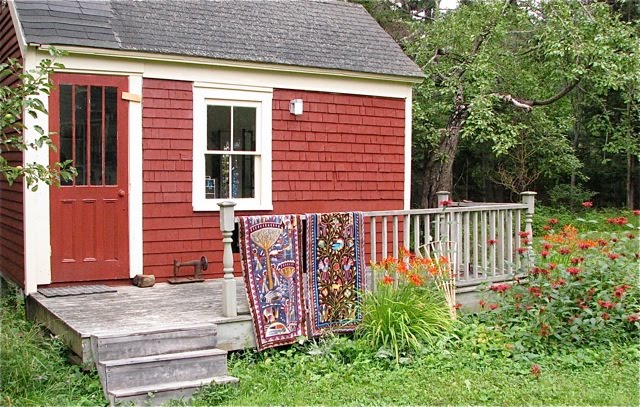
Valerie Hearder: "This is my little store house. 
It was the old "summer kitchen" which was built onto our house 
in about 1850.  It sits between 2 apple trees."


Where and how often do you travel?  What do you love/hate about it?  What challenges do you face culturally?  Is your local community interested in what you do?  What are the greatest lessons learned for you?  What are your long term goals?

Valerie:

It’s become more stressful to travel but now that I’ve developed a strong working relationship with women’s groups in South Africa I travel more frequently there. It's part of fair trade to visit and know the people I buy from. I’ve also just launched a new project to lead a cultural tour to South Africa next year.

Valerie Hearder's suitcase: "This is my suitcase on my trip last 
year to South Africa. I packed a bag full of embroidery 
threads that has been donated by lots of different women 
in Canada. I distributed the threads to various women's
sewing groups I visited during my 6 weeks in South Africa."

Interested in going to South Africa with Valerie? Visit her blog for more information.


"Ndebele Painted village that we'll visit on my tour 
next year."  Valerie Hearder of African Threads.


Visit Valerie's member post on TAFA to see all her links: facebook fan page, shop on Etsy, and more!

Zulu doll maker from rural KwaZulu Natal, South Africa.
Dolls available through African Threads.


Share/Bookmark

Tuesday, July 28, 2009

TAMMACHAT Natural Textiles, Part 2: The Artisans

“I feel in harmony with this work.”
Loek Khonsudee, Member, Panmai Group, Northeast Thailand

By Ellen Agger and Alleson Kase
All Photos © Ellen Agger 2009

TAMMACHAT Natural Textiles works with rural communities in Thailand and Laos where women have long been recognized as valuable and equal members of their families and communities. These artisans:

• transform barks, berries, leaves, seeds and silk cocoons into gorgeous weavings
• create traditional and contemporary designs using traditional floor looms
• develop and use natural dyeing techniques that support their health and the environment

TAMMACHAT Natural Textiles is building trading relationships – based on fair trade principles – with a growing number of weaving groups and non-governmental organizations in Thailand and Laos that work with village groups. We want to introduce you to a few of these groups.

Panmai Group in Thailand works with silk production
and organic weaving production.


Panmai Group has 250 members living in 3 provinces in Northeast Thailand in both Khmer and Laotian villages, who draw on these traditions in their designs. These women are very skilled in sericulture (the entire cycle of silk production) and are proud to weave only organic, village-reeled and naturally dyed silk yarns. They are expert and widely respected for their dyeing skills using natural materials, protecting both their own health and that of their environment.

Prae Pan Group in Northeast Thailand dye cotton naturally
and weave silk.


Prae Pan Group has 200 members in 7 villages in Khon Kaen province in Northeast Thailand. They are highly skilled at supplementary weft weaving and the natural dyeing of cotton, although they weave silk as well. Prae Pan, like Panmai, has been operating for 20 years and is proud to be entirely villager-run and self-sufficient.

During a recent visit, women from both groups told us that this work allows them to stay in their villages where they can live with their families, grow rice and practice their foremothers’ art – while preserving it for their heirs.

Pattanarak Foundation works with
disadvantaged and stateless peoples along
the Thai border.


Pattanarak Foundation works to balance development and conservation among disadvantaged communities and stateless peoples along Thailand’s borders. Their products are handmade with an indigenous species of cotton organically grown along the Thai-Lao border on the banks of the Mekong River. After spinning, dyeing and weaving, some products are sewn by projects in the west of Thailand along the Burmese border. This helps forge links and exchange ideas between communities that are experiencing similar challenges. One village group working with Pattanarak specializes in indigo dyeing, always popular for its lively colour – “nature’s true blue.”


Saoban provides technical assistance and training for
low income textile entrepreneurs in Laos.


Saoban is a Vientiane-based marketing outlet for over a dozen village groups that work with the Participatory Development Training Center (PADETC) in rural Laos. At Saoban’s shop, young entrepreneurs develop business skills while providing much-needed markets for village products that range from bamboo-silk handbags to naturally dyed silk scarves. This is part of PADETC’s vision for Laos: education for sustainable development.

Mulberries is the market brand of the Lao Sericulture Co., a not-for-profit organization that is accredited by the World Fair Trade Organization (formerly IFAT, the International Fair Trade Association). Its goal is to strengthen the position of women in Laos by providing them with dependable incomes and to preserve their sophisticated weaving and natural dyeing techniques. Women are further trained to bring diverse skills and environmental sustainable to the complex cycle of silk production with extraordinary results. Founder Kommaly Chantavong was a nominee for 1000 Women for the Nobel Peace Prize 2005 for her work on this important project that is recognized for its poverty alleviation, cultural preservation and peace building.

Green Net Coop helps Thai organic farmers market their products. One Green Net project brings together grandmothers who grow, spin and weave organic cotton in Ban Kokkabok in Loei province with sewers in Panmai Group in Northeast Thailand, who transform the cloth into children’s sunhats and baby products. Read the story of the Kokkabok Women’s Cotton Group.

Fai Gaem Mai helps groups in Northern Thailand
develop handwoven silk products.


Fai Gaem Mai
is based in Chiang Mai University and helps community-based production groups in Northern Thailand develop handwoven Eri silk products, one of the textile products that TAMMACHAT carries. The Eri silkworm feeds on the leaves of cassava, rather than mulberry, providing additional income for villagers already growing this high-volume, low-value commodity.

Suan Nguen Mee Ma Company (Garden of Fruition) was founded by Sulak Sivaraksa, who was honoured with the Right Livelihood Award (the “Alternative Nobel Prize”), to explore new markets for indigenous crafts, to publish educational materials and to act as a small-scale, practice-based “think tank.” Among their projects, they support small groups of farmers in Nan, Thailand to revitalize organic cotton growing, spinning and weaving, and to preserve heritage varieties of naturally coloured cotton.

Each of these groups bring their special skills in creating their unique products. We feel honoured to work with and learn from them when we visit on our annual networking/buying trips, deepening our relationships each year. The products highlighted in this post are available at TAMMACHAT Natural Textile’s Fair Trade Textile Events. Select products are also available in TAMMACHAT’s Online Shop. Visit www.tammachat.com to learn more.


Voices of the Weavers

“You must consider the whole process if you want to support this art.
It is difficult to produce by hand.
Our work is real women’s group work, handmade art and tradition.”
Mae Samphun Jundaeng, Chairperson,
Panmai Group
, Northeast Thailand


“We want to work with natural dyes –
it’s better for our health and for the environment.
The colours we use in our weavings depend on the plants
available around our village.
I am told that most people appreciate my work –
especially the colours.”

Noi Simpree, Member, Panmai Group, Northeast Thailand

TAMMACHAT Natural Textiles imports fairly traded, naturally dyed, handcrafted textiles directly from the artisan groups that create them. TAMMACHAT, which mean ‘natural’ in Thai, was established in 2007 by Alleson Kase and Ellen Agger. Alleson and Ellen love textiles and had been involved with both fiber and empowering women for decades.

Ellen Agger, co-founder of TAMMACHAT Natural Textiles. See Part 1 of this post to learn more about TAMMACHAT's mission.


Ellen is a member of our Fiber Focus Group.

Clicking on her slide show below will take you to her page:


Find more photos like this on Fiber Focus

Share/Bookmark

Monday, July 27, 2009

TAMMACHAT Natural Textiles: Empowering Women Artisans in Thailand and Laos, Part 1


By Ellen Agger and Alleson Kase
Photos © Ellen Agger 2009

TAMMACHAT Natural Textiles imports eco-friendly, fair trade fashion and home decor from rural Thailand and Laos. TAMMACHAT, which mean natural in Thai, was established in 2007 by Alleson Kase and Ellen Agger. Learn more about the artisan groups TAMMACHAT works with in Part Two of this post.

Ellen Agger, co-founder of
TAMMACHAT Natural Textiles


Why we started TAMMACHAT

Two reasons: First, the more idealistic one, was to realize the sayings that “another world is possible” and “vote with your wallet.” We believe that people impact human rights, communities and the environment with every purchase we make. So, it’s important that people have access to fairly traded and environmentally friendly products.

Second (and this is more serendipitous and more personal), we were in the right place at the right time. A few years ago we were traveling around Thailand, searching out weaving groups, an interest of Alleson’s since 1980 when she first traveled in Guatemala. The women we met at one weaving co-op told us their sales were down, which meant they had to limit membership in the co-op. Right away, we knew we were going to connect their desire to expand their market with our desires to find new and meaningful careers.

What motivates us:
We want to live in a world where:
• women have choices about and control over their lives within their families and communities;
• people are fairly and adequately paid for their work; and
• everyone uses resources wisely and according to their needs, so that communities and the planet are preserved for future generations.

Thai weaver hanging organic silk,
coloured with natural dyes, to dry.

© Ellen Agger 2009

Fair trade in action
As social entrepreneurs, we want to encourage fair trade and ethical consumption. This means:
• knowing what goods are made of
• where they are made
• how their making impacts the people who make them, their communities and the environment

TAMMACHAT Natural Textiles imports fairly traded, naturally dyed, handcrafted textiles directly from the artisan groups that create them.

Weaver at her loom in rural Thailand weaving
organic cotton table runners.

© Ellen Agger 2009

Handweaving, one of the world’s oldest arts, continues to be practiced with amazing skill and well-deserved pride in many rural villages in Thailand and Laos. The silks and cottons woven by women in these areas reflect cultural traditions that have endured from earlier times, passing from mothers to daughters.

We select each piece of wearable art, each table cloth and wall hanging, and every length of hand-loomed fabric that we purchase. Every textile chosen displays technical expertise, aesthetic beauty, careful finishing and sustainable production.

We travel extensively in rural Thailand and Laos, visiting weaving villages and artisan groups, to learn firsthand about the textiles we buy and how they are made. After 2 years of trading, we will apply for fair trade accreditation with the World Fair Trade Association.

We support the artisans and communities that create these textiles by:
• paying fair prices set by individual artisans and artisan groups
• building long-term trade relationships with artisan groups and non-governmental organizations that work with village groups
• supporting environmentally and socially sustainable practices, and appropriate technologies used by artisan groups in the creation of their products
• providing international markets for this work to help preserve this women’s art form and encourage the younger generation to continue these traditions

Raising mulberry silkworms in traditional bamboo baskets
to create organic silk yarns.

© Ellen Agger 2009

Natural fibres, natural dyes
Whenever possible, we source organically produced natural fibres. Heritage varieties of silkworms are raised without chemicals in artisans’ homes rather than in factories. The cocoons spun there are painstakingly hand-reeled into yarn, yielding extraordinary beauty and value. Traditional varieties of cotton, in 3 natural colours, are grown organically, most often on the banks of the Mekong River. Unique, nubbly textures result from ginning, fluffing and spinning these fibres by hand.

Before weaving, silk and cotton yarns are hand-dyed in small batches with organic materials that are locally raised or sustainably gathered. Emerging from these village dye pots are colours that range from subtle to intense, in all the rich hues that nature can create. Of course, some yarns are woven in their natural shades of white, cream, butter yellow or tan.

Age-old designs for contemporary life
Many of the pieces that we buy use designs and techniques that have been handed down for generations. Others – especially weavings that are sewn into clothing, bags and cushion covers – combine the beauty of naturally dyed, handwoven fabric with contemporary flare. We work with artisan groups to develop new products, such as the 100% SILK. 100% ART silk squares for quilters and other fibre artists – developed with the expert colour sense of Panmai Group members and advice from internationally known quilters Valerie Hearder and Laurie Swim in Nova Scotia.

We also buy traditional designs, such as khit (supplementary weft) and mudmee (tie-dyed yarns that produce a design when woven), choosing pieces that will be popular with western consumers.

How we sell these textiles
We sell these handwoven textiles at Fair Trade Textile Events that we organize in communities throughout Atlantic Canada and beyond. We also opened an Online Shop to make select pieces available anywhere in the world. We also have a shop on Etsy. Everywhere that we take these textiles we tell the stories behind them, because this showcases the real value of this beautiful work.

For more information, visit our website. Also enjoy the TAMMACHAT travel blog written by Alleson and Ellen.


Ellen is a member of our Fiber Focus Group. Clicking on her slide show below will take you to her page:


Find more photos like this on Fiber Focus
Share/Bookmark

Thursday, July 24, 2008

Fiber Art to the Max: Tree Shaping and the Dictates of Nature

My first exposure to sculpting with living plants was through my best friend's father when I was a kid in Brazil. Our city was 30% Japanese and her father had immigrated from Japan after World War II. He spent hours with his little bonsai trees and in his garden. Over the years, my appreciation for art as it relates to nature has continued to grow. I am drawn to environments that blend in with their surroundings and that seem to have a conversation with all the elements around them. In college, I fell in love with artist and architect Friedensreich Hundertwasser.


Way before there was even a green movement, Hundertwasser explored how buildings can function as organic structures, both in design and in incorporating living plants and trees as part of the architectural dictates of the environment. Never square, buildings replicate natural mountains. Roofs are gardens, both insulating the living spaces and allowing the mind and body to breathe.

Since then, people have been experimenting with nature in a partnership of art, form and chance. My friend Pam sent me an e-mail with some images of artists who have been taking the ancient bonsai practice to another level. Most had no source information, so if anybody out there knows where these images came from, please leave a comment so we can credit them. I got a big kick out of the time, effort and patience it took from conception of the idea to its fruition.

This bicycle in a tree reminds me of my mother's cousin, Darren, who for years has been sculpting a garden and cemetery in Western Minnesota. His forest is filled with bathtubs, old cars, and other discarded household appliances that are planted with nature and slowly eroding back into the soil. Maybe my interest is partly genetic...

All knotted up...

Star of David

Arch

A living hut


Tree ladder

One of the photos did have a name on it, so I was able to trace it, Pooktre. Australian artists Peter Cook and Becky Northey have transformed their land into a living sculpture. Calling themselves tree shapers, they work on two kinds sculptural work, pieces that are eventually harvested and others that remain planted. The two photos below show Peter with a couple of his living chairs:


Pete's favorites are his trees shaped like men:

Explore their site. They seem like wonderful people. Apparently, they have never sold a piece yet, but had a show in Japan that made the bonsai community wild with excitement. They are thinking of having workshops in the future.

All of this coincides with another Canadian fiber artist that I had recently bookmarked, Alastair Heseltine. You see, to me, working with these plants and trees is fiber art in its most raw and basic form. Yet, it cannot be done without tremendous patience, skill and foresight. Heseltine also plays with tree shaping, but most of his larger pieces involve juxtaposing created structures with nature's background. Here is a living bush that is replicating a basket weave (Heseltine also makes traditional baskets):

And, here is a large sculptural piece that has been assembled by a body of water:

Many of Heseltine's pieces are functional, such as this bench, which I absolutely love:

But, his mastery of basket weaving is especially shown in this gorgeous figurative sculpture:

What I take from this as a fiber artist is that the materials are secondary to the vision. Developing our skills to their fullest potential is a life time of hard work, patience and pushing the elements to tell a new story. Hundertwasser was considered a nut in his early days. He passed away in 2000, finally receiving recognition as the visionary that he was. Most of us will never be famous or rich, but we can enjoy our craft and let it lead us to new places that right now might only live in the murky lands of our imagination.

Alastair Heseltine

Share/Bookmark

Thursday, April 3, 2008

Guest Artist: Inese Smelters of Monkey House

Canadian artist Inese Smelters of Toronto is my first guest on Fiber Focus. She also sells on Etsy under the name PlanetMonkey. I love her ability of transforming a sock into a character with such expression and life, bringing a little humor into the world of fiber. Surely we all know a Madge or Sylvia! Visit her website to see all her other funny characters.

Madge

"I started making sock monkeys about 2 years ago as a rainy Saturday project with my teenagers. They loved them so much and all their friends kept taking them. I thought, "If teenaged BOYS are interested in these, there is certainly a market for sock monkeys". I applied to Canada's largest juried craft show (One of a Kind Craft Show) on a whim and was accepted.

I work full time and do the sock monkeys during ALL my down time. I never get sick of making them and I never run out of ideas. I have a website www.themonkeyhouse.ca and do the one Christmas craft show per year and have an Etsy shop. I also give sock monkey birthday parties.

Sylvia is the queen-bee of the sock monkeys and is my best seller. Recently her gruff sister Madge joined the group. New this year are the felted babies and I am sewing clothing for this Xmas show.


My goal is to have the sock monkey replace the teddy bear as the cuddly friend of choice. They just have so much more personality! I don't believe there are any commercially made sock monkeys (The Gap came out with one last year but I think it flopped) . That's the beauty of a handmade monkey - they are so homely and vintage. They literally appeal to all age groups."

-Inese Smelters

Sylvia


Share/Bookmark

LinkWithin

Related Posts with Thumbnails